- Tokyo: 05:37
- Singapore: 04:37
- Dubai: 00:37
- London: 21:37
- New York: 16:37
Honey as a Natural Bioindicator of Environmental Pollution
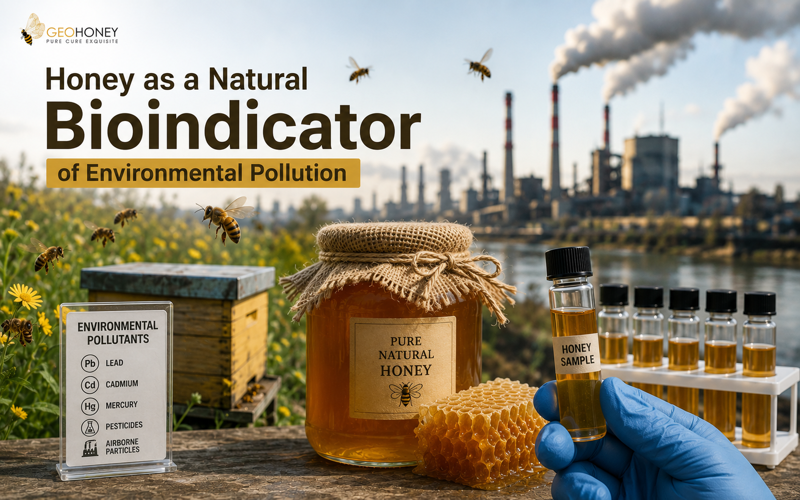
Environmental pollution has become one of the most pressing global challenges, affecting ecosystems, biodiversity, agriculture, and human health. Conventional environmental monitoring methods often require costly equipment and extensive field sampling. As a result, scientists have increasingly explored natural bioindicators that can provide reliable information about environmental quality. Among these, honey has emerged as an effective natural bioindicator of environmental pollution.
Honey reflects the quality of the environment in which honeybees forage. During nectar and pollen collection, bees interact with air, water, soil, and vegetation across large geographic areas, inadvertently gathering traces of environmental contaminants. By analysing honey, researchers can assess pollution levels while gaining valuable insights into ecosystem health. This article examines the scientific basis for using honey as a bioindicator, the types of pollutants detected, analytical techniques, and its applications in environmental monitoring.
Understanding Bioindicators
A bioindicator is a living organism or biological material used to evaluate the condition of an environment. Bioindicators respond to environmental changes by accumulating pollutants or exhibiting measurable biological responses.
Honey is considered an excellent bioindicator because:
Honeybees forage within a radius of 2–5 km around their hives.
They collect nectar, pollen, water, and plant resins from diverse ecosystems.
Honey integrates environmental information over an extended period.
Sampling honey is non-destructive and environmentally friendly.
Why Honey Reflects Environmental Quality
During foraging, honeybees encounter pollutants deposited on flowers, leaves, airborne particles, and water sources. Small quantities of these contaminants can become incorporated into honey.
Factors influencing honey composition include:
Floral diversity
Soil characteristics
Atmospheric conditions
Agricultural practices
Industrial emissions
Urban development
Consequently, honey serves as a natural archive of environmental conditions surrounding the hive.
Environmental Pollutants Detected in Honey
Heavy Metals
Honey can accumulate trace amounts of heavy metals originating from industrial emissions, mining activities, traffic, and contaminated soils.
Commonly monitored metals include:
Lead (Pb)
Cadmium (Cd)
Mercury (Hg)
Arsenic (As)
Chromium (Cr)
Nickel (Ni)
Elevated concentrations may indicate long-term environmental contamination.
Pesticide Residues
Agricultural chemicals represent another important category of contaminants detected in honey.
Researchers commonly investigate residues from:
Insecticides
Herbicides
Fungicides
Neonicotinoid pesticides
Monitoring these compounds helps evaluate agricultural pollution and pollinator exposure.
Persistent Organic Pollutants (POPs)
Honey may contain low concentrations of persistent environmental chemicals, including:
Polychlorinated biphenyls (PCBs)
Dioxins
Polycyclic aromatic hydrocarbons (PAHs)
Although concentrations are typically low, their detection provides important information about long-term environmental contamination.
Airborne Particulate Pollution
Honey can also reflect atmospheric pollution through the deposition of airborne particles on flowers visited by honeybees.
Sources include:
Vehicle emissions
Industrial smoke
Power plants
Construction activities
Scientific Methods for Honey Analysis
Environmental monitoring requires highly sensitive laboratory techniques capable of detecting contaminants at trace levels.
Common analytical methods include:
Inductively Coupled Plasma Mass Spectrometry (ICP-MS)
Used to quantify heavy metals with exceptional sensitivity.
Gas Chromatography–Mass Spectrometry (GC-MS)
Widely employed for identifying pesticide residues and organic pollutants.
Liquid Chromatography–Mass Spectrometry (LC-MS/MS)
Provides accurate detection of multiple chemical contaminants simultaneously.
Atomic Absorption Spectroscopy (AAS)
Frequently used for routine heavy metal analysis in environmental samples.
These techniques allow researchers to compare pollution levels across regions and monitor changes over time.
Applications of Honey in Environmental Monitoring
Urban Pollution Assessment
Honey collected from urban apiaries often reflects contamination associated with traffic emissions, industrial activities, and construction.
Researchers use urban honey to evaluate:
Air quality
Heavy metal distribution
Industrial pollution hotspots
Agricultural Monitoring
Honey serves as an effective indicator of agricultural chemical use by revealing pesticide residues originating from nearby farming operations.
Monitoring supports:
Sustainable farming practices
Pollinator protection
Food safety assessments
Industrial Impact Studies
Apiaries located near industrial zones provide valuable information about environmental contamination caused by manufacturing activities.
Scientists can identify:
Heavy metal accumulation
Atmospheric pollution
Changes in environmental quality over time
Long-Term Environmental Surveillance
Because honey is produced annually, it enables long-term monitoring of pollution trends.
Repeated sampling helps researchers evaluate:
Effectiveness of pollution control measures
Environmental recovery
Emerging contamination risks
Advantages of Using Honey as a Bioindicator
Honey offers several scientific and practical advantages:
Non-invasive sampling method
Cost-effective environmental monitoring
Wide geographical coverage through bee foraging
Simultaneous detection of multiple contaminants
Supports biodiversity and ecosystem health assessments
Provides valuable data for environmental policy development
Limitations and Challenges
Despite its advantages, honey-based monitoring has limitations:
Natural variation due to botanical origin
Seasonal differences in nectar availability
Regional climate influences
Need for standardized sampling protocols
Variability in analytical methodologies
Combining honey analysis with complementary environmental assessments improves monitoring accuracy.
Future Perspectives
Emerging technologies are enhancing honey's role in environmental science.
Promising research areas include:
Artificial intelligence for pollution prediction
Geographic Information Systems (GIS) mapping
Remote sensing integration
Blockchain-based environmental traceability
Multi-contaminant environmental surveillance
Climate change impact assessments
These innovations are expected to improve environmental monitoring while strengthening food safety and ecosystem conservation.
Conclusion
Honey has become a valuable natural bioindicator for assessing environmental pollution due to its unique connection with the surrounding ecosystem. By analysing contaminants accumulated during honeybee foraging, researchers can evaluate air quality, agricultural practices, industrial emissions, and overall ecosystem health. As analytical technologies continue to advance, honey-based environmental monitoring will play an increasingly important role in pollution assessment, sustainable land management, and biodiversity conservation. Protecting honeybees not only safeguards pollination services but also preserves one of nature's most effective tools for monitoring environmental quality.


