- Tokyo: 15:35
- Singapore: 14:35
- Dubai: 10:35
- London: 07:35
- New York: 02:35
Our Blogs
Geohoney
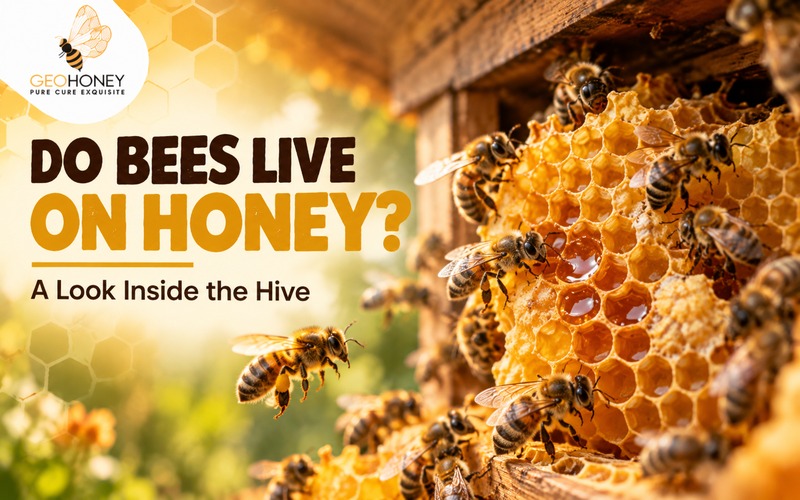
Do Bees Live on Honey? A Look Inside the Hive
Have you ever looked at a bee buzzing around a flower and thought, "So... does it spend its whole life eating honey?"
The more you think about it, the more questions pop up.
If bees make honey, do they eat only honey? Why do they make so much of it? And what exactly must be the life inside a hive all day?
Let's step inside a hive. You might be surprised by what you find.
Key Takeaways
Honey gives bees the energy to fly and work.
Bees need more than honey. They also need pollen, nectar, and water.
Bees save honey. They eat it when they cannot find flowers.
Every bee has its own job inside the hive.
Inside the hive, food and baby bees are carefully arranged.
Do Bees Eat Honey?
The short answer is yes.
But do they eat only honey?
No.
Think about your own meals. You wouldn't want to eat only bread every single day, would you? Even if it filled your stomach, your body would still need other nutrients.
The same idea applies to bees.
Adult bees keep eating honey because they need energy. And they need a lot of it.
A tiny bee may visit hundreds of flowers, carry nectar back home, clean the hive, feed young bees, guard the entrance, or help keep the hive alive. That's a busy day for such a small insect.
All of that takes energy. Honey gives them that energy. It's their fuel.
But fuel alone isn't enough.
If honey is so important, why do bees collect pollen too?
Honey and pollen do completely different jobs.
Honey is packed with sugars. It keeps adult bees going.
Pollen has protein and other nutrients. That's what growing baby bees need.
That's how it works inside a hive. Honey powers the workers. Pollen helps build the next generation.
A healthy hive always tries to store plenty of both.
Why Do Bees Make So Much Honey?
Bees make far more honey than they can finish in a day.
Because they aren't making food just for today, they're thinking months ahead.
Flowers don't bloom forever. There are rainy days, cold days, and entire seasons when nectar becomes difficult to find.
You can't collect food if the food isn't there.
That's why worker bees spend the warmer months gathering nectar and turning it into honey. They keep it safe inside the hive. That's almost like filling your kitchen shelves before a long storm.
When flowers disappear, the honey takes over. It becomes the colony's food supply until nature becomes generous again.
What Happens Inside a Beehive All Day?
You might picture a hive full of bees quietly making honey all day.
It's much busier than that.
It's like walking into a small city.
Some bees are leaving for work. Some are returning with food. Some are feeding babies. Others are cleaning empty cells. A few bees stand near the door. They watch for danger. Some even help keep the hive at the right temperature.
Everyone has a specific job.
How do bees tell each other where flowers are?
Here's something that sounds almost unbelievable.
When a worker bee finds many flowers with nectar, it does not just fly back and hope the other bees find them. It has to tell them where the flowers are. But how? Bees can't speak or point.
The bee does a special dance. You may think, "A dance? Really?" Yes! The dance tells the other bees where the flowers are.
Where Do Bees Store Honey?
You may think bees simply pour honey into any empty space.
They don't.
If you could carefully look inside a healthy hive, you'd notice there's a designated place for everything and everyone.
The baby bees stay mostly in the middle. Nearby, you'll find pollen. Around those areas, bees store honey.
Why do they arrange it like that?
Because it makes their life easier.
The young bees can be fed quickly. Adult bees don't have to travel far inside the hive for food. Everything is placed where it's needed most.
What Happens When Winter Arrives?
Flowers disappear for weeks or even months. Then what happens in winters? What do bees eat? After all, they can't simply fly somewhere else and find fresh nectar.
This is when all that stored honey becomes incredibly important.
In winter, bees stay close to each other in a cluster. This keeps the hive warm. They don't fly outside every day. They slowly eat the honey they stored during the warmer months.
That honey becomes their winter fuel.
Without enough stored honey, many colonies wouldn't survive until spring.
This means, in all those busy summer days, they weren't just making something sweet. They were preparing for the hardest season of the year.
You walked through the hive. The next stop is the honey. Explore GeoHoney.
FAQs
Do bees ever eat their own honey?
Yes, they do. Bees eat the honey they make. It gives them energy. Flowers become few in winter. Then bees need this honey.
Can bees hear humans talk?
Not like you do. Bees cannot hear voices the same way. But they are able to sense minute vibrations in their surroundings and the air.
Can bees survive if we take their honey?
Sometimes. But only if they still have enough food. To help them live, beekeepers regularly give them sugar syrup or leave them a lot of honey.
Geohoney
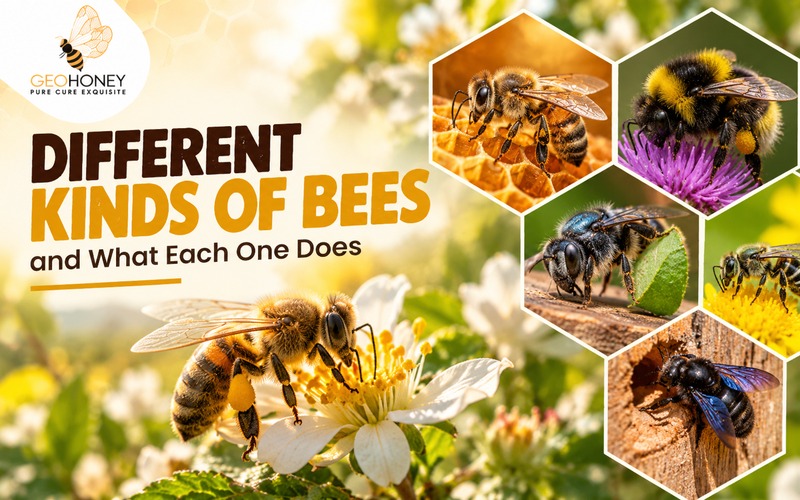
Different Kinds of Bees and What Each One Does
What if the bee story most of us grew up hearing wasn't the whole story? After all, do all bees really spend their days making honey?
Do all bees collect nectar? Does the queen make honey? And what are thousands of other bees doing inside the hive?
The answers are far more interesting than the story many of us grew up hearing.
Key Takeaways
Honey bee colonies contain queens, workers, and drones.
Worker bees are responsible for collecting nectar and producing honey.
Queens focus on laying eggs and maintaining the colony.
Drones exist mainly to mate with new queens.
Worker bees perform different jobs as they age.
A hive succeeds because thousands of bees perform different tasks at the right time.
Not Every Bee You See Is Making Honey
Imagine walking into a bakery.
One person mixes dough. Another operates the oven. Someone else handles deliveries. The person running the business may never touch a loaf of bread.
A honey bee colony works in a surprisingly similar way.
Even though honey is the final product most people associate with bees, only certain members of the colony are directly involved in making it.
The hive is made up of three types of adult bees: queens, workers, and drones. And each has a completely different job description.
The Queen's Job Isn't What Most People Think
When you hear the word "queen," you usually picture the bee as a ruler.
Honey bees don't work that way. Her actual role is much more specific and much more interesting.
The queen's most important responsibility is laying eggs. A healthy queen can lay up to 1,500 eggs in a single day during peak season. That's important because worker bees don't live very long. During busy months, many survive only a few weeks.
The colony constantly needs replacements.
Interestingly, the queen doesn't collect nectar. She doesn't gather pollen. She doesn't build honeycombs. She doesn't even help make honey.
Her contribution is different.
A queen may never visit a flower or make a drop of honey herself. Yet every forager, nurse, guard, and honey maker in the hive exists because she laid the egg that became them.
So, without a queen, the workforce eventually disappears.
The Real Honey Makers Are Worker Bees
If honey production had a department, worker bees would be the entire staff.
These female bees handle almost every task inside and outside the hive. However, even worker bees don't spend their whole lives doing the same thing. A young worker usually starts indoors. She cleans empty cells, feeds developing larvae, and helps care for the queen.
As she gets older, her responsibilities change. She may help build wax comb, process incoming nectar, or regulate temperature inside the hive. Eventually, she graduates to the job most of you recognize: foraging.
These workers leave the hive and visit flowers in search of nectar and pollen. A single foraging bee may visit thousands of flowers in a day.
The nectar she brings home still isn't honey. Other workers receive it, process it, reduce its moisture content, and store it inside honeycomb cells. Only then does it become the honey we recognize.
So when you taste honey, you're really seeing the result of an enormous chain of worker bee labor.
Why Does the Hive Need Drones?
At first glance, drones seem like the easiest members of the colony.
They don't gather nectar. They don't make wax. They don't make honey. They don't even guard the entrance. So why does the colony spend valuable resources raising them?
Because honey bees need future generations too.
Drones are male bees. They have only one role: mating with virgin queens. Their large eyes help them locate queens during mating flights, and unlike worker bees, they cannot sting.
Their contribution doesn't show up inside a jar of honey. It shows up in the survival of future colonies.
How Thousands of Bees Stay Organized
A hive can contain tens of thousands of bees.
You'd expect complete chaos. Yet honey bee colonies are remarkably coordinated. Bees keep on sharing updates. Sometimes they use chemical signals called pheromones. Other times, they literally dance.
When a worker discovers a rich source of nectar, she does a waggle dance at the hive. The dance helps other workers understand where the flowers are located.
Think about that for a moment. A bee finds food, comes home, shares directions, and sends other bees directly to the same location. There are no maps and words. They just move.
What Happens When the Queen Disappears?
Most organizations struggle when they lose an important leader. Honey bee colonies are no different.
That said, they do have a backup plan.
Thankfully, a colony isn't completely helpless when it loses its queen.
Worker bees can take a very young larva and start feeding it large amounts of royal jelly. That single change can completely alter the larva's future, turning it into a potential queen instead of an ordinary worker.
It doesn't always work. But it gives the colony a fighting chance. For a society made up of insects, that's an impressive contingency plan.
Every jar has a bee story behind it. Explore GeoHoney's range of natural honey and find one you'd love to bring home.
FAQs
What is the 3-3-3 rule for bees?
The 3-3-3 rule helps explain bee development. A bee egg hatches in about 3 days. After that, it grows through different stages before becoming an adult bee.
Which type of honey bee is best?
There isn't a "best" honey bee. Queens, workers, and drones all do different jobs. A healthy hive needs all of them.
Are guard bees male or female?
Guard bees are female worker bees. They stand near the hive entrance. They check who comes in and help protect the colony.
Geohoney
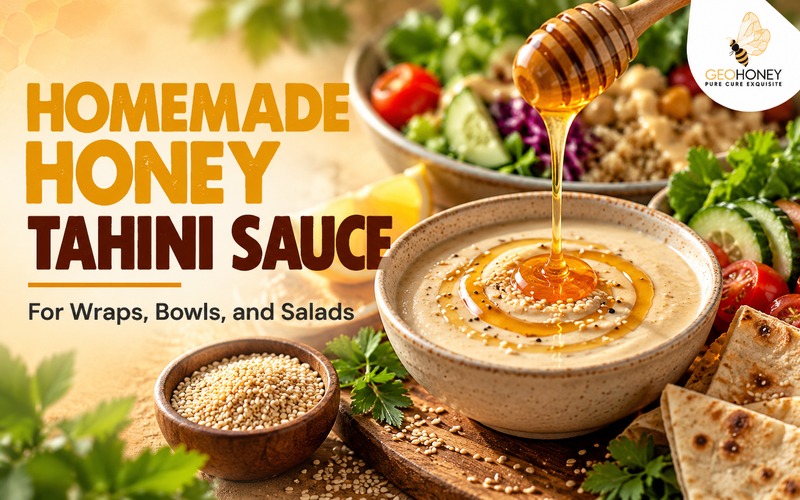
Homemade Honey Tahini Sauce for Wraps, Bowls, and Salads
A homemade honey tahini sauce is an extremely flavorful ingredient that can spice up your everyday meals instantly. You can add this dressing to your wraps, grain bowls, and salads to elevate their flavor without any significant recipe modifications.
This sauce combines the sweetness of different types of honey with the flavor richness of tahini. The tang of lemon juice along with the savory character of garlic further makes this recipe more delectable.
The best part about this sauce is that anyone can make it with ease. You just need a few everyday ingredients to make this delicious condiment at home.
This article delves into the recipe for homemade honey tahini sauce in detail. So stay with us till the end to spice up your quick lunches or healthy dinner recipes with the homemade honey tahini sauce.
What Is Honey Tahini Sauce?
Step-By-Step Process to Make Honey Tahini Sauce at Home
Best Ways to Use Honey Tahini Sauce
Additional Tips to Make the Best Homemade Honey Tahini Sauce
What Is Honey Tahini Sauce?
Honey tahini sauce refers to a creamy mixture that you can make with simple kitchen ingredients such as tahini, lemon juice, raw honey, and water. Tahini is a popular Middle Eastern culinary ingredient that is basically a ground sesame seed paste with a smooth consistency. This ingredient is what adds an earthy or nutty flavor to this sauce.
Honey adds subtle sweetness to the sauce which balances its natural bitterness. Fresh lemon juice or garlic further adds brightness or tanginess to the taste. The use of water makes this sauce easier to drizzle over a variety of foods.
A single batch of honey tahini sauce can complement several meals throughout the week. You can also easily customize this sauce to change its sweetness or consistency to match the needs of different recipes. These features make homemade bee honey tahini sauce an amazing tool in your recipe collection.
Step-By-Step Process to Make Honey Tahini Sauce at Home
Before you start this recipe make sure to buy organic honey and tahini from a reputable store that promises 100% purity. This can help you create honey tahini sauce with a rich flavor that complements your every recipe effortlessly.
Ingredients
Here are some key ingredients you will need to make this sauce at home.
Smooth or well-stirred tahini – 1/4 Cup
Raw monofloral honey – 1 tbsp
Fresh lemon juice – 2 tbsp
Minced Garlic – 1 Clove
Water – 2 to 4 tbsp
Salt – just a pinch
Easy Step-By-Step Recipe to Make Homemade Honey Tahini Sauce
Here are some simple steps that you can follow to prepare a delicious polyfloral honey tahini sauce at home.
Step 1: Add a monofloral honey like acacia honey with tahini to a bowl. Also throw in the lemon juice and minced garlic. Finally add a pinch of salt. Mix these ingredients to create a thick paste.
Step 2: Add a tablespoon of water to the mixture while you whisk continuously. If the sauce is still hard to stir due to its thickness add more water one tbsp at a time until it becomes creamy or easy to stir.
Step 3: Do a taste test to adjust the sweetness or tanginess of the sauce. If the garlic overpowers the flavor you can let the recipe rest for a while to make sure the flavor blends evenly.
Step 4: The honey tahini sauce is now ready to be served with salads, roasted vegetables, wraps, and more.
Best Ways to Use Honey Tahini Sauce
The honey tahini sauce is a versatile recipe that you can use in a variety of different ways in your meals. This section lists some common uses of this tasty sauce in homemade recipes.
Wraps or Sandwiches
This sauce creates a delicious spread that you can use on wraps or sandwiches. The creamy consistency of this sauce elevates other ingredients in your wraps such as chicken, falafel, roasted chickpeas, lettuce, tomatoes, and more.
Grain Bowls
This flavorful sauce pairs well with grain bowl ingredients like rice, quinoa, bulgur, couscous, and more. You can drizzle the honey tahini sauce on your grain bowls to level them up in terms of texture as well as flavor instantly.
Salad Dressings
This sauce also works like magic in homemade salad dressings. This creamy ingredient coats leafy greens or vegetables in salads. This makes every bite more delicious as well as healthy at the same time.
Roasted Vegetables
The nutty flavor of this sauce complements the caramelized flavor of roasted vegetables. You can drizzle honey tahini sauce over roasted sweet potatoes, zucchini, carrots, or cauliflower to enjoy a rich flavor that stays with you for a long time.
Additional Tips to Make the Best Homemade Honey Tahini Sauce
Here are some useful tips you need to keep in mind to ace your honey tahini sauce recipe every single time.
Make sure to buy tahini with a smooth consistency. It should also have a pleasant sesame flavor.
Use fresh lemon juice to add a brighter flavor to the sauce.
Do not add water in large amounts. Instead add it slowly to make sure the consistency of the recipe stays fine.
Add small amounts of honey first to adjust the sweetness.
Make sure to whisk thoroughly as it creates a more uniform texture.
Experiment with different seasonings such as cumin, smoked paprika, or black pepper to further elevate the flavor.
Conclusion
Homemade honey tahini sauce can be a really flavorful addition to your recipe collection. This sauce can elevate your savory wraps or spice up bland grain bowls. It also pairs well with a variety of salads and roasted vegetables.
The creamy texture along with the nutty flavor of this sauce is what makes it a versatile condiment. The sweetness of honey and the tanginess of lemon further make this sauce pleasant for your taste buds.
This simple recipe only needs a few everyday ingredients and a little bit of your time. This is what makes this sauce stand out both in traditional as well as modern culinary applications globally.
Visit our website Geohoney today to explore more than 360 monofloral honey varieties that promise minimal processing and 100% purity. Our premium-quality honey can enhance your every homemade honey tahini sauce recipe both in flavor and nutritional value every single time.
Geohoney
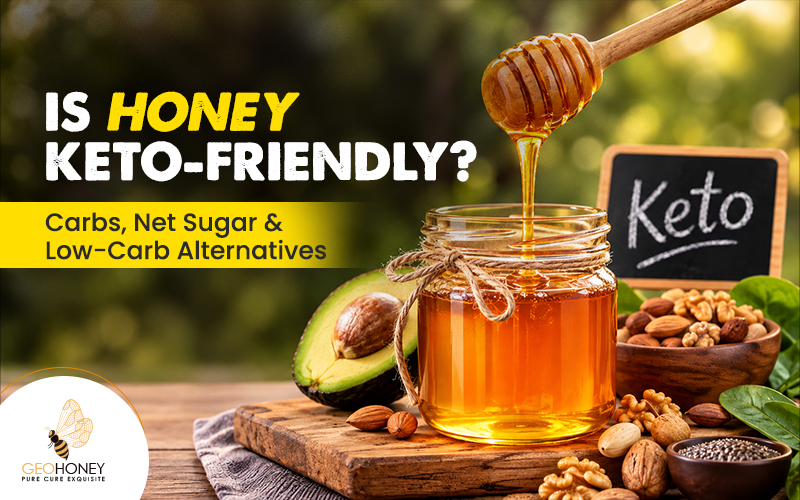
Is Honey Keto-Friendly Carbs, Net Sugar & Low-Carb Alternatives
Honey is natural, but that does not make it low-carb. One tablespoon contains about 17.3 g of carbohydrates, almost all from sugars, which can consume most of a strict keto carb budget. A teaspoon may fit some plans, but there is no universal amount that guarantees ketosis. This guide explains the numbers, the metabolism, and better substitutes for keto diets.
Key Takeaways
One tablespoon of honey contains about 17.3 g of total carbohydrates and 17.2 g of sugars, with almost no fiber to subtract.
One teaspoon provides about 5.8 g of carbs, so even a small serving can use a meaningful share of a 20–50 g daily keto carbohydrate target.
“Net sugar” is not a standard nutrition term. Honey’s conventional net carbs are effectively the same as its total carbs because it contains negligible fiber.
Raw, organic, and Manuka honey may differ in processing or bioactive compounds, but none gains a meaningful low-carb advantage.
Allulose, stevia, monk fruit, erythritol, and sucralose can reduce the carb load, but they do not all reproduce honey’s moisture, bulk, viscosity, or browning.
Is Honey Keto-Friendly?
Usually, no. Honey is not a low-carb sweetener, and a normal serving can take up a large share of the carbohydrate allowance used in many ketogenic diets. Keto works by restricting carbohydrate enough to support nutritional ketosis, so concentrated sugars are difficult to accommodate regularly.
There is no universal carb number that defines keto for everyone. Many nontherapeutic ketogenic approaches use roughly 20–50 g of carbohydrate per day, but individual thresholds vary. Therefore, “one teaspoon of honey always kicks you out of ketosis” is more confident than the evidence allows.
How Many Carbs and Sugars Are in Honey?
USDA reference data for generic honey show about 82.4 g of carbohydrate and 82.1 g of total sugars per 100 g. A typical tablespoon weighs about 21 g, while a teaspoon weighs about 7 g.
What Does “Net Sugar” Mean?
“Net sugar” is not a standard FDA nutrition term. Food labels use terms such as Total Sugars and Added Sugars. Keto discussions more commonly use “net carbs,” which is an unofficial consumer calculation intended to estimate digestible carbohydrates.
A common calculation is net carbs = total carbohydrate − dietary fiber. Some low-carb products also subtract certain sugar alcohols or allulose, but there is no single FDA-defined formula for every product.
For honey, this debate barely changes the result. One tablespoon has about 17.3 g total carbs and only a trace of fiber, so its conventional net-carb value remains about 17.3 g. Honey’s sugars are not subtracted from its carb count.
How Much of a Keto Carb Budget Does Honey Use?
The carb cost becomes clearer when honey is compared with illustrative daily limits. The percentages below show how quickly even small honey portions can accumulate.
The formula is:
Percentage of daily carb budget = carbs in honey ÷ daily carb budget × 100
These are examples, not universal keto prescriptions. Still, a tablespoon can consume most of a 20 g target and more than half of a 30 g target, leaving less room for vegetables, dairy, nuts, sauces, and other carb-containing foods.
Can One Teaspoon of Honey Fit Into Keto?
Mathematically, yes, in principle. One teaspoon supplies about 5.8 g of carbs. Against a 20 g daily target, that is roughly 29% of the day’s allowance.
But “it fits my macros” does not guarantee an identical metabolic response in every person. Ketosis depends on the overall diet and individual response, not on a universal honey cutoff.
Will Honey Kick You Out of Ketosis?
Honey can suppress ketone production because its glucose and fructose provide readily metabolizable carbohydrates. Glucose enters circulation and can raise insulin, while fructose is handled substantially by the intestine and liver. Together, they increase carbohydrate availability and work against the low-carbohydrate conditions that promote ketogenesis.
Controlled research has not identified a universal teaspoon or tablespoon threshold for honey. A tablespoon is more likely to disrupt a strict keto pattern than a teaspoon because it supplies almost three times as much carbohydrate.
Does Honey’s Glycemic Index Make It Better for Keto?
Not necessarily. Glycemic index and keto compatibility answer different questions. GI describes the blood-glucose response to available carbohydrate; it does not tell you whether a food is low in carbohydrate.
Published GI values for honey vary substantially with botanical composition and testing conditions. A honey with a lower GI can still provide about 17.3 g of carbohydrate per tablespoon. “Lower GI than sugar” therefore does not equal “keto-friendly.”
Is Honey Better Than Table Sugar on Keto?
Honey is not nutritionally identical to refined sucrose. It contains small quantities of phenolic compounds, minerals, enzymes, and other bioactive substances, and some research has examined possible cardiometabolic effects of particular honeys.
Those differences do not erase its carb load. For a person restricting carbohydrates specifically to maintain ketosis, the 17.3 g of carbohydrate in a tablespoon matters more than trace micronutrients or antioxidants.
By weight, honey contains less carbohydrate than granulated sugar because honey contains water. By tablespoon, honey can contain more because liquid honey is denser. So carb comparisons need a clear serving basis.
Are Raw, Organic, or Manuka Honey More Keto-Friendly?
No meaningful low-carb advantage has been established for any of them. Raw honey may retain different amounts of heat-sensitive compounds; organic certification concerns production standards; Manuka honey is distinguished by botanical origin and authentication markers.
Those differences do not change the central keto calculation. Raw, organic, and Manuka honey remain sugar-rich foods, so none should be treated as a genuinely low-carb form of honey.
Is Honey an Added Sugar?
Yes, in FDA nutrition-labeling terms, honey contributes added sugars when used as a sweetener. The wording can sound odd because no extra sugar has to be physically added to a jar of pure honey.
Single-ingredient honey receives special label treatment so consumers are not led to believe another sweetener was added. When honey sweetens another food, however, its sugars count as added sugars.
Best Low-Carb Alternatives to Honey
Honey does more than sweeten. It also contributes moisture, bulk, viscosity, browning, binding, and flavor. That is why the best replacement depends on how honey functions in a specific recipe.
Allulose
Allulose is useful where bulk or syrup-like behavior matters. FDA allows it to be excluded from Total Sugars and Added Sugars declarations, although it remains within Total Carbohydrate, and it contributes about 0.4 kcal per gram for labeling purposes.
It can brown during cooking, sometimes more readily than sucrose, so it may suit glazes, sauces, and some baked goods where color and surface browning matter.
Stevia, Monk Fruit, and Sucralose
These high-intensity sweeteners work particularly well in coffee, tea, yogurt, or smoothies, where sweetness matters more than honey-like texture. Only small amounts are typically required.
They do not replace honey’s moisture or bulk. Commercial blends may contain carriers or other sweeteners, so check the ingredient list and Nutrition Facts panel.
Erythritol
Erythritol contributes very little usable energy and appears widely in low-carb blends. It can work in desserts, but may create a cooling sensation, crystallize, or cause gastrointestinal discomfort in larger amounts.
Is Maple Syrup, Agave, or Another Natural Sweetener Better?
Usually not for keto. Maple syrup, agave, molasses, date syrup, and coconut sugar remain concentrated sources of digestible carbohydrate. Replacing honey with another caloric “natural” sweetener generally changes the sugar profile more than it solves the carb problem.
Agave is a useful example. Its relatively high fructose content can produce a lower immediate glycemic response than a more glucose-heavy sweetener, yet it remains carbohydrate-rich. Again, lower GI and low carb are not interchangeable.
Who Should Be Especially Careful?
People with diabetes should count honey as carbohydrate, not treat it as a “free” natural sweetener. People taking SGLT2 inhibitors need particular caution with ketogenic diets because very-low-carbohydrate eating is a recognized risk factor for diabetic ketoacidosis in that setting.
Nutritional ketosis is not diabetic ketoacidosis. DKA is a dangerous condition involving significant ketonemia and metabolic acidosis and cannot be diagnosed from one ketone number alone.
Honey should also never be given to children younger than 12 months because of the risk of infant botulism, regardless of whether the honey is raw or processed.
The Bottom Line
Honey is not a low-carb sweetener. One teaspoon contains about 5.8 g of carbs, and one tablespoon contains about 17.3 g, with almost no fiber to reduce the conventional net-carb count.
A very small amount can fit some ketogenic diets, but no serving guarantees that everyone will remain in ketosis. Raw, organic, and Manuka honey do not change the carb math.
For routine keto sweetening, allulose, stevia, monk fruit, erythritol, or sucralose are easier to accommodate. Choose the substitute according to whether you need only sweetness or also honey’s bulk, moisture, viscosity, and browning.
Want the sweetness without the guesswork? Explore Geohoney to discover honey varieties from around the world and find one that fits your taste, recipes, and lifestyle. Sweet choices start with knowing what’s in your spoon.
Geohoney
What Does a Queen Bee Look Like?
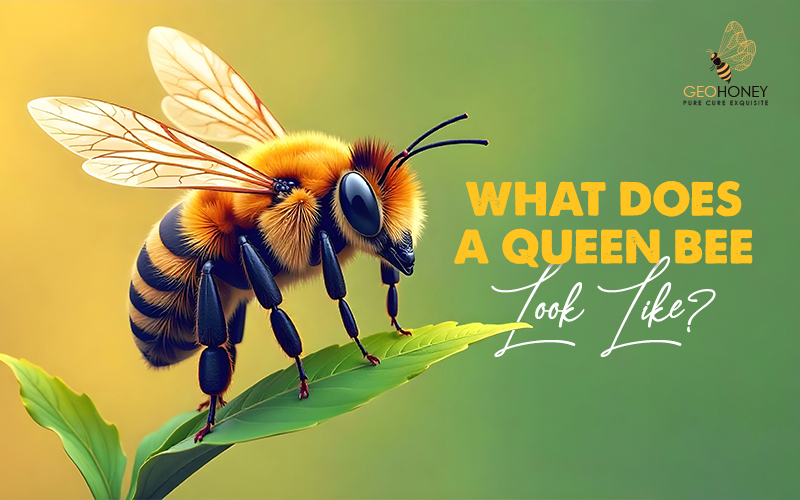
A queen bee is an integral part of a beehive. Queens bees are larger and longer than worker or drone bees. Their abdomens are elongated, which extend beyond their shorter wings. Overall, these bees have a more regal appearance than any other member of the colony.
But this is not all that makes this important bee stand out inside the hive. If you do not know how to spot a queen bee and you want to know exactly what a queen bee looks like, this blog is all you need.
This article looks into the physical features of queen bees in detail. This information highlights what sets a queen bee apart from the rest of the hive. So, let’s get right into it.
What is a Queen Bee?
How is a Queen Bee Born?
What Does a Queen Bee Look Like?
Queen Bees vs Worker Bees vs Drones
What is the Queen Bee’s Role in a Hive?

What is a Queen Bee?
A queen bee is a large, adult, mated female bee that is the mother of all the bees inside the hive. These bees are essential for the survival of bee colonies as they are the only fertile females in the hive.
A healthy honey bee queen lays between 1,500 and 2,000 eggs every day during peak season. This makes her the primary reproductive individual in the colony. These bees ensure a consistent supply of worker and drone bees inside the hive, which is essential for the survival of the colony.
The main duty of a queen bee is to maintain a healthy bee population inside the hive. Other bees, like workers and drones, on the other hand, perform tasks like collecting nectar, building honeycomb, and rearing the larvae.
Queen bees are larger in size than worker bees. Queen bees are 18-20 mm in size, while regular bees are about 11-15 mm in size. The queen bee is also the only creature inside the hive that feeds on a special diet called royal jelly in the larval phase. Other bees feed on bee pollen or organic honey for survival.
Unlike the barbed stinger of worker bees, queen bees have a smooth stinger, which allows them to survive even after stinging multiple times.
How is a Queen Bee Born?
The honey bee queen lays a few eggs in special queen cups inside the hive. Queen cups are dome-shaped cups that contain eggs for future colony queens. Once an egg is inside the cup, the nurse bees draw out the comb to create a queen cell. These cells have vertically oriented structures that look like peanut shells.
After that, worker bees excrete royal jelly and feed it to the larvae for the first few days. Then, bees switch the diet of workers and drones to bee bread or pollen while the future queen continues to get royal jelly. This change in diet leads to full development of the ovaries or reproductive organs and a longer life of the queen.
When the old queen dies or the colony splits in two due to a large population, the new queen emerges inside the hive. Once the new queen appears, she kills other developing queens inside the hive to ensure her survival.

What Does a Queen Bee Look Like?
It is very easy to spot a queen bee inside a hive if you just know what to look for. Here are some distinctive physical features of a queen bee that set her apart.
Bigger in Size
Queen bees are bigger than regular bees. They have elongated bodies with 18-20mm dimensions. In comparison, a worker bee is only 10-15mm long.
Long and Tapered Abdomen
The abdomen of a honey bee queen is long, and it extends well beyond its wings. This is what leads to its elegant appearance. The abdomen of this queen appears more pointed than that of worker bees. This part of the bee is what carries its fully developed reproductive organs.
Smaller Wings
The wings of the queen bees are much shorter relative to their abdomen. The wings of worker bees cover their entire bodies. This is not the case with queen bees, whose wings reach only partway down the abdomen.
Smooth and Shiny Thorax
The thorax is the middle part of a bee’s body. Queen bees have a smoother and shinier thorax than worker bees. These bees do not gather pollen or nectar, which makes their thorax appear more polished.
Different Movement Patterns
The movement pattern of the queen bee inside the hive is also different. It moves across the honeycomb in a calm and purposeful fashion while worker bees surround her at all times. This bee inspects cells to find the right spots for laying eggs.
Color of Queen Bee
The color of the queen bee is not drastically different from that of regular bees. This bee appears golden yellow or black with amber stripes.
Mandibles
Just like worker bees, queen bees also have mandibles, which are a pair of jaws on either side of the head. The mandibles on a queen bee are not tough enough to sting or defend the hive.

Queen Bees vs Worker Bees vs Drones
Queen, worker, and drone bees are different in terms of their looks as well as their roles inside the hive. Queen bees are larger with long and pointed abdomens. A queen bee is the longest-lived member of a honey bee colony. It can survive 2–5 years. In comparison, the worker bees often live only 4–6 weeks during summer.
Worker bees have smaller bodies and longer wings. These bees are sterile, and they only live for 5-6 weeks. These bees have hairy thoraxes, and their main purpose is to collect nectar, make honey, and raise the larvae.
Drone bees are male honey bees. The only role of these bees is to mate with the queen. Drones have wide and stockier bodies with round abdomens. These bees do not have stingers, and they possess large eyes that nearly touch the top of their heads.
What is the Queen Bee’s Role in a Hive?
A queen bee is at the reproductive center of the hive. These bees produce new workers and drones that keep the hive healthy. When the queen becomes weaker, worker bees begin raising new larvae by feeding them royal jelly. Queen bees are the only bees with fully developed ovaries. This means only they are the ones who can lay eggs.
Queen bees release a specific pheromone known as Queen Mandibular Pheromone (QMP). A reduction in the amount of this pheromone helps worker bees know when the lifecycle of queen bee ends, and this is what allows them to rear new queens.
The QMP pheromone also prevents worker reproduction as well as the rearing of new queens. This ensures there is only one queen inside the hive at a time.
Inside the hive, the queen bee directs the behavior, work assignments, and population balance. They influence the behavior of other bees, which causes them to assume specific roles inside the hive as workers, drones, and potential future queens.
Conclusion
A queen bee looks a lot different than other members of the hive. This bee is larger, longer, and shinier. Queen bees have long and tapered abdomens, shorter wings, and a calm demeanor.
These are the only bees inside the hive who have a fully developed reproductive system. These unique features result from a special diet called royal jelly that worker bees feed them throughout their lives.
Queen bees lay thousands of eggs during their life, and they maintain a healthy hive function by releasing special chemicals or pheromones. This is what makes queen bees a fascinating and really integral part of beehives, without which no bee colony can survive for long.
Visit us at Geohoney today to learn more about bees and beekeeping and to explore our wide range of 100% pure, raw monofloral honey varieties that guarantee an amazing flavor and countless health benefits in every spoonful.
FAQs
How can you spot a queen bee?
These bees have larger bodies with elongated abdomens inside the hives. They also possess smooth thoraxes, and their wings are much shorter than their bodies. Typically, several worker bees surround the queen bee inside the hive for protection.
Do queen bees possess a stinger?
Yes. These bees have stingers. However, their stingers are smooth and non-hairy. They use these mainly to fight rival queens.
Why are queen bees essential for beehives?
These bees lay eggs that turn into workers, drones, and future queens. They also release pheromones to maintain order inside the hive. This makes them extremely important for the health of a beehive.
What makes a queen bee different from a worker bee?
Queen bees are fertile, larger in size, and they release chemicals or pheromones to direct the roles of other bees inside the hive. Worker bees are smaller, and they lack reproductive capabilities. These bees forage, feed the larvae, and care for the queen bee.
Geohoney
Honey vs Sugar: The Complete Nutritional Comparison (2026)
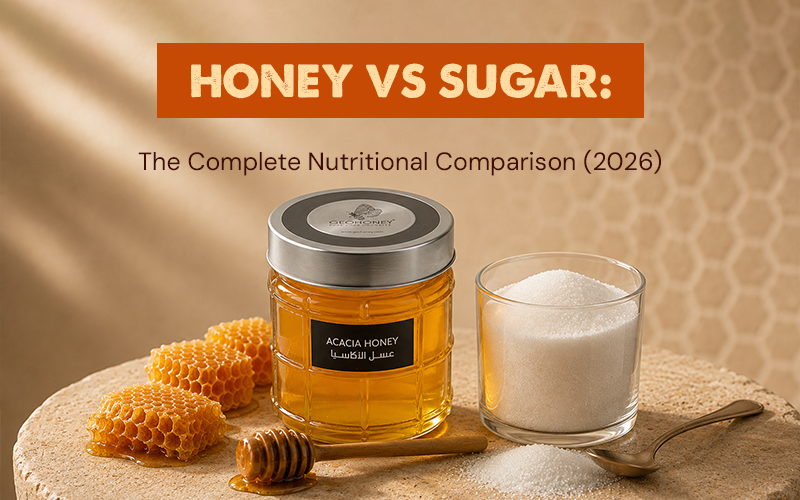
Honey and sugar are both common culinary ingredients that humans have used for thousands of years. Both of these substances are basically concentrated sugars. However, these are not the same when it comes to their nutritional profiles. A single serving or 100 grams of honey gives you more than 300 calories, 82 grams of carbs, 82 grams of sugars, antioxidants, vitamins, and trace minerals. The same serving of regular sugar gives you about 400 calories, 100 grams of carbs, 100 grams of sugars, and some trace minerals. This sweetener lacks beneficial antioxidants or minerals. This means sugar’s nutritional benefits are somewhat less than those of organic honey. This blog gives you a complete nutritional comparison of honey vs. sugar. With this information, you will come to know which of these sweeteners is nutritionally better than the other for your personal use. Honey vs Sugar: A Quick Nutritional Comparison Honey VS Sugar: Key Nutritional Differences Honey vs Sugar: Which Is Healthier? Here is a comprehensive table that highlights key nutritional differences between 100 grams of raw honey and sugar to help you make a smarter choice of sweetener that you need to add to your diet. This section lists some major differences between honey vs sugar in terms of their nutritional value. Honey vs Sugar: What are the Made of Table sugar is pure sucrose. It is a refined carbohydrate that contains glucose and fructose. This sugar is the result of the intense purification or processing of cane juice or beet juice. This processing removes most of the nutrients or minerals. The final product is a calorie-dense sweetener that has a neutral flavor. Pure or raw monofloral honey, on the other hand, comes from honey bees who feed on the nectar of flowers to make this natural substance. Honey mainly contains glucose or fructose. It contains less sucrose or carbs. Honey also contains water, minerals, healthy enzymes, and antioxidants that keep you healthy and energetic without side effects. These features are responsible for the countless health benefits of natural honey. Calories Content One tbsp of honey gives you 64 calories. The same amount of sugar gives you about 48 calories. This is because a tbsp of honey weighs a lot more than the same amount of sugar. However, if you take 100 grams of each, you find that honey actually has fewer calories because about 17-18% of its weight is actually water. Research shows 100 grams of honey gives you about 304 kcals. The honey is energy-dense because most of its dry matter is carbohydrates. This means you can take a small amount of honey to get your desired sweetness without an increase in your calorie intake. Carbohydrates and Sugar Content A 100 grams serving of honey gives you about 82 grams of carbs. With sugar, a 100 grams serving gives you close to 100 grams of carbs since most of it is essentially sucrose. Honey, on the other hand, has more free glucose or fructose that your body can easily digest. With sugar, your body first has to convert sucrose into glucose and fructose and then absorb it for energy. This difference in sugar content results in the different sweetness levels of these substances. Nutrient Comparison Research shows the superior nutritional features of honey in comparison with refined sugar are due to the presence of small quantities of minerals and bioactive compounds such as phenolics and flavonoids. Apart from sugars or carbs, honey also has other nutrients that are absent in refined sugar. Honey contains vitamins A, B, and C and minerals like potassium, calcium, zinc, and iron. It also has antioxidants, amino acids, and healthy enzymes. These healthy nutrients are not present in sugar. In some organic sugar products, however, you can find these nutrients in very small amounts. Antioxidants Honey has beneficial bioactive compounds that make it nutritionally superior. It is a rich source of antioxidants like flavonoids or phenolic compounds. These compounds strengthen your body’s natural defenses against free radicals. With sugar, you do not get these antioxidants, which affects your health. Glycemic Index The GI, or glycemic index, determines how quickly a carbohydrate-rich food can raise your blood glucose level. The GI ranges between 50 and 60, depending on different types of honey. The GI of sugar, on the other hand, is more than 65. This means sugar raises your blood sugar more quickly than honey. However, it is important to note that if you consume a large serving of a low GI food, it can still lead to a sugar spike. This is why you need to consume honey in moderation. It is clear from the nutritional comparison between honey and sugar that the former is a healthier sweetener. Honey is lower in calories and rich in antioxidants. It also comes with trace amounts of vitamins and minerals. Another thing that makes it better is its low glycemic index. However, you still need to use honey in moderation, as its calorie content is comparable to sugar. Sugar, on the other hand, has no additional nutrients. It is rich in carbs, and it raises your blood glucose faster. However, for most culinary applications in home kitchens, sugar is a more favorable ingredient due to its neutral flavor or predictable behavior. This is why, in terms of health, it has more to do with the quantity of these sweeteners rather than their nutritional value. Honey’s nutritional profile is superior to regular sugar. However, the difference between the two should not be exaggerated. It is true that honey is rich in nutrients like minerals, vitamins, antioxidants, and enzymes that you do not find in sugar. You still need to consume it in moderation. Regular sugar doesn’t give you micronutrients due to its intense processing. You can replace it with raw honey in most recipes to fulfil your nutritional needs to some extent without sacrificing sweetness. The healthier approach, however, is to always use less of these sweeteners whenever possible. This ensures you are able to enjoy your recipes without risking your health in the long run. Visit our website Geohoney today to explore our exclusive range of over 300 different raw monofloral honey types. We source our honey ethically from over 155 farms in more than 53 countries where local beekeepers prioritize bee conservation and environmental sustainability above all else.
Honey vs Sugar: A Quick Nutritional Comparison

Honey VS Sugar: Key Nutritional Differences


Honey vs Sugar: Which Is Healthier?
Conclusion
Geohoney
Garlic and Honey: The Ancient Remedy Backed by Modern Science
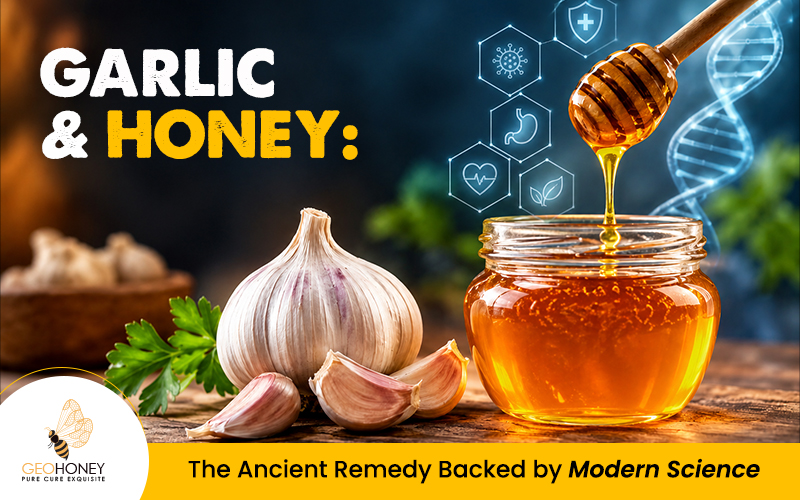
Garlic and honey have been combined in traditional medicine for thousands of years. In Ayurvedic practice, ancient Egyptian remedies, and folk medicine across the Mediterranean and Middle East.
The combination has lasted so many years because the individual ingredients are genuinely effective, and together they help remedy several problems.
Today, modern research has caught up with a lot of what traditional healers already knew. Garlic's active compound, allicin, has documented antimicrobial and anti-inflammatory properties. Raw honey brings its own antibacterial activity and antioxidants.
In this blog, we will cover what each ingredient brings, the proven garlic and honey benefits, and how to use them.
What Makes Garlic and Honey Benefits Actually Work
Health Benefits of Garlic and Honey
How to Get the Most Out of Garlic and Honey Benefits
What Makes Garlic and Honey Benefits Actually Work
The reason why garlic and honey benefits have worked for so long is that both ingredients have real benefits
Garlic's Active Compound: Allicin
Crushing or chopping garlic releases allicin, the compound behind most of its medicinal power. Allicin is antimicrobial, antifungal, and antiviral. It is also unstable, as heat breaks allicin down quickly. This is why raw garlic is significantly more potent than cooked.
Studies have shown allicin inhibits the growth of bacteria, including Staphylococcus aureus and E. coli. It also interferes with several of the mechanisms viruses use to replicate. That means the traditional use of garlic as a first line of defence against illness is actually based on evidence.
What Raw Honey Adds
Raw honey produces hydrogen peroxide through enzymatic activity. It also contains defensin-1, a protein with documented antibacterial properties. Along with this, raw honey brings a range of polyphenols and flavonoids with antioxidant and anti-inflammatory effects.
Honey's high sugar content and low moisture create conditions most bacteria just can't survive in. This is what gives raw honey its natural preservation ability and contributes to its antibacterial activity on wounds and in the digestive system.
Together, garlic and honey target bacteria and viruses through different mechanisms, which may be part of why the combination has been used so consistently across cultures.
Health Benefits of Garlic and Honey
According to research and different cultures, raw honey and garlic are often taken for these health benefits:
Immune Support
Both garlic and honey stimulate immune function. Garlic has been shown to increase the activity of natural killer cells and T-lymphocytes, which are central to the body's immune response. A widely referenced clinical study found that garlic supplementation reduced the frequency of colds by 63% compared to a placebo.
Raw honey supports immunity partly through its antibacterial properties and partly through its antioxidant content.
Cardiovascular Health
Garlic has one of the stronger evidence bases in natural medicine for cardiovascular benefits. Regular consumption of garlic has been linked to lower blood pressure and reduced LDL cholesterol.
Raw honey also has similar effects. Its antioxidant content reduces oxidative stress, which is a driver of arterial damage over time. As a dietary habit, the combination can really help maintain heart and cardiovascular health.
Anti-Inflammatory Effects
Chronic low-grade inflammation is the reason behind many common conditions, from joint pain to metabolic issues. People have used garlic and honey to calm inflammation for centuries, and science backs up the reasoning.
Garlic is packed with organosulfur compounds that slow down prostaglandins, the chemicals your body makes during an inflammatory response. Raw monofloral honey brings its own benefit through phenolic compounds, which studies tie to lower inflammation too.
Gut Health
Garlic acts as a prebiotic, feeding beneficial gut bacteria. Raw honey has oligosaccharides that do pretty much the same thing. Put them together, and they help keep your gut microbiome more balanced.
Garlic is a bit choosy with its antimicrobial power too, going after harmful bacteria more than the good ones. This sets it apart from antibiotics, which tend to disrupt the entire gut microbiome in the process.
How to Get the Most Out of Garlic and Honey Benefits
The most effective and traditional preparation is fermented garlic in honey, and it is pretty simple to make.
Fermented Garlic in Honey
Peel a full head of garlic and place the cloves in a clean jar
Cover completely with raw honey
Leave the jar loosely covered at room temperature for at least a week, ideally a month
The garlic will soften and mellow in flavour, and the honey will thin and darken
Take one or two cloves daily, or a teaspoon of the infused honey
The fermentation process makes the garlic easier to digest and may make some of its compounds easier for the body to absorb. The honey acts as both a preservative and a medium to take the garlic in.
Other Ways to Use Them Together
A clove of raw garlic with a teaspoon of honey in the morning can be a simple daily habit
Mixed into salad dressings or marinades with olive oil and lemon
Stirred into warm water with ginger as a cold remedy
Applied as a topical paste for minor skin irritation, though this is more of a traditional remedy and doesn’t have much research to back it
It’s important to use raw garlic and not cook it, and raw honey rather than processed. Both lose their most active compounds when exposed to high heat.
Conclusion
Garlic and honey are one of those combinations where traditional use and modern research both agree with the benefits. Both have individual benefits and also work really well when taken together.
But for the combination to work, the honey needs to be raw and unprocessed. At Geohoney, we source 100% pure raw honey from verified beekeepers across 53 countries and 155 farms worldwide.
Explore our collection and bring home honey you can actually trust.
Geohoney
Apitherapy 101: Everything You Need to Know About Bee Products in Natural Medicine
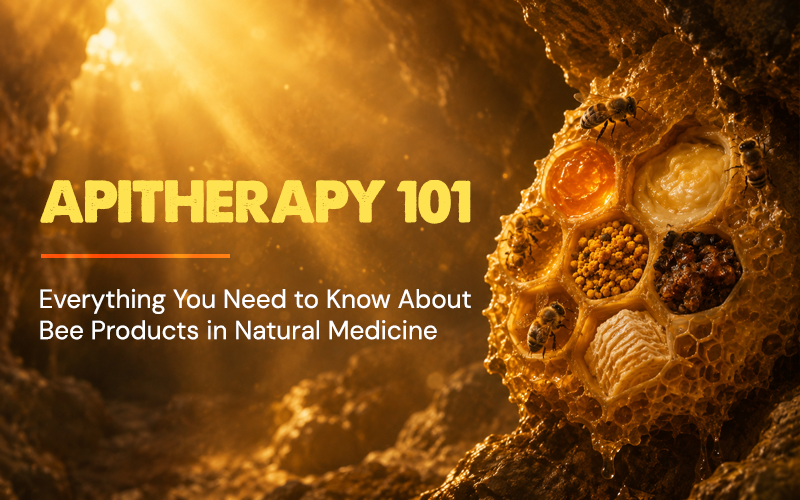
Apitherapy is a traditional practice that involves the use of products that honey bees make to treat illnesses or to enhance overall health. There are various bee products like organic honey, pollen, propolis, beeswax, royal jelly, and bee venom that find uses in countless traditional remedies as well as modern healthcare products due to their high nutritional value or exceptional medicinal properties.
A lot of scientific research focuses on exploring the health benefits of bee products. Researchers study many apitherapy claims to gather clinical evidence for the effectiveness of this medical approach. And the results of this research are quite promising so far.
This blog explores apitherapy in detail. It highlights key products that we use in apitherapy along with their potential health benefits. So, let’s get right into it.
What Is Apitherapy?
How Bee Products Work in Apitherapy
Apitherapy: A Historical Background
Bee Products That Find Uses in Apitherapy
Are Bee Products for Apitherapy Safe?
Who Should Avoid Apitherapy?
What Is Apitherapy?
The word apitherapy has two parts. Apis is a Latin word that stands for bee, and therapy is derived from the Greek word therapeia, which means healing. The word apitherapy thus means bee therapy or healing with the help of bees.
In modern English, the word apitherapy describes the use of products that honey bees produce for health or wellness applications. Unlike normal medicine, apitherapy is all about the use of natural substances that we get from a hive.
Each hive product, such as raw honey, propolis, bee pollen, bee venom, beeswax, and royal jelly, possesses unique bioactive compounds. These compounds offer robust antimicrobial, anti-inflammatory, antioxidant, and immune support features that make them beneficial for your overall health.
How Bee Products Work in Apitherapy
The bee products that we use in apitherapy contain a mix of several healthy natural compounds. These compounds not only help your body heal after workouts or injuries, but they also keep you safe from seasonal illnesses with their immune-support properties. Studies show possible antioxidant and anti-inflammatory effects in royal jelly or bee pollen-based products.
Here are some key compounds that bee products contain.
Polyphenols
Flavonoids
Enzymes
Vitamins
Minerals
Natural sugars
Essential fatty acids
These bioactive compounds make bee products superior in terms of their antioxidant effects or anti-inflammatory activities. They also offer antimicrobial properties or immune modulation features that help you with faster tissue repair and wound support.
The antioxidants in these apitherapy products neutralize free radicals. The antibacterial features help your body fight fungi or harmful bacteria. Natural minerals and fatty acids also keep you energetic. Regular use of these products ensures your skin stays fresh as well. This way, apitherapy aims to improve your health both internally and externally without side effects.
Apitherapy: A Historical Background
Apitherapy’s roots are in ancient medicine. Humans have been using these products for thousands of years to support health. Strong evidence suggests that ancient Egyptians used honey for wound treatment and embalming.
Greek physician Hippocrates suggested the use of honey for fever or wound healing over a millennium ago. There are several ancient Chinese medicinal remedies as well as those that incorporate bee products in many herbal formulations. Ayurvedic medicine in India also hails honey as a potent natural substance that offers so many health benefits for the mind and body.
All of these historical claims force modern researchers to look more closely into the medicinal effects of honey bee products. This is what makes apitherapy a huge area of research in a wide range of applications, including oral health, immunity support, inflammation control, skincare, and more.
Bee Products That Find Uses in Apitherapy
Here are some major honey bee products that find uses in apitherapy.
Honey
Honey is the most popular bee product that contains several bioactive compounds. Bees make honey after collecting nectar from flowers and breaking down the natural sugars with special enzymes in their stomach.
It has natural sugars, amino acids, enzymes, vitamins, minerals, organic acids, polyphenols, flavonoids, etc. These components are what lead to countless medicinal uses of honey.
Honey's impressive nutritional profile gives it exceptional antibacterial, anti-inflammatory, and antioxidant features. Honey supports your immune health, and it leads to faster recovery after minor injuries.
Regular use of honey also protects you from seasonal allergies or coughs. The antioxidants in honey ensure your body stays safe from oxidative stress. Honey’s prebiotic features ensure your digestive system stays in the best condition at all times.
Propolis
This is another popular apitherapy product. It is a resinous material that honey bees make by mixing tree buds or plant saps with beeswax or their own discharge. Bees use this product to seal or repair gaps inside the hive. This protects the hive from bad weather, pests, and bacteria.
Propolis is rich in essential oils, antioxidants, vitamins, minerals, resins, balsams, and waxes. These components impart superior antibacterial or antiviral effects to this bee product.
Propolis is also very effective for immune system support. It is a key component in many toothpastes and mouthwashes due to its ability to reduce oral bacteria.
The antimicrobial features of propolis also make it a main ingredient in skincare products like creams or ointments.
Royal Jelly
This is a nutritionally rich secretion that worker bees produce to feed the queen bee. This ingredient in the diet of queen bees is what allows them to grow larger and live longer. It is also what helps in the development of the reproductive organs of the queen bee.
This bee product is rich in amino acids, unique fatty acids, proteins, vitamins, lipids, and trace minerals. Royal jelly has exceptional anti-inflammatory features.
It also hydrates your skin and maintains its elasticity. Research also shows royal jelly has anti-aging effects when you use it regularly. Regular use of royal jelly also helps with menopausal symptom relief and cholesterol management.
Bee Pollen
Bee pollen is a mix of flower pollen, nectar, and bee enzymes. It is in the form of tiny granules that worker bees pack into tiny pellets on their hind legs. This nutrient-rich apitherapy ingredient contains proteins, essential amino acids, vitamins, minerals, healthy fats, polyphenols, and enzymes.
Bee pollen-based remedies neutralize free radicals in your body. This builds a stronger immune system. This energy-dense food is a part of the diet of fitness enthusiasts across the globe. Bee pollen also provides you with seasonal allergy support. Its regular use alleviates the symptoms of seasonal flu or cold.
Beeswax
Worker bees produce beeswax from the special glands in their abdomen to make hexagonal raw honeycomb structures. The cells bees make this way allow them to store honey and to develop their brood.
Beeswax is a key ingredient in medicine due to its high content of hydrocarbons or esters. It also has fatty acids and long-chain alcohols. These components give it exceptional therapeutic effects.
This naturally water-resistant substance is a key ingredient in topical products like lip balms or ointments. It creates a breathable barrier on your skin which prevents water loss or skin dryness.
Beeswax has potent anti-inflammatory properties that further enhance its effectiveness in skincare applications. You can also find uses of beeswax in products like candles or photometrical coatings for tablets.
Bee Venom Therapy
This is a relatively new and somewhat controversial area of research in apitherapy. Bee venom is an acidic liquid that worker honeybees produce as a part of their defense mechanism.
In bee venom therapy you administer bee venom through controlled stings or purified venom injections to treat inflammatory and musculoskeletal disorders, neurodegenerative disease, skin issues, or chronic pain.
Bee venom has several active compounds like apamin, peptides, melittin, and phospholipase that show promising results in the treatment of autoimmune diseases or neurological disorders.
Research shows bee venom acupuncture results in improved pain conditions compared with sham injections in people with osteoarthritis or rheumatoid arthritis.
Patients who receive bee venom therapy for musculoskeletal pain also report lower back, shoulder, and tendon pain relief.
Venom therapy comes with serious health risks, including allergic reactions and life-threatening anaphylaxis. This is why you need to consult with experts before you choose this treatment option.
Are Bee Products for Apitherapy Safe?
Bee products that we use in apitherapy are generally safe. However, you need to use these in the right doses after consultation with your healthcare professional. Here are some side effects that people who have allergies to honey bee products generally report after apitherapy.
Minor allergic reactions
Skin rashes or irritation
Digestive system issues
Swelling
Breathing issues if allergic reactions are severe
Who Should Avoid Apitherapy?
Apitherapy is an effective treatment option for a wide range of diseases. However, there are some cases when it can do you more harm than good. Here is when you should avoid apitherapy.
You are allergic to honey or pollen.
You are pregnant or breastfeeding.
You have severe allergies or asthma.
You suffer from chronic asthma.
You have chronic autoimmune disorders.
Conclusion
Apitherapy is an area of medical research that looks into the use of bee products to treat or prevent illnesses. This ancient science aims to harness the antibacterial or anti-inflammatory features of bee products like honey, bee venom, beeswax, or royal jelly to enhance your physical as well as mental health.
Apitherapy has become a hot topic recently due to its great potential as a modern treatment avenue. However, there is still a long way to go when it comes to understanding how we can better utilize this natural approach to improve our health or to prevent chronic illnesses.
Visit Geohoney today to get more insights into apiculture and apitherapy. Our 100% pure bee products like honey, royal jelly, propolis, and beeswax promise exceptional flavor and nutrition that can enhance your every culinary recipe and medicinal remedies without any side effects.
Geohoney
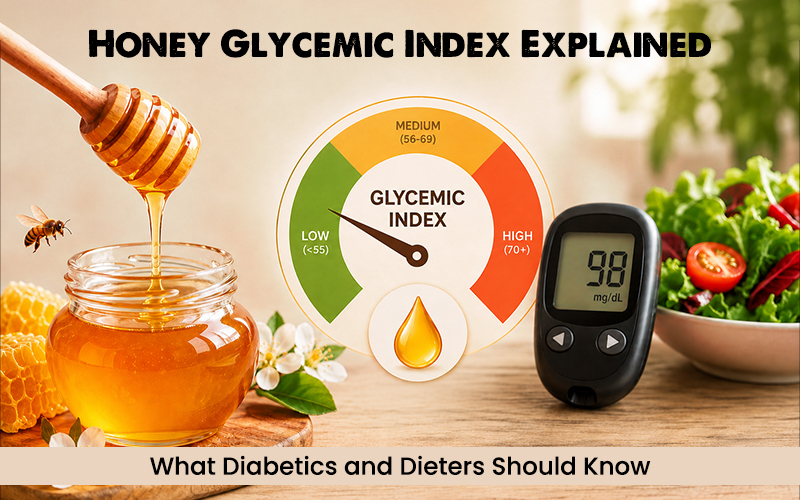
Honey Glycemic Index Explained: What Diabetics and Dieters Should Know
A lot of people switch from sugar to honey hoping it is the better option for blood sugar. For the most part, it is. The honey glycemic index is lower than refined sugar for most varieties, which means it raises blood glucose more slowly. But honey is still a source of sugar, and the type you choose matters more than most people realise. This blog covers how the honey glycemic index works, which varieties have the lowest GI, and what that means practically for diabetics and dieters. Understanding the Honey Glycemic Index How the Honey Glycemic Index Compares to Sugar Which Honey Has the Lowest Glycemic Index? What Diabetics Should Know About Honey Glycemic Index What Dieters Should Know About Honey Glycemic Index The glycemic index measures how quickly a food raises blood sugar, scored from 0 to 100. The lower the number, the slower the blood sugar rise. Anything under 55 is considered low GI. Anything above 70 is high. The honey glycemic index typically falls between 45 and 65, depending on the variety. That puts most honeys in the low to medium range. Refined white sugar sits at around 65. So honey is not dramatically different on paper, but the practical difference comes down to how much you use and which type you choose. The main reason honey tends to have a lower GI than sugar is its fructose content. Most honey varieties contain more fructose than glucose. Fructose has a very low GI of around 19, while glucose is at 100. The higher the fructose content in a honey, the lower its GI. White sugar is made of sucrose, which breaks down into equal parts fructose and glucose. Most honey varieties have more fructose than glucose, which is why the honey’s glycemic index tends to come in lower. Honey is also sweeter than sugar by volume. You need less of it to get the same level of sweetness, which means fewer calories and less sugar per serving in practice. Gram for gram, honey has slightly more calories than sugar. But most people naturally use less of it, and that changes the actual comparison. The other factor is nutritional value. Sugar offers nothing except sweetness. Raw honey brings antioxidants, enzymes, and trace minerals alongside its natural sugars. The calories are not empty in the same way. GI varies considerably between honey types, and the difference is worth knowing if blood sugar management is the goal. Acacia honey has one of the lowest GI values of any honey, coming in at around 32 to 35. It has an unusually high fructose content, which keeps its blood sugar impact very low. It is also mild in flavour and stays liquid longer than most varieties, which makes it practical for everyday use as a sweetener. Manuka honey has a moderate GI of around 55 to 60. It is more commonly known for its antibacterial properties, but it still compares well against refined sugar. Clover honey sits at around 58. Multifloral honeys vary more because their fructose and glucose ratios depend on which flowers the bees foraged from. If consistency matters to you, a single-origin monofloral honey is more predictable than a blend. Processing does not change the honey’s glycemic index significantly, but it does strip out the antioxidants, enzymes, and pollen that make honey nutritionally useful. Raw honey gives you the same GI range with everything else still intact. Honey is not a sugar-free food. It raises blood sugar, and anyone managing diabetes needs to treat it accordingly. That said, you should also consider the glycemic index of honey here. A lower GI food raises blood glucose more gradually, which is easier for the body to handle. Choosing a low-GI honey like acacia over refined sugar makes a real difference in how quickly blood sugar spikes after eating. There is also early evidence that the antioxidants in raw honey may have mild benefits for metabolic health. The research is still developing, and it is not a reason to eat more honey. Overall carbohydrate intake still matters most. Anyone with diabetes should check with their doctor or dietitian before making honey a regular part of their diet. Lower GI foods cause a steadier blood sugar curve, which tends to keep hunger at bay for longer and reduce cravings between meals. That is one reason switching from sugar to honey makes sense for people watching their weight. But honey is calorie-dense. A tablespoon of honey contains around 64 calories. Using it in the same quantities as sugar will not produce different results. The glycemic index of honey is the only advantage it holds if you use moderate portions. The practical approach is to use honey as a replacement, not an addition. A teaspoon in tea or yogurt instead of sugar is a sensible daily habit. Drizzling it freely on top of an already high-calorie diet is not. The honey glycemic index is lower than refined sugar for most varieties, and that’s because of the fructose content in the honey. Not all honeys are the same, and choosing the right type makes a real difference. For the best combination of a lower GI and full nutritional value, raw monofloral honey is the strongest option. At Geohoney, we source 100% pure raw honey from verified beekeepers across 53 countries and 155 farms worldwide. Browse our collection and choose a honey that actually helps your health.Understanding the Honey Glycemic Index
How the Honey Glycemic Index Compares to Sugar
Which Honey Has the Lowest Glycemic Index?
Acacia Honey
Manuka Honey
Clover and Multifloral Honeys
A Note on Raw vs Processed Honey
What Diabetics Should Know About Honey Glycemic Index
What Dieters Should Know About Honey Glycemic Index
Conclusion
Geohoney
Apple Cider Vinegar and Honey: The 'Oxymel' Trend Explained
An oxymel is a herbal tonic that has ancient traditional roots. To make it you have to combine apple cider vinegar with raw honey and some medicinal herbs. The recent surge in popularity of apple cider vinegar with honey may make it sound like a fleeting wellness trend. However this natural remedy is anything but new. This healthy tonic is becoming more popular by the day for its beneficial effects on your gut health, digestive system, immunity, and more. Many wellness influencers on social media also hail this sweet and sour mixture as a powerful natural detoxing agent for your body. This blog looks into apple cider vinegar and honey in detail. This information will help you figure out why there is so much buzz around the “Oxymel” trend online and why you need to try it for your own wellness. What Is Oxymel? Apple Cider Vinegar: What's in It? Honey: Nature’s Healthy Sweetener Honey and Apple Cider Vinegar Combination: Is it Really Effective? Potential Health Benefits of Apple Cider Vinegar and Honey How to Make a Simple Traditional Oxymel The word oxymel combines two Greek words i.e., oxys which means acid or vinegar and meli which means honey. The term oxymel thus means acid and honey. In modern English oxymel refers to a mixture of apple cider vinegar with raw honey. This remedy has ancient roots in the treatment of sore throat or respiratory issues. The combined antimicrobial features of vinegar and organic honey further make it a powerful ingredient in traditional medicine. You can make a simple oxymel today by mixing apple cider vinegar, honey, water, and some optional herbs such as lemon or ginger. This drink has a sweet and slightly tart flavor that instantly improves your mood as well as energy levels. To make apple cider vinegar, you ferment apple-based liquids, which converts sugar into alcohol and then acetic acid. This is what results in the sour taste of this vinegar. Vinegar consumption is good for your metabolic health. It also has positive effects on your fasting as well as post-meal glucose. People with body weight issues or cholesterol imbalance can also use apple cider vinegar to see positive effects. This shows vinegar can be a very healthy addition to your diet if you consume it in moderation. Honey is an ancient natural sweetener that finds countless uses in traditional medicine. It is rich in antioxidants and sugars. It also contains vitamins and minerals that boost your immunity. You can find honey in a wide range of colors or consistencies that depend on its floral origin. Honey’s impressive nutritional profile makes it a key ingredient in remedies for allergies, seasonal colds, flu, or wound care. This substance also affects your blood sugar less than regular sugar due to its lower glycemic index. But what happens when you combine honey with apple cider vinegar? This is where the oxymel trend comes into the picture. Historically, there is a lot of evidence that suggests the use of this combination for general wellness. However, there is still a need for concrete clinical research to prove these claims. This combination might be effective as honey counteracts the acidity or sharp flavor of the vinegar. This allows you to get the best of both of these ingredients. A small amount of this honey-based remedy can add more nutrients to your system, resulting in better immunity. However, medical research indicates you should not rely solely on this remedy since there is limited proof that it has synergistic medical effects. Here are some purported health benefits of apple cider vinegar and monofloral honey that make it a popular wellness trend. The “Detox” Claim You can replace high-sugar beverages with a diluted oxymel to optimize the detoxification process of your body. This means it doesn’t directly detoxify your system. Instead, it can reduce the intake of high-calorie beverages or sweeteners, which reduces stress on your liver, resulting in better detoxification. Benefits for Digestion Honey and vinegar-based beverages help with digestion as they make you feel less heavy after you eat. However, the highly acidic nature of vinegar can lead to unpleasant symptoms in some people who are extra sensitive to acidic drinks. Immunity Benefits There is no denying that raw honey is a potent immunity booster. Its high antimicrobial activity and antioxidant effects strengthen your body’s natural defenses against seasonal or chronic illnesses. The antimicrobial effects of apple cider vinegar further support the immune-boosting potential of this wellness drink. May Support Healthy Blood Sugar Levels Apple cider vinegar and honey also help with blood-glucose management. The acetic acid in vinegar changes the way your body processes carbohydrates. It reduces post meal glucose response in your body resulting in fewer sugar spikes. The low GI benefits of raw honey further ensure your blood sugar levels do not rise abruptly. This is why people with diabetes can consume this wellness drink after meals to maintain steady glucose levels. Better Weight-Management An oxymel promotes better satiety as well as digestion. With an increased feeling of fullness, you naturally consume less food which results in a reduction in body weight. Just make sure to use polyfloral honey in moderation when you make this tonic as it can help minimize your calorie or sugar intake. May Soothe a Cough and Irritated Throat Honey and apple cider vinegar combo is a potent remedy for a sore throat or acute cough. Honey coats the lining of your throat which prevents irritation. Honey’s antibacterial features allow you to fight seasonal illnesses like the flu or cold much better. A Healthier Alternative to Some Highly Sweetened Drinks The oxymel can replace your highly refined-sugar beverages like soft drinks or iced tea. This mixture contains a natural sweetener which reduces your overall sugar intake. However, just like anything else, moderation is still the key here. Has Ingredients with Antimicrobial Properties Honey and apple cider vinegar both show impressive antimicrobial activity. Vinegar’s acidity with honey’s superior antibacterial effects, inhibits the growth of certain harmful microorganisms. This way, the oxymel can not only reduce the attacks of harmful bacteria but also prevent internal or external infections. The recipe for a traditional oxymel is pretty simple. To make this drink, you need to combine 1 teaspoon of apple cider vinegar with 1 to 2 teaspoons of bee honey. You can add this mixture to about one cup of water. Then you can mix these ingredients until it reaches a smooth consistency. After that you can add more honey or apple cider vinegar to adjust the flavor to your taste. You can either drink this solution as it is or make it a part of your culinary recipes like salads or marinades. The oxymel may seem like a simple modern trend that only lasts for some days until everyone gets over it eventually. What most people do not know is that it has roots in ancient medicinal tradition. Both honey and apple cider vinegar boost impressive nutritional profiles. People who use this combination regularly report better physical as well as mental well-being. The oxymel can boost your immunity, improve digestion, and help you manage both your blood glucose and body weight. Its regular use reduces your sugar intake and ensures you are able to enjoy a beverage with a strong flavor and no side effects for your health. Though the clinical evidence for the health benefits of oxymel is limited, you can still add it to your daily diet in moderation to see firsthand what makes the oxymel trend so popular among wellness enthusiasts globally. Visit us at Geohoney today to order from our premium range of 100% pure monofloral honey products to maximize the benefits of your oxymel trend diet. Our raw honey offers better immunity support, gut health, and energy every single day. What Is Oxymel?
Apple Cider Vinegar: What's in It?
Honey: Nature’s Healthy Sweetener
Honey and Apple Cider Vinegar Combination: Is it Really Effective?
Potential Health Benefits of Apple Cider Vinegar and Honey
How to Make a Simple Traditional Oxymel
Conclusion
- 1 of 2
Geohoney
Does Honey Go Bad The Complete Guide to Shelf Life, Storage & Crystallization
That forgotten jar sitting at the back of your pantry has probably made you pause at least once. "Can I still eat this?"The... read more
Geohoney
Are Bees Endangered? The Truth About Global Bee Populations in 2026
Bee populations around the world have been declining, and it is truly a cause for concern. But the question of whether bees... read more
Geohoney
How to Become a Beekeeper: A Step-by-Step Beginner's Guide
Beekeeping, or apiculture, is a practice where humans care for or manage bee colonies in man-made hives to collect honey or... read more
Geohoney
Is Honey Vegan? The Full Debate, Explained
Whether honey is vegan is one of the more genuinely contested questions in plant-based eating. The honest answer is: it depe... read more

Press Release
Geo Honey Extends Warm Eid Al-Adha عيد الأضحى 2026 Greetings to Customers, Partners and Communities Across the Region
A message of gratitude, unity and blessings from the heart of Geo HoneyDUBAI, UAE May 2026 . As the blessed days of Ei... read more

Geohoney
Health Benefits of Fasting in Ramadan
Fasting in the holy month of Ramadan has a lot of significance for Muslims all over the globe. In fact, fasting is among the... read more

Geohoney
Regenerative Agriculture & Bees: A Partnership That Heals the Soil
Regenerative agriculture and bees help each other. They heal the soil and protect plants and animals. They also support our... read more

Geohoney
Best Ways to Use Honey for Immunity, Cough & Sore Throat (Doctor-Approved Tips)
So many cultures around the world consider honey to be a potent natural healing food. The recent medical research not only s... read more

Press Release
Geohoney Marks World Clean Energy Day 2026: Clean Power, Climate Action, Global Impact
Geohoney, a global advocate for ethical beekeeping and environmental stewardship, observes World Clean Energy Day 2026 by re... read more
Geohoney
What Happens If You Eat Honey Before Bed?
Honey is one of nature’s most revered gifts to us, which has been used in kitchens and Ayurveda for years now. Honey is used... read more
