- Tokyo: 21:33
- Singapore: 20:33
- Dubai: 16:33
- London: 13:33
- New York: 08:33
Biotechnological Applications in Disease-Resistant Bee Breeding
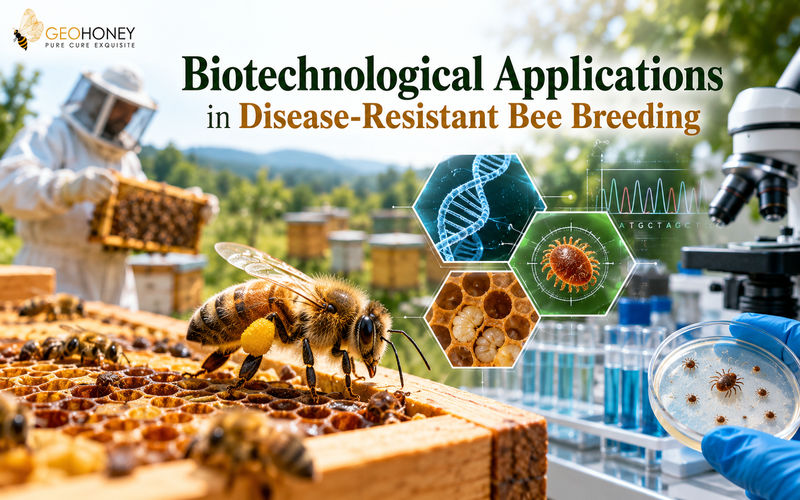
Honeybee health is influenced by a complex combination of genetics, pathogens, parasites, nutrition, climate, pesticides, and beekeeping practices. Among these pressures, Varroa destructor, viral diseases, bacterial infections, and other pathogens remain major challenges for modern apiculture. Conventional disease management has relied heavily on chemical treatments and hive-level interventions, but the increasing complexity of honeybee health problems has strengthened interest in breeding colonies with inherent resistance or tolerance traits.
Biotechnology is helping researchers move beyond conventional visual selection. Genomics, molecular markers, proteomics, transcriptomics, reproductive technologies, and RNA-based approaches are providing new ways to identify and propagate honeybee traits associated with disease resistance. Importantly, some of these technologies are already being used in breeding research, while others remain experimental.
This article examines how biotechnology is changing disease-resistant honeybee breeding and the scientific opportunities and limitations surrounding these approaches.
Why Disease-Resistant Breeding Matters
Honeybee colonies do not defend themselves against disease through individual immunity alone. Colonies also rely on social immunity, in which worker bees collectively identify, remove, groom, or isolate threats.
One of the best-characterized examples is hygienic behavior. Workers detect unhealthy or dead brood and remove it from the colony, interrupting the development or transmission of certain brood diseases. A related trait, Varroa-sensitive hygiene (VSH), involves detecting and removing brood infested with reproductive Varroa mites.
Research has demonstrated that these traits have a heritable component and can therefore be incorporated into selective breeding programs.
1. Genomics and Genome-Wide Association Studies
Modern honeybee genomics enables scientists to examine genetic variation across the genome and investigate relationships between specific genetic variants and resistance traits.
Genome-Wide Association Studies
Genome-wide association studies (GWAS) compare genetic variants among bees showing different phenotypes. Researchers can then look for single-nucleotide polymorphisms (SNPs) or genomic regions associated with traits such as:
Hygienic behavior
Varroa-sensitive hygiene
Grooming behavior
Immune responses
Disease tolerance
USDA research has specifically investigated genomic regulatory variants associated with VSH, combining whole-genome sequencing with expression quantitative trait locus analysis to identify candidate markers that could potentially be used in breeding.
The important advantage is that breeders may eventually be able to use genetic information alongside observed colony performance, rather than relying exclusively on labor-intensive behavioral tests.
2. Marker-Assisted Selection
Marker-assisted selection (MAS) uses measurable molecular markers associated with desirable traits to support breeding decisions.
Traditional selection for hygienic behavior can require repeated colony-level testing. This creates a practical bottleneck for commercial breeding because behavioral measurements can be influenced by environment, season, colony strength, and management.
Researchers have therefore investigated molecular and protein biomarkers that correlate with disease-resistance phenotypes.
A recent multi-region study found that colonies selected using marker-assisted approaches performed comparably to colonies selected using field-based hygienic-behavior assays, while selected colonies maintained lower Varroa populations at certain sites and times without acaricide treatment.
This does not mean genetic markers can replace field testing completely. Rather, the evidence supports their use as additional tools for making breeding more efficient.
3. Proteomics and Biomarker Discovery
Genomics identifies differences in DNA, while proteomics examines proteins and protein expression.
Honeybee antennae are particularly interesting in resistance research because worker bees rely heavily on chemical signals when identifying unhealthy or parasitized brood.
Researchers have identified antennal proteins associated with hygienic behavior and Varroa-sensitive hygiene. These biomarkers have been investigated as potential indicators for marker-assisted breeding.
Proteomic screening may therefore provide an intermediate layer between genotype and behavior:
Genetic variation → protein expression → sensory response → defensive behavior
Understanding this chain could improve the precision of future disease-resistance breeding programs.
4. Genomic Selection
Marker-assisted selection generally focuses on specific markers. Genomic selection takes a broader approach by using large numbers of genetic markers simultaneously to estimate the breeding value of an animal.
Honeybee breeding presents particular challenges because many commercially important characteristics are colony-level traits, and honeybee queens mate with multiple drones. This makes inheritance and phenotype prediction more complex than in many conventional livestock systems.
Nevertheless, USDA research is developing genomic resources specifically to modernize honeybee breeding. Its work includes a honeybee pangenome, which provides a broader representation of genetic diversity across multiple honeybee populations and can support future genomic-selection applications.
The development of these resources could eventually allow breeders to select simultaneously for several traits rather than optimizing for one characteristic at a time.
5. Artificial Reproductive Technologies
Biotechnological breeding is not limited to DNA analysis.
Controlled reproductive techniques—including instrumental insemination of queens—allow researchers to manage which drones contribute genetically to future colonies.
This is particularly useful in experimental breeding because it allows researchers to:
Maintain selected genetic lines
Control mating combinations
Replicate breeding experiments
Study inheritance of resistance traits
Reduce uncertainty caused by uncontrolled mating
Honeybee reproductive biology remains challenging because queens normally mate with multiple drones during mating flights, making controlled mating an important research tool for genetic-selection programs.
6. Breeding for Varroa Resistance
Among disease and parasite-resistance programs, Varroa resistance is one of the most developed areas of honeybee breeding research.
Scientists have identified multiple resistance or tolerance mechanisms, including:
Hygienic Behavior
Workers remove dead or diseased brood.
Varroa-Sensitive Hygiene
Workers preferentially detect and remove Varroa-infested brood.
Grooming
Workers remove mites from themselves or nestmates.
Reduced Mite Reproduction
Some honeybee populations have characteristics that interfere with successful Varroa reproduction.
These mechanisms are biologically different but can contribute to lower parasite pressure within colonies. Research has identified genetic and physiological components associated with several of these traits.
A 2022 study reported that a selected honeybee stock demonstrated resistance to Varroa and reduced associated viral transmission, illustrating how breeding for host resistance can affect more than the parasite itself.
7. Breeding for Resistance to Multiple Diseases
An important development is the recognition that resistance traits may have effects extending beyond their original target.
For example, 2025 USDA-supported research reported that honeybees bred for Varroa-sensitive hygiene also demonstrated resistance to chalkbrood disease, suggesting that some colony defense traits may provide broader protection than previously expected.
This raises an important research question:
Can breeders develop honeybees with combinations of complementary defense traits rather than selecting for resistance against a single pathogen?
Future breeding programs may increasingly focus on multi-trait resilience.
8. RNA Interference: A Different Biotechnological Approach
RNA interference (RNAi) is not itself a breeding method, but it represents an important biotechnology that can complement genetic disease management.
RNAi uses double-stranded RNA to reduce expression of a selected gene. Researchers have investigated this technology against honeybee viruses, Nosema ceranae, and Varroa mites.
Studies have examined approaches in which RNA molecules target genes essential to Varroa survival or reproduction.
A recent field study reported a 33% reduction in phoretic Varroa infestation relative to one control group under natural colony conditions, demonstrating the potential of RNAi beyond laboratory experimentation.
RNAi is particularly interesting because it can provide highly targeted control without changing the bee's genome.
9. Engineered Symbionts and Molecular Delivery Systems
One of the more experimental directions involves using microorganisms naturally associated with honeybees as delivery systems for RNAi molecules.
Researchers have investigated engineered gut symbionts capable of producing dsRNA inside the bee. Experimental systems have shown potential for sustained gene silencing affecting both honeybees and Varroa mites.
These technologies are scientifically promising, but they require further assessment of:
Long-term stability
Environmental effects
Delivery consistency
Colony-level efficacy
Regulatory requirements
Effects on beneficial microbial communities
Consequently, engineered-symbiont systems should presently be viewed as emerging research technologies rather than routine beekeeping tools.
10. Integrating Biotechnology with Conventional Selection
Biotechnology does not eliminate the importance of field-based breeding.
A practical resistance-breeding program still needs to evaluate actual colony performance, including:
Varroa infestation levels
Hygienic behavior
Colony survival
Brood development


