- Tokyo: 22:32
- Singapore: 21:32
- Dubai: 17:32
- London: 14:32
- New York: 09:32
Comparative Analysis of Raw, Processed, and Commercial Honey Varieties
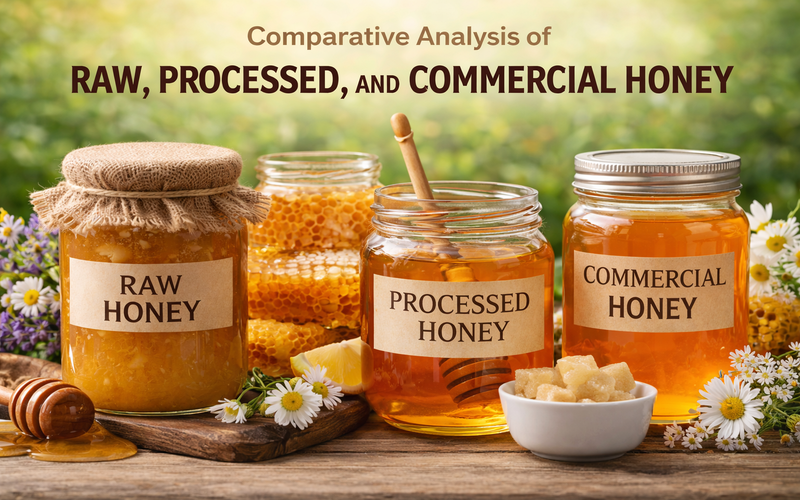
Honey has been valued for centuries as both a natural sweetener and a therapeutic food. However, not all honey available in the market is the same. Differences in processing methods significantly influence honey’s nutritional value, bioactive compounds, safety, and overall quality. This article presents a comparative analysis of raw, processed, and commercial honey varieties, highlighting their chemical composition, health benefits, and practical applications.
Understanding Honey Processing Levels
Honey classification is primarily based on the degree of filtration, heating, and industrial handling it undergoes before reaching consumers.
Raw Honey
Raw honey is extracted directly from honeycombs and minimally strained to remove large impurities such as wax and dead bees. It is not pasteurised or extensively filtered, preserving its natural components.
Processed Honey
Processed honey undergoes controlled heating and fine filtration to improve clarity, shelf life, and texture. While safer and visually appealing, some heat-sensitive compounds may be reduced.
Commercial Honey
Commercial honey is typically ultra-filtered and pasteurised, often blended from multiple sources to achieve consistent colour, taste, and viscosity. In some cases, it may contain additives or undergo adulteration with sugar syrups.
Comparative Chemical Composition
Enzymes and Bioactive Compounds
Raw Honey retains enzymes such as diastase, invertase, and glucose oxidase, which contribute to antimicrobial activity and digestion.
Processed Honey shows partial enzyme degradation due to heat exposure.
Commercial Honey often contains negligible enzyme activity, limiting its functional benefits.
Antioxidants and Polyphenols
Raw honey contains higher concentrations of phenolic compounds and flavonoids, which act as antioxidants. Studies consistently show that excessive heating reduces antioxidant capacity, making raw honey nutritionally superior.
Vitamins and Minerals
While honey is not a major vitamin source, raw honey contains trace levels of vitamins B-complex, vitamin C, potassium, calcium, and magnesium. Processing and commercial refinement further diminish these micronutrients.
Nutritional and Health Implications
Antimicrobial Properties
Raw honey exhibits strong antibacterial activity due to:
Hydrogen peroxide production
Low pH
High osmotic pressure
Presence of phytochemicals
Commercial honey often lacks these properties because of heat inactivation and filtration.
Digestive and Immune Support
Raw honey may act as a prebiotic, supporting beneficial gut bacteria. Processed and commercial varieties provide energy but limited digestive or immune benefits.
Glycaemic Impact
All honey varieties contain natural sugars, primarily fructose and glucose. However, raw honey’s complex composition may result in a slightly lower glycaemic response compared to refined commercial honey blends.
Safety, Shelf Life, and Quality Control
Microbial Safety
Raw honey may contain natural spores, including Clostridium botulinum, making it unsuitable for infants under one year.
Processed and commercial honey undergo pasteurisation, reducing microbial risks and extending shelf life.
Crystallisation
Raw honey crystallises faster due to pollen and natural glucose structures.
Commercial honey is often treated to delay crystallisation, which affects natural texture and quality indicators.
Adulteration Risks in Commercial Honey
Commercial honey is more vulnerable to adulteration with high fructose corn syrup, rice syrup, or inverted sugar. Advanced testing methods such as stable isotope ratio analysis and NMR spectroscopy are required to detect such adulteration, as visual inspection is insufficient.
Environmental and Ethical Considerations
Raw and minimally processed honey often comes from small scale or ethical beekeeping practices, supporting biodiversity and sustainable pollination. Large scale commercial production may prioritise volume over ecological balance, impacting bee health and habitat quality.
Comparative Summary Table
Conclusion
The comparative analysis clearly indicates that raw honey offers the highest nutritional and therapeutic value, followed by processed honey, while commercial honey primarily serves as a sweetener with limited functional benefits. Consumers seeking health advantages should prioritise authentic, minimally processed honey, while industry stakeholders must emphasise transparency, quality testing, and ethical sourcing.
As scientific awareness grows, distinguishing between honey varieties becomes essential not only for consumer health but also for protecting the integrity of the global honey industry.


