- Tokyo: 06:35
- Singapore: 05:35
- Dubai: 01:35
- London: 22:35
- New York: 17:35
Influence of Floral Sources on Honey Color, Aroma, and Nutritional Profile
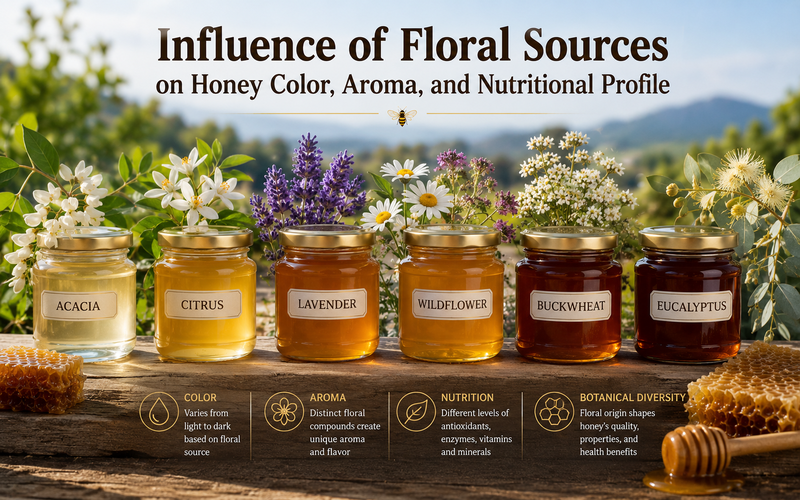
Honey is far more chemically diverse than its familiar golden appearance suggests. Although honey is primarily composed of sugars and water, its smaller fraction of organic acids, minerals, enzymes, amino acids, phenolic compounds, pigments, and volatile substances gives each honey its distinctive color, aroma, flavor, and functional characteristics.
One of the strongest determinants of this variation is the floral source from which honeybees collect nectar. Honeys derived predominantly from different plants can differ substantially in physicochemical properties, volatile compounds, phenolic profiles, mineral composition, and antioxidant activity. Recent research continues to demonstrate that botanical origin can be an important factor in distinguishing honey varieties and understanding their nutritional and sensory characteristics.
This research examines how floral sources influence three important dimensions of honey quality: color, aroma, and nutritional profile.
What Is Floral Origin in Honey?
Floral origin refers to the plant or group of plants from which bees obtain the nectar used to produce honey.
Honey can broadly be categorized as:
Monofloral honey: Produced predominantly from nectar associated with one botanical source.
Multifloral honey: Produced from nectar collected from multiple plant species.
Honeydew honey: Produced primarily from honeydew rather than floral nectar.
The botanical origin does not act alone. Geography, climate, soil conditions, bee foraging behavior, harvesting practices, processing, and storage can also modify honey's final composition. Consequently, even honeys associated with the same plant species may not be chemically identical.
How Floral Sources Influence Honey Color
Honey can range from almost colorless and pale yellow to amber, dark brown, or reddish tones. Botanical origin is an important contributor to this variation, although processing, temperature, storage time, and other environmental factors can also influence color.
Pigments and Phenolic Compounds
Plant-derived compounds entering honey through nectar can influence its optical characteristics. Phenolic acids, flavonoids, carotenoid-related compounds, and other pigments contribute to differences in color among honey varieties.
Research has found an association between honey color and its phenolic composition. In many datasets, darker honeys tend to show greater concentrations of phenolic compounds and stronger antioxidant activity, although this relationship is not universal enough for color alone to determine nutritional quality.
Why Honey Color Matters
Color is important for both consumers and the honey industry because it can influence:
Consumer perception
Sensory expectations
Product classification
Floral-origin characterization
Market positioning
However, color should not be interpreted as a definitive indicator of purity or health value. A darker honey is not automatically "better" than a lighter honey.
Floral Sources and Honey Aroma
Aroma is one of the most distinctive characteristics separating honey varieties.
The aromatic profile of honey is generated by a complex mixture of volatile organic compounds (VOCs) that may originate from plants, nectar, bee metabolism, and chemical transformations occurring during processing and storage.
These compounds can produce sensory impressions described as:
Floral
Fruity
Citrus-like
Herbal
Woody
Spicy
Caramel-like
Nutty
Floral-Specific Volatile Fingerprints
Certain volatile compounds can serve as chemical markers associated with particular botanical sources. Research has shown that volatile profiles can help differentiate monofloral honeys and contribute to the authentication of botanical origin.
For example, honeys associated with citrus, lavender, eucalyptus, thyme, buckwheat, acacia, and other floral sources can develop distinctive aromatic profiles.
However, the relationship is complex. The same floral source can produce different volatile profiles depending on geographical location, climate, season, processing, and storage conditions. Therefore, researchers generally use multiple chemical and sensory indicators rather than relying on one aroma compound.
Influence on Nutritional and Functional Composition
The nutritional profile of honey extends beyond its carbohydrates. Although sugars account for most of its composition, minor constituents can have important nutritional and functional significance.
Floral origin can influence several of these components.
Phenolic Compounds
Phenolic acids and flavonoids are among the most extensively studied bioactive compounds in honey.
They are associated with:
Antioxidant activity
Sensory characteristics
Botanical-origin identification
Potential biological activity
A comprehensive survey of monofloral honeys found that phenolic compounds vary substantially among botanical sources, with many plant-derived phenolics serving as potential floral markers.
Flavonoid concentration can vary considerably between honey types. Research comparing different unifloral and multifloral honeys has reported substantial differences in total phenolic and flavonoid content, with relationships observed between these compounds and antioxidant activity. This means that the plant source can contribute to differences in the antioxidant profile of honey. Nevertheless, antioxidant measurements should not be interpreted as direct evidence that one honey variety will produce a particular health outcome in humans. Laboratory antioxidant capacity is only one component of nutritional and biological assessment. Honey contains numerous mineral elements in trace quantities, and their concentrations can be influenced by botanical and geographical conditions. Mineral composition may reflect: Soil mineral availability Plant uptake Environmental conditions Botanical source Geographic origin Recent reviews identify mineral composition, electrical conductivity, phenolic compounds, pollen, sugars, and other chemical characteristics as useful parameters for differentiating honey origins. This also illustrates why botanical origin and geographic origin are closely connected in honey research. Organic acids contribute to honey's acidity and sensory character. Their concentrations can vary according to botanical origin and other production factors. Acidity can influence: Taste Flavor balance Microbial stability Sensory perception Research reviews indicate that organic acid composition is substantially influenced by botanical origin, adding another layer of differentiation between honey varieties. Different floral sources can produce noticeably different honey characteristics. The following comparison is a general characterization rather than a universal rule, because geography, climate, harvest conditions, and processing can alter the final product.Flavonoids and Antioxidant Activity
Minerals and Botanical Origin
Organic Acids and Taste
Comparative Influence of Selected Floral Sources


