- Tokyo: 02:47
- Singapore: 01:47
- Dubai: 21:47
- London: 18:47
- New York: 13:47
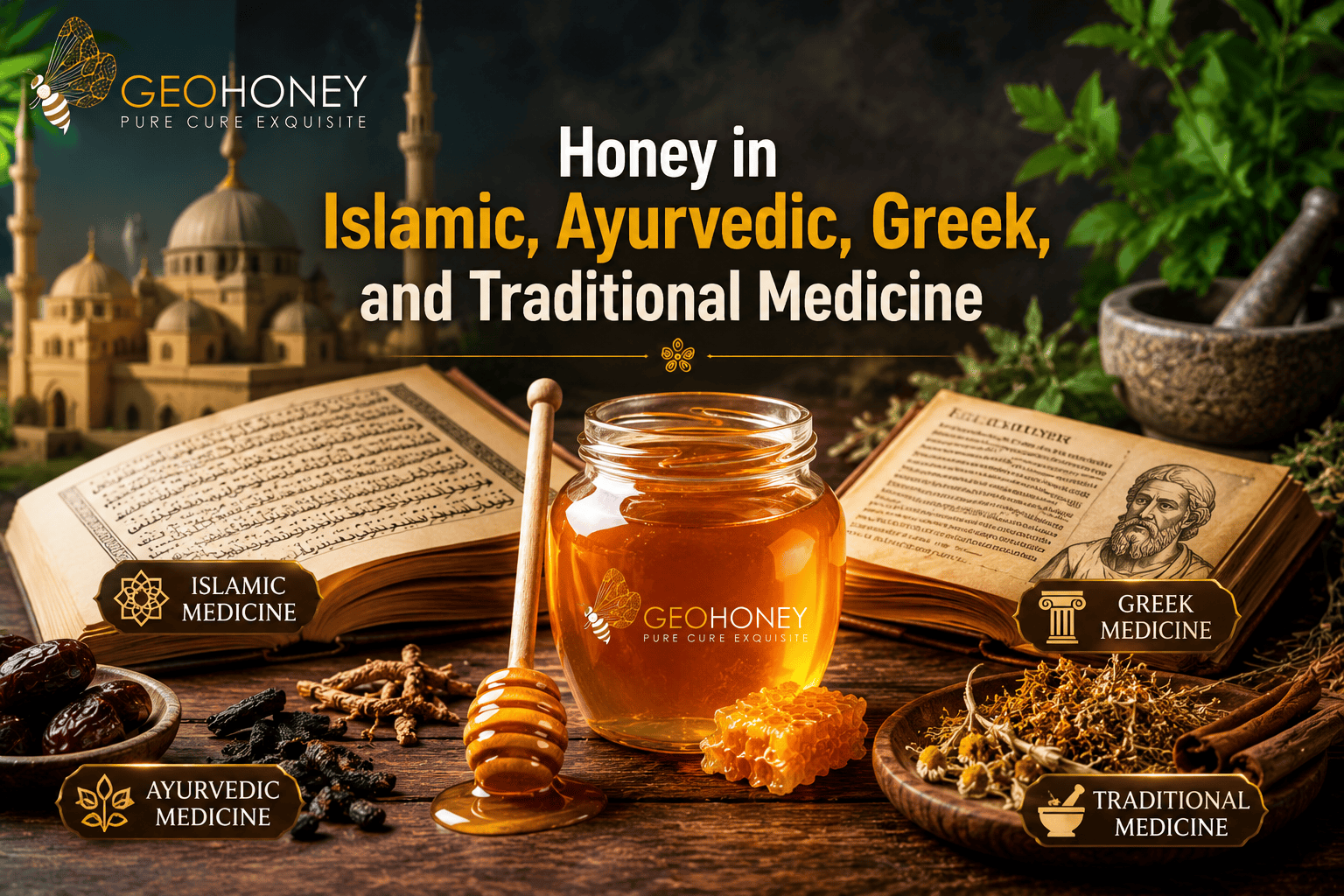


Honey in Islamic, Ayurvedic, Greek, and Traditional Medicine
- Reading Time: 2 minutes, 43 seconds
- Post Views: 1327
Honey has occupied a distinctive place in the history of medicine. Long before modern laboratories identified its sugars, enzymes, organic acids, polyphenols, and antimicrobial properties, different civilizations used honey as a food, preservative, topical preparation, and ingredient in medicinal formulations.
Historical records indicate that honey was used medicinally in ancient Egypt, Greece, India, China, the Islamic world, and other traditional medical systems. Its applications varied considerably between cultures, reflecting their different theories of health and disease. Some uses have subsequently attracted scientific investigation, particularly honey's antimicrobial activity and its role in wound care. However, historical use should not automatically be interpreted as proof that every traditional application is clinically effective.
Honey in Islamic Tradition
Honey has a particularly prominent position in Islamic tradition. The Qur'an refers to bees and the substance produced by them in Surah An-Nahl (16:68–69). The passage describes bees making their homes and producing a drink of different colors in which there is "healing for people."
This religious reference contributed to honey's longstanding cultural and medicinal importance in Muslim societies. Classical Islamic medical traditions subsequently incorporated honey into various preparations.
Historical medical literature also records the use of honey for digestive complaints and other conditions. A review of traditional and modern uses reports that the Prophet Muhammad is traditionally described as recommending honey in the management of diarrhea.
Honey also became an important ingredient in the broader development of Islamic and Unani medicine. Medieval physicians incorporated honey into compound preparations, sometimes combining it with vinegar, herbs, spices, or other medicinal substances.
Honey and Avicenna
The Persian physician and philosopher Ibn Sina (Avicenna) discussed honey and other bee products in the medical tradition that developed during the Islamic Golden Age. Historical accounts describe honey being incorporated into medicinal preparations for several conditions.
One particularly important preparation was oxymel, a mixture traditionally based on honey and vinegar. Its use can be traced back to Greek medicine, and it subsequently appeared in Persian and Arabic medical traditions.
Honey in Ayurveda
Honey, known as Madhu in Sanskrit, has been an important substance in Ayurvedic literature for centuries. Ayurvedic texts describe honey not simply as a sweetener but as an ingredient with specific traditional properties and applications.
Historical Ayurvedic literature identifies several varieties of honey and distinguishes them according to characteristics such as source, appearance, and traditionally attributed effects. The Sushruta Samhita, for example, describes eight categories of honey.
Honey was traditionally used:
As a food and sweetening substance
As an ingredient in herbal preparations
As Anupana, a vehicle taken with medicinal substances
In traditional wound management
For cough and throat complaints
In certain digestive preparations
In traditional approaches to skin conditions
A review of Ayurvedic literature describes honey as being used for wounds, burns, cough, digestive complaints, and certain eye and skin conditions.
Honey in Ayurvedic Wound Care
The role of honey in wound management is particularly well documented in Ayurvedic literature. The Sushruta Samhita describes Madhu among the measures used in the management of wounds.
Traditional Ayurvedic terminology attributes properties such as cleansing and wound-healing activity to honey. Modern research has investigated some of the biological mechanisms that could help explain these historical observations.
Honey's acidity, high sugar concentration, low water activity, and, depending on the honey, hydrogen-peroxide-producing activity can inhibit microbial growth. These properties are now studied independently of the traditional Ayurvedic framework.
It is important, however, to distinguish traditional Ayurvedic theory from modern clinical evidence. A historical description of honey's properties does not establish that every Ayurvedic indication has been clinically proven.
Honey in Ancient Greek Medicine
Honey was also deeply integrated into ancient Greek medicine.
Hippocrates and Honey
The Greek physician Hippocrates, traditionally dated to approximately 460–370 BCE, used honey in several preparations. Historical medical sources describe:
Hydromel - honey combined with water
Oxymel - honey combined with vinegar
Honey-containing preparations for wounds and other complaints
Hippocratic medicine used honey both independently and as an ingredient in compound preparations.
Honey was also valued as a food capable of providing energy. Historical accounts describe Greek athletes consuming honey and honey-water preparations, reflecting the ancient recognition of honey as a concentrated source of carbohydrates.
Dioscorides and De Materia Medica
The Greek physician and pharmacologist Dioscorides, who lived during the first century CE, documented honey in De Materia Medica, one of the most influential pharmacological works of antiquity.
Honey appears in historical descriptions of treatments for ulcers, burns, throat complaints, and other conditions. Importantly, Dioscorides frequently used honey as a vehicle or carrier for other medicinal substances, rather than treating it as a standalone drug for every condition.
Honey and Oxymel
Oxymel became one of the best-known honey-based preparations associated with ancient medicine. The combination of honey and vinegar was used as a medicinal formulation and later influenced medical traditions beyond the Greek world.
Historical research shows that honey-based preparations such as oxymel and hydromel moved across cultures and continued to appear in medical literature during the medieval period.
Honey in Other Traditional Medical Systems
The importance of honey was not limited to the three traditions above. Historical evidence shows its use across numerous cultures.
Ancient Egyptian Medicine
Egypt provides some of the earliest written evidence for medicinal honey. The Edwin Smith Papyrus, generally dated to around 2600–2200 BCE, contains wound-treatment instructions involving honey and other substances. Another Egyptian medical papyrus from around 1325 BCE describes a honey-containing dressing for burns.
The Ebers Papyrus, dated to approximately 1550 BCE, also contains numerous medicinal preparations involving honey and other ingredients.
Chinese Traditional Medicine
Honey also became part of traditional Chinese medical practice. Historical reviews describe its use in wound care and digestive conditions, demonstrating that medicinal honey traditions developed independently across several ancient cultures.
Roman Medicine
Roman physicians inherited and developed many Greek medical practices. Honey was used as a sweetener, preservative, and ingredient in medicinal preparations. Authors such as Galen and Pliny the Elder wrote about honey and other bee products.
Why Did Ancient Physicians Value Honey?
Although ancient medical systems did not possess modern microbiology or biochemistry, several properties of honey would have been observable in practice.
1. Honey Resists Spoilage
Honey's low water activity and high sugar concentration make it difficult for many microorganisms to grow. This unusual stability would have been apparent to people who stored honey for long periods.
2. Honey Can Inhibit Microbial Growth
Modern research has identified several mechanisms behind honey's antimicrobial activity, including osmotic effects, acidity, hydrogen peroxide in some honeys, and plant-derived compounds.
3. Honey Forms a Protective Layer
Its thick consistency allows honey to form a physical barrier when used topically. Modern wound research has investigated its ability to support a moist wound environment and assist with antimicrobial protection.
4. Honey Provides Energy
Honey is rich in readily available carbohydrates, making it a concentrated energy source. This helps explain its longstanding use as both food and medicinal nourishment.
Traditional Knowledge and Modern Science
Modern research has investigated several properties historically associated with honey.
Laboratory and clinical research indicates that honey can possess:
Antimicrobial activity
Anti-inflammatory effects
Antioxidant activity
Osmotic effects
Wound-supporting properties
Research reviews have identified hydrogen peroxide, acidity, osmotic pressure, phenolic compounds, and other honey constituents as contributors to its biological activity.
However, not every traditional use has the same level of scientific evidence. Honey's composition varies according to floral source, geography, processing, maturity, and storage. Consequently, findings from one type of honey cannot necessarily be generalized to every honey.
From Traditional Remedy to Medical-Grade Honey
The modern medical use of honey represents an important transition from traditional practice to standardized healthcare.
Medical-grade honey is specially processed and controlled for clinical use. It differs from ordinary culinary honey because medical products undergo appropriate quality and safety controls.
Modern wound-care research suggests that certain medical-grade honeys can support the management of particular wounds, although outcomes vary according to wound type, treatment protocol, and the honey preparation used. Researchers continue to investigate optimal formulations and delivery systems.
Traditional Claims vs Scientific Evidence
It is useful to distinguish three different concepts:
This distinction allows traditional knowledge to be respected without presenting historical claims as established medical facts.
Safety and Modern Medical Use
Honey intended for food consumption should not automatically be substituted for medical-grade honey in wound care. Raw or culinary honey may contain microorganisms or contaminants and has not necessarily undergone the processing required for clinical application.
Honey should also not be given to infants younger than 12 months because of the risk of infant botulism.
For serious wounds, burns, infections, diabetic ulcers, or other medical conditions, professional healthcare advice is appropriate.
The Continuing Legacy of Honey
The history of honey in medicine demonstrates an unusual continuity between ancient knowledge and modern scientific investigation. Egyptian physicians used honey thousands of years ago; Greek physicians incorporated it into preparations such as hydromel and oxymel; Ayurvedic texts described Madhu in dietary and medicinal contexts; and Islamic tradition gave honey a distinctive religious and medical significance.
Modern science has identified several biochemical properties that help explain some, but not all, of these historical applications.
Honey therefore occupies a unique position at the intersection of food, culture, traditional medicine, pharmacology, and modern healthcare.
Conclusion
From ancient Egyptian wound preparations to Ayurvedic Madhu, Greek hydromel and oxymel, and the prominent place of honey in Islamic tradition, honey has been used medicinally across cultures for thousands of years. Its historical importance reflects both its accessibility as a natural food and its unusual physical and biological properties.
Today, scientific research is helping distinguish traditional observations that have plausible biological foundations from claims that still require stronger evidence. The result is not a rejection of traditional knowledge, but a more precise understanding of where honey's historical reputation aligns with modern science and where further research is needed.
