- Tokyo: 02:42
- Singapore: 01:42
- Dubai: 21:42
- London: 18:42
- New York: 13:42
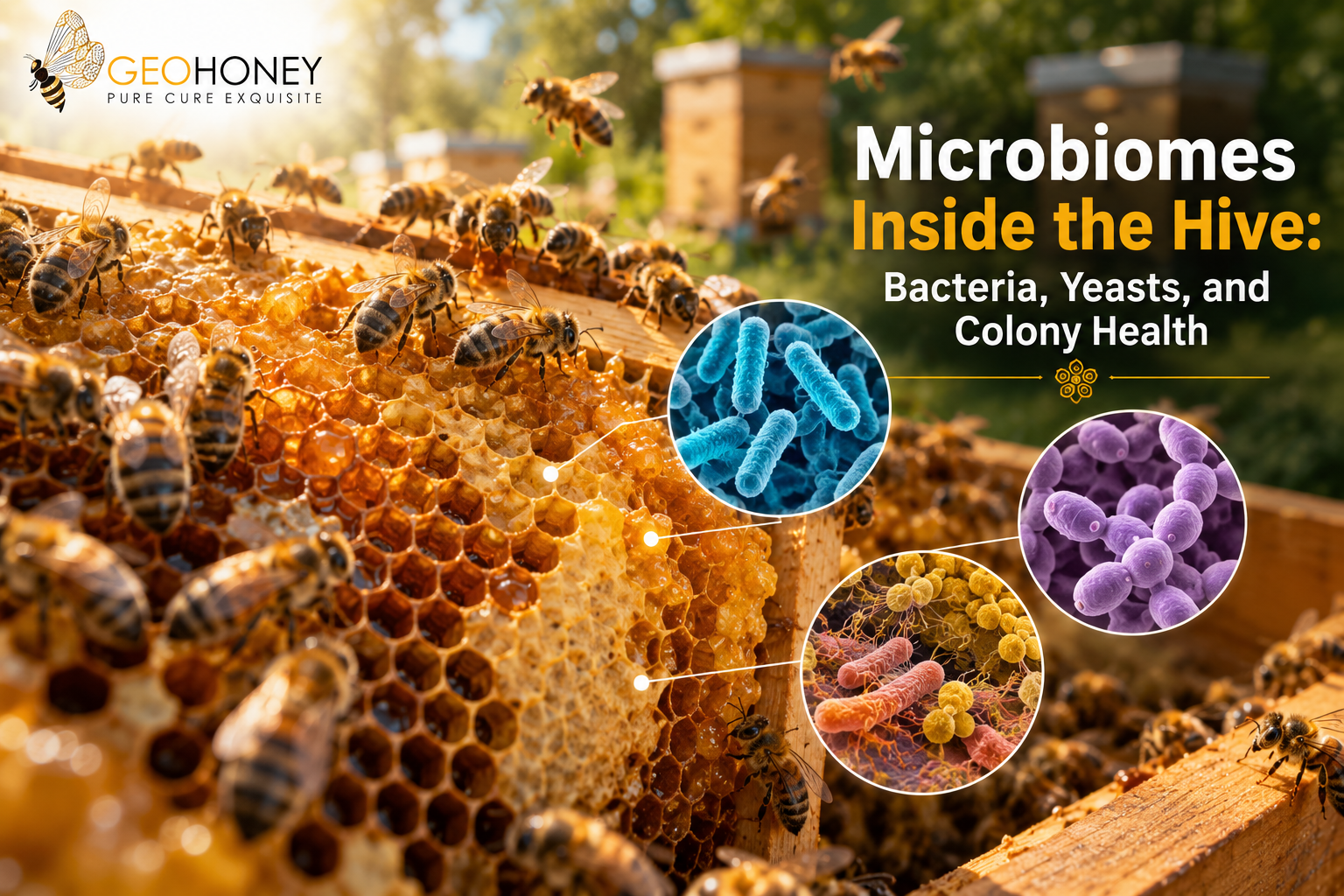


Microbiomes Inside the Hive: Bacteria, Yeasts, and Colony Health
- Reading Time: 2 minutes, 43 seconds
- Post Views: 1327
A honey bee colony is more than a collection of insects living together. It is a highly organized biological community in which bees interact continuously with microorganisms in their bodies, food, nest materials, and surrounding environment. Among the most important of these microorganisms are bacteria and yeasts. Some live within the digestive tract of honey bees, while others occur in nectar, pollen, honey, royal jelly, wax, and stored food. Together, these microbial communities influence nutrition, digestion, immune defence, food preservation, and the ability of a colony to resist disease. Modern microbiome research has shown that the adult worker bee has a relatively specialized gut microbiota, with several bacterial lineages consistently associated with healthy Apis mellifera. These microorganisms are not simply passengers; they occupy specific locations in the gut and interact with the bee and with one another. The term microbiome broadly refers to microorganisms and their genetic material associated with a particular environment or host. In a honey bee colony, this includes microbial communities associated with: The bee gut Nectar and honey Stored pollen and bee bread Royal jelly Mouthparts and other hive-associated surfaces Wax and other nest materials It is important to distinguish the honey bee gut microbiome from the broader hive microbiome. The gut contains a relatively stable community of host-adapted bacteria, whereas microbial populations in stored food and other hive compartments are more strongly influenced by environmental conditions and incoming plant material. The adult worker honey bee has an unusually specialized gut microbial community. Research has identified five major bacterial lineages that form the core community in healthy worker bees: Bifidobacterium, Bombilactobacillus, Gilliamella, Lactobacillus, and Snodgrassella. Other bacteria, including Frischella, Bartonella, and Commensalibacter, may also occur but are generally considered less consistently present. The terminology has changed as researchers have refined bacterial classification. For example, some groups historically referred to as Lactobacillus Firm-4 are now classified within Bombilactobacillus. A mature worker bee's gut can contain approximately 10⁸–10⁹ bacterial cells, although the composition and abundance vary with factors such as bee age, season, geography, and environmental conditions. Honey bees do not emerge from the pupa with the full adult gut microbiome already established. Young workers acquire many of their characteristic gut bacteria through social interactions with older bees and contact with the colony environment. Transmission can occur through: Food sharing Social contact Contact with hive surfaces Exposure to material containing microorganisms from established workers This social transmission is a distinctive feature of honey bee biology. The colony effectively helps transfer microbial partners from one generation of workers to another. The adult worker microbiome becomes established rapidly, largely within the first several days after emergence and before young workers begin normal foraging activity. The honey bee gut is not microbiologically uniform. Different bacteria prefer different locations. Snodgrassella alvi is strongly associated with the ileum, where it forms a biofilm along the gut lining. Its metabolism can consume oxygen and help create a lower-oxygen environment suitable for other members of the community. Gilliamella species also inhabit the ileum and possess metabolic capabilities that help process carbohydrates and components of pollen. Research has shown that some strains can degrade substances such as pectin and metabolize a range of sugars. These groups are particularly associated with the rectal region and are involved in fermentation and carbohydrate metabolism. Their production of organic acids contributes to the chemical environment of the gut. Frischella perrara, when present, is associated with the pylorus. Its colonization can activate components of the bee's immune system and is associated with the formation of a melanized structure sometimes described as a "scab" in the gut tissue. Honey bees consume diets dominated by nectar or honey and pollen. Pollen contains complex plant materials that bees cannot process entirely on their own. Some gut microorganisms produce enzymes capable of breaking down difficult compounds, including components of the pollen cell wall. Research has identified microbial processing of substances such as pectin, hemicellulose, and various carbohydrate compounds. The microbiome therefore expands the metabolic capabilities of the bee. This relationship can help with: Nutrient processing Carbohydrate metabolism Processing components of pollen Transformation of plant-derived compounds Recycling certain waste products Research also indicates that some gut bacteria can modify or degrade plant secondary metabolites and dietary compounds that could otherwise be difficult for bees to process. One of the most significant areas of honey bee microbiome research concerns disease resistance. The normal gut microbiota can help defend against invading microorganisms through a combination of mechanisms. Beneficial or resident microbes occupy ecological niches within the gut. This can make it harder for invading organisms to establish themselves. Microorganisms can inhibit one another by competing for nutrients or producing metabolites that affect neighbouring organisms. Microbial metabolism influences oxygen availability, acidity, and other conditions within the digestive tract. These changes can make the environment less suitable for some potential pathogens. The result is often described as colonization resistance: an established microbial community can help limit the growth or establishment of undesirable organisms. The microbiome does more than support adult digestion. Research indicates that the presence or absence of gut microorganisms can affect biological pathways associated with: Immunity Metabolism Development Behaviour Experimental studies using microbiota-depleted and colonized bees have demonstrated that altering the gut microbial community can change aspects of bee physiology and social behaviour. This has helped scientists recognize the bee microbiome as part of the organism's wider biological system rather than an isolated digestive phenomenon. Bacteria receive much of the scientific attention, but yeasts and other fungi are also part of the microbial ecology of honey bee colonies. Yeasts can be found in: Stored pollen Honey Nectar Royal jelly Bee-associated environments Many hive-associated yeasts are adapted to conditions that are difficult for ordinary microorganisms, including environments with high concentrations of sugars and relatively low water availability. Studies of stored pollen have found that osmotolerant yeasts can persist longer than many bacterial populations during pollen storage. When bees collect pollen, they pack it into cells and mix it with nectar, honey, and their own secretions. Stored pollen is often referred to as bee bread after undergoing biochemical and microbial changes during storage. The microbial ecology of stored pollen is complex. Lactic acid bacteria and yeasts can be present, while changing acidity and water availability influence microbial growth over time. Microbial activity can contribute to: Acidification Preservation Chemical transformation Changes in the availability of some nutrients and compounds However, scientists caution against describing bee bread simply as pollen that is "predigested" by bacteria. Research has produced evidence that preservation, rather than extensive microbial nutrient conversion, is an important part of what happens during pollen storage. When bees collect pollen, they pack it into cells and mix it with nectar, honey, and their own secretions. Stored pollen is often referred to as bee bread after undergoing biochemical and microbial changes during storage. The microbial ecology of stored pollen is complex. Lactic acid bacteria and yeasts can be present, while changing acidity and water availability influence microbial growth over time. Microbial activity can contribute to: Acidification Preservation Chemical transformation Changes in the availability of some nutrients and compounds However, scientists caution against describing bee bread simply as pollen that is "predigested" by bacteria. Research has produced evidence that preservation, rather than extensive microbial nutrient conversion, is an important part of what happens during pollen storage. Honey itself is challenging for most microorganisms. Its high sugar concentration, relatively low water activity, and acidic environment limit microbial growth. Nevertheless, specialized microorganisms can survive or persist under these conditions. Some yeasts are particularly adapted to high-sugar environments, which is why excess moisture in honey can become important to its stability and fermentation risk. The microbial ecology of honey is therefore closely connected to: Sugar concentration Water availability Acidity Temperature Storage conditions Dysbiosis generally refers to a disruption or imbalance in a normal microbial community. In honey bees, researchers have studied microbiome disturbances associated with: Pesticide exposure Antibiotics Nutritional stress Disease Environmental changes However, microbiome changes are not always straightforward indicators of disease. Microbial composition naturally changes with age, season, geography, diet, and other variables, so researchers must distinguish normal variation from harmful disruption. Growing research suggests that certain pesticides can alter the composition of honey bee gut communities. A review of the available evidence found that pesticide exposure can change the abundance of core microbial groups, with effects influenced by pesticide concentration, duration of exposure, season, and other simultaneous stressors. More recent research continues to investigate these relationships. A 2026 study on pirimicarb, for example, reported selective changes in the honey bee gut microbiome without changing the total bacterial load, with responses differing between spring and winter bees. These findings highlight an important point: environmental chemicals may influence bee health not only through direct effects on the insect but also through interactions with its microbial partners. Antibiotics can be useful tools in veterinary and agricultural settings, but exposure to antimicrobial compounds can also affect beneficial microorganisms. Researchers have raised concerns that repeated or unnecessary antimicrobial exposure may reduce important symbiotic microbes and potentially interfere with normal host–microbe relationships. For beekeeping, this reinforces the importance of using medications and antimicrobial treatments according to appropriate veterinary or regulatory guidance rather than assuming that eliminating microorganisms is always beneficial. Honey bee health is influenced by multiple interacting pressures, including parasites and viruses. The microbiome is increasingly being studied as one component of this larger system. The established gut community can provide protection against some pathogens and parasites, while its disruption may weaken aspects of host defence. Research has also explored microbial approaches to disease management. For example, experimental work has investigated engineered or naturally occurring gut bacteria as potential tools for influencing viral infections and parasite-related threats. These approaches remain research-stage technologies rather than routine replacements for established colony-health practices. The science of the honey bee microbiome continues to evolve. A 2026 research highlight reported new work concerning Frischella perrara and its production of colibactin, a bacterial compound with genotoxic activity. The finding illustrates how a microorganism can have complex effects on its host and demonstrates that scientists are still uncovering important functions within the bee–microbe relationship. Such discoveries also demonstrate why it is too simplistic to classify every microorganism as either universally "good" or "bad." Their effects can depend on species, strain, location, abundance, host condition, and environmental context. Microbiome research does not mean that beekeepers need to manipulate bacteria directly in every colony. Instead, it reinforces several established principles of good colony management. A varied supply of pollen and nectar supports nutritional resilience and may help sustain a robust microbial community. Responsible pesticide management and appropriate treatment decisions can reduce avoidable pressure on bees and their microbiota. Clean equipment, appropriate hive management, and disease monitoring help reduce opportunities for harmful microorganisms to spread. Microbiome health is only one component of colony resilience. Beekeepers should also consider queen health, nutrition, parasites, pathogens, weather, forage availability, and population strength. The growing understanding of beneficial bee-associated bacteria has generated interest in probiotics and microbial supplements. Researchers have investigated whether selected microorganisms could: Support digestion Improve pathogen resistance Restore disrupted microbial communities Increase resilience to environmental stress Some laboratory findings are promising, but evidence from large-scale field conditions remains more limited. The effectiveness of a probiotic can depend on the strain, delivery method, existing colony microbiota, diet, and environmental conditions. Therefore, commercial microbial supplements should not automatically be considered equivalent to naturally established bee microbiota. One of the most fascinating concepts emerging from this research is the idea of the honey bee colony as a superorganism. An individual bee depends on other colony members for food, temperature regulation, social interactions, and microbial transmission. At the same time, microorganisms contribute to the biology of individual bees. This creates several interconnected levels: Flower → Nectar & Pollen → Bee → Gut Microbiome → Colony → Ecosystem Changes at one level can influence another. Scientists are increasingly combining genomics, metabolomics, microbial culture, sequencing, and ecological studies to understand the bee microbiome in greater detail. Important research questions include: Which microbial strains provide the greatest benefits? How does microbiome composition change across seasons? How do pesticides and other contaminants affect microbial metabolism? How does diet influence microbial resilience? Can specific microbes improve disease resistance? How do hive microorganisms interact with emerging pathogens? Can microbiome-based tools be developed safely for practical beekeeping? The field is moving from simply cataloguing microorganisms toward understanding what they actually do. The microorganisms living in and around a honey bee colony form a complex biological network that contributes to nutrition, food preservation, immune defence, metabolism, and colony resilience. The gut microbiome of adult worker bees is particularly specialized, with core bacterial groups occupying distinct regions and performing complementary functions. Yeasts and other microorganisms also participate in the ecology of stored pollen, honey, and other hive resources. At the same time, microbiome research shows that bee health cannot be reduced to the presence or absence of individual microbes. Diet, pesticides, medications, pathogens, parasites, season, and environmental conditions can all influence these microbial communities. The emerging picture is therefore one of partnership, balance, and interaction. Understanding the microscopic life inside the hive may ultimately prove as important to sustainable apiculture as understanding the bees themselves.What Is a Hive Microbiome?
The Honey Bee Gut Microbiome
How Bees Acquire Their Microbiome
Microbes Occupy Different Regions of the Bee Gut
Snodgrassella
Gilliamella
Lactobacillus and Bifidobacterium
Frischella
How Gut Bacteria Help Bees Digest Their Food
Microbiome and Immune Defence
Competition for Space and Resources
Antagonistic Interactions
Changes in the Gut Environment
The Microbiome and Bee Development
Yeasts Inside the Hive
The Microbiology of Bee Bread
The Microbiology of Bee Bread
Honey as a Microbial Environment
What Is Dysbiosis in Honey Bees?
Pesticides and the Bee Microbiome
Antibiotics and Microbial Balance
Microbiome, Parasites, and Disease
Recent Discoveries: Microbes Can Have Unexpected Roles
What Beekeepers Can Learn From Microbiome Science
Provide Diverse Forage
Minimize Unnecessary Chemical Stress
Maintain Hygienic Hive Conditions
Monitor Colony Health Holistically
Can Probiotics Improve Honey Bee Health?
The Hive as a Superorganism
Future Research
Conclusion
