- Tokyo: 12:35
- Singapore: 11:35
- Dubai: 07:35
- London: 03:35
- New York: 22:35
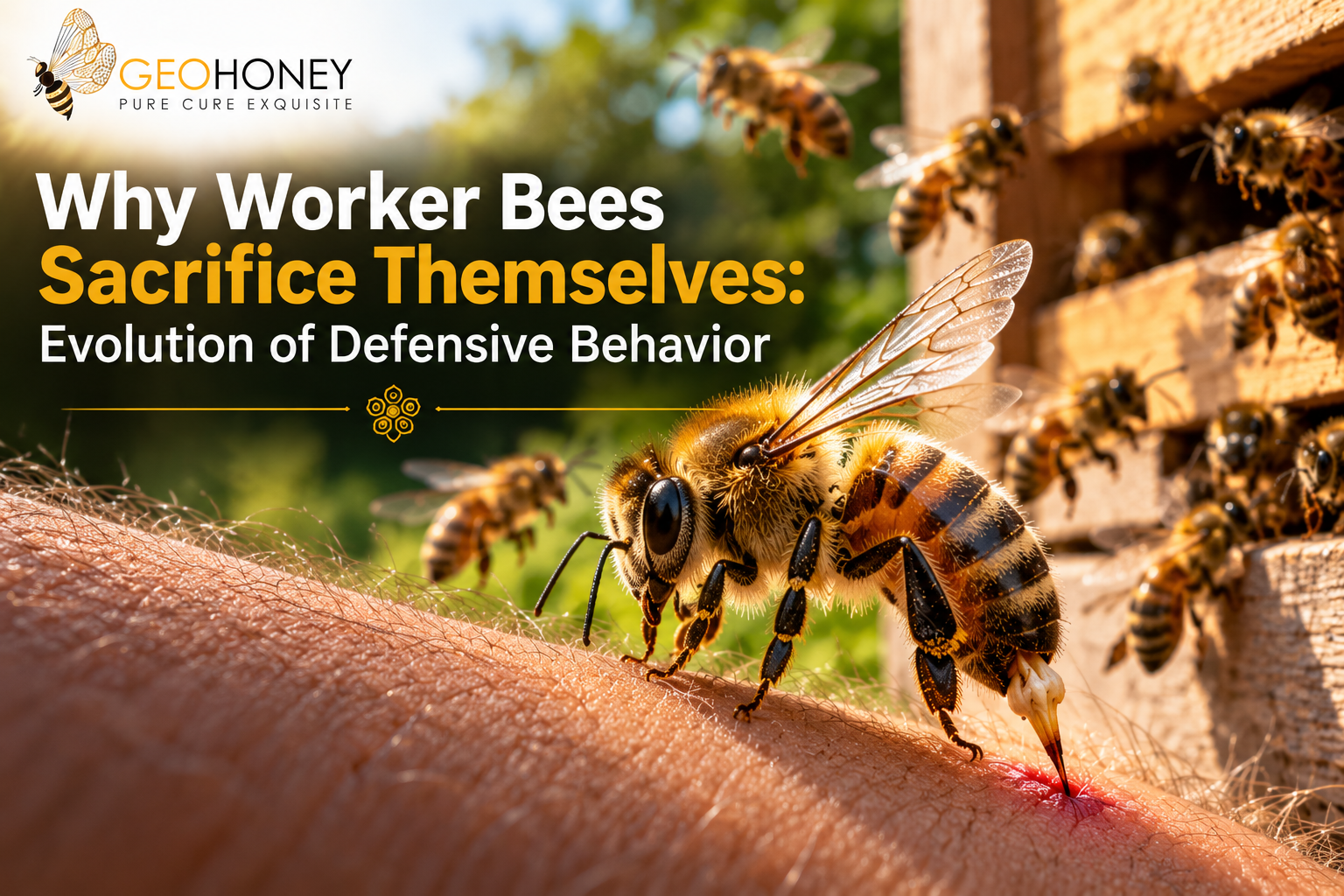


Why Worker Bees Sacrifice Themselves: Evolution of Defensive Behavior
- Reading Time: 2 minutes, 43 seconds
- Post Views: 1327
A honey bee is a tiny insect capable of defending a colony containing thousands of individuals, valuable food reserves, developing larvae, and a reproductive queen. When a serious threat approaches the hive, worker bees may respond by surrounding the intruder, releasing alarm pheromones, and delivering painful stings. In some encounters, a worker pays the ultimate biological cost: its own death.
This behavior is one of the most fascinating examples of self-sacrificial defense in the animal kingdom. It raises an important evolutionary question: why would natural selection favor a behavior that can kill the individual performing it?
The answer lies in the relationship between individual survival and colony survival. Honey bee workers evolved within a highly cooperative social system in which protecting the colony can preserve their relatives, the queen, and the next generation. At the same time, the worker bee's specialized stinger makes its defense particularly effective against certain large predators. Scientific research into sting anatomy, alarm communication, and social evolution helps explain how this remarkable defensive strategy developed.
What Is Self-Sacrificial Behavior in Honey Bees?
Self-sacrificial behavior occurs when an animal performs an action that benefits others but carries a substantial risk of injury or death to itself.
In the western honey bee (Apis mellifera), the best-known example is sting autotomy: the detachment of the worker's sting apparatus from its body after stinging an attacker. When the barbed sting becomes firmly embedded in the elastic skin of a mammal, the worker may be unable to withdraw it normally. As the bee pulls away, parts of its abdominal tissue can tear away with the sting, causing fatal injuries.
The detached apparatus can continue operating for a short time, injecting additional venom and releasing alarm pheromones that help recruit other defensive workers. This allows the sting to remain effective even after the original attacker has separated from the bee.
However, it is important to clarify that honey bees do not consciously plan their deaths in the human sense. Their defensive responses are shaped by biological mechanisms and evolutionary pressures that have made colony protection an important component of worker behavior.
Why Does a Worker Bee Die After Stinging?

The explanation lies in the remarkable anatomy of the worker bee's sting.
1. The Barbed Stinger
A worker honey bee's stinger is derived from structures that evolved from the ovipositor, the organ used for egg laying in ancestral insects. Over evolutionary time, the worker's structure became specialized for defense rather than reproduction.
The sting contains two lancets with rear-facing barbs that help it penetrate and remain anchored in tissue. When it enters a mammal's skin, these barbs can make withdrawal difficult.
2. The Sting Becomes Detached
If the stinger is firmly lodged and the worker flies away, the apparatus may separate from the abdomen. This process, known as sting autotomy, can also remove associated tissues and cause severe injury.
The worker usually dies as a consequence, although death is not necessarily immediate. Research reviews report that some workers can survive for hours after autotomy, with survival depending partly on the extent of tissue damage.
3. The Detached Sting Continues to Deliver Venom
The detached apparatus contains more than a piercing structure. It includes components of the venom-delivery system and neural machinery that enable continued activity for a short period.
Consequently, muscular movements can continue driving the sting deeper and delivering venom after the bee has detached. Alarm pheromones released around the sting site may also attract additional workers to the perceived threat.
This mechanism makes the sting an unusually persistent defensive weapon.
Does Every Worker Bee Die After Stinging?
No. The outcome depends on the circumstances.
A worker is most likely to lose its sting apparatus when stinging a mammal or another vertebrate with elastic skin. Against some smaller invertebrate attackers, the sting may be withdrawn without the same fatal damage. A worker may also escape autotomy if it successfully frees the sting.
The widely repeated statement that every honey bee dies after stinging is therefore inaccurate. The risk of death is especially associated with stinging incidents in which the barbed apparatus becomes firmly lodged in vertebrate tissue.
Why Would Evolution Favor a Behavior That Kills the Worker?
This is the central question in the evolution of bee defense.
Natural selection is often described as favoring individual survival and reproduction. Yet social insects demonstrate that evolutionary success can also depend on how an individual's behavior affects genetically related members of its colony.
Three connected concepts help explain this.
1. Kin Selection
Kin selection is an evolutionary process in which a behavior can spread when it improves the reproductive success of genetic relatives, even if it carries a cost for the individual performing it.
Honey bee colonies contain a queen, worker females, and male drones. Workers generally perform tasks such as nursing, food collection, nest maintenance, and defense. The queen is the colony's principal reproductive female, producing the eggs from which new colony members develop.
Protecting the queen and developing brood can preserve the reproductive future of the colony. A worker that defends its nest may therefore benefit its relatives even when its own survival is jeopardized.
2. Inclusive Fitness
Inclusive fitness expands the idea of evolutionary success beyond an individual's own offspring. It considers both direct reproductive success and the effects an individual's behavior has on the reproductive success of relatives.
A worker honey bee usually has far fewer reproductive opportunities than the queen. By helping the colony survive, it can contribute indirectly to the propagation of shared genes through relatives.
This does not mean that every sting necessarily produces an evolutionary benefit. Instead, the explanation concerns how defensive behavior can be favored over many generations when its benefits to relatives and colony survival outweigh its costs under relevant conditions.
3. Colony-Level Survival
A large predator can damage far more than a single bee. It may destroy comb, consume honey stores, kill developing brood, and threaten the queen.
An effective defensive response can help prevent these losses. In evolutionary terms, the ability to repel an attacker may be valuable enough to offset the death of individual defenders.
The key principle is that a worker's death can be an individual cost while its defensive action contributes to the long-term survival of the colony.
How Worker Bees Coordinate Their Defense
The defense of a honey bee colony does not depend on a single worker acting alone. It is an organized response involving specialized roles and chemical communication.
Guard Bees Identify Potential Threats
Some workers serve as guards near the hive entrance. They inspect approaching insects and animals and help distinguish nestmates from potential intruders.
Defensive responses can be influenced by visual, tactile, and chemical cues. The threshold for responding also varies with colony conditions and genetic background.
Alarm Pheromones Recruit Other Workers
When a worker stings an intruder, chemicals associated with its sting apparatus can help signal danger.
Other bees may then become more alert, approach the threat, and join the defensive response. The result is a form of collective defense in which the actions of one bee can mobilize many others.
Repeated Stinging Increases the Cost to the Attacker
A large intruder may initially be capable of tolerating the presence of one small bee. Multiple stings, however, can produce much greater pain and may encourage the attacker to retreat.
The effectiveness of this response comes not from the size of any single worker but from the combination of venom delivery, alarm signaling, and coordinated recruitment.
Why Is the Worker Bee's Sting So Effective?
The worker bee's sting is a highly specialized structure.
Its functional features include:
Barbed lancets: Help anchor the sting in tissue.
Venom-delivery components: Transfer venom into the attacker.
Muscular mechanisms: Allow the piercing structures to move.
Autonomous activity: Enables the detached apparatus to continue functioning briefly.
Alarm signaling: Helps recruit additional workers.
Research using high-speed video, microscopy, and three-dimensional imaging has helped scientists understand how these parts work together. The design demonstrates how evolutionary processes can shape a complex defense system capable of deterring animals much larger than the insect itself.
Worker Bees, Queen Bees, and Drones: How Their Roles Differ
The different members of a honey bee colony have distinct biological roles.
These differences reflect the division of labor within a honey bee colony. Worker defense protects the nest, while the queen's main role is reproduction. Male drones are specialized for mating and do not participate in stinging defense.
Do Bees Always Choose to Sacrifice Themselves?
The word sacrifice is useful for describing the outcome, but it can be misleading if it suggests deliberate, human-like reasoning.
Research on honey bee defense indicates that responses depend on the severity of the threat and the circumstances of the encounter. Defensive behavior is not simply an automatic decision to die whenever danger appears. Bees may threaten an intruder, recruit other workers, retreat from a situation, or sting in response to particular cues.
The evolutionary explanation is therefore about the effects of behavior across generations, rather than a conscious understanding by individual bees of how their deaths might benefit their relatives.
Is Self-Sacrifice Unique to Honey Bees?
No. Self-destructive defensive behaviors have evolved in several groups of social insects.
Some ants and termites use defenses that can injure or kill the defending individual. Certain stingless bees may also persist in biting an attacker even when doing so puts them at substantial risk.
These strategies differ in their anatomy and consequences, but they share a common evolutionary context: colony defense can impose costs on individual defenders while helping protect other members of the social group. Research reviews describe a wide range of these behaviors across social insects.
Honey bees are especially familiar examples because their barbed stingers can remain embedded in mammalian skin, making the cost of defense visible and easily observed.
What This Behavior Teaches Us About Evolution
The worker honey bee demonstrates that natural selection does not always favor the longest possible life for every individual.
Instead, biological traits evolve within ecological and social environments. In a highly cooperative colony, the reproductive success of relatives, the survival of brood, and the protection of shared food reserves can all influence which defensive traits are favored.
Several broader principles emerge:
Cooperation can have evolutionary benefits. Behaviors that help relatives survive can contribute to the persistence of shared genes.
Specialized structures can have trade-offs. The worker's barbed sting is effective in particular circumstances but can also cause fatal injury to the bee itself.
Collective defense can amplify individual actions. Alarm pheromones and recruitment allow one worker's response to trigger a larger colony defense.
Evolution does not require foresight. A behavior can become widespread because of its consequences over generations, without individual animals anticipating those consequences.
Conclusion
Worker honey bees sometimes sacrifice their lives while defending their colonies because their defensive anatomy and social behavior have evolved in a system where colony survival is critically important.
The barbed sting can become lodged in a mammal's skin, causing the worker to lose part of its abdomen while leaving behind an apparatus that continues delivering venom and releasing alarm pheromones. Meanwhile, kin selection and inclusive fitness help explain how costly defensive behavior can persist when it protects the queen, brood, and other genetically related colony members.
This is not a simple story of individual death. It is an example of how anatomy, chemical communication, social cooperation, and evolutionary pressures combine to produce a remarkably effective defense strategy.
The worker bee's final act reveals one of nature's most striking biological trade-offs: a defensive trait can carry a severe cost for the individual while helping preserve the future of the colony.
Suggested scientific reference
For further reading, see Functional Anatomy of the Worker Honeybee Stinger (Apis mellifera), published in iScience in 2023. The study uses advanced imaging techniques to examine the sting's anatomy and explain how its structures support piercing, venom delivery, and autonomous activity.
