- Tokyo: 08:56
- Singapore: 07:56
- Dubai: 03:56
- London: 00:56
- New York: 19:56
Buckwheat Honey vs Manuka Honey: Antioxidants, Taste, and Best Use Case
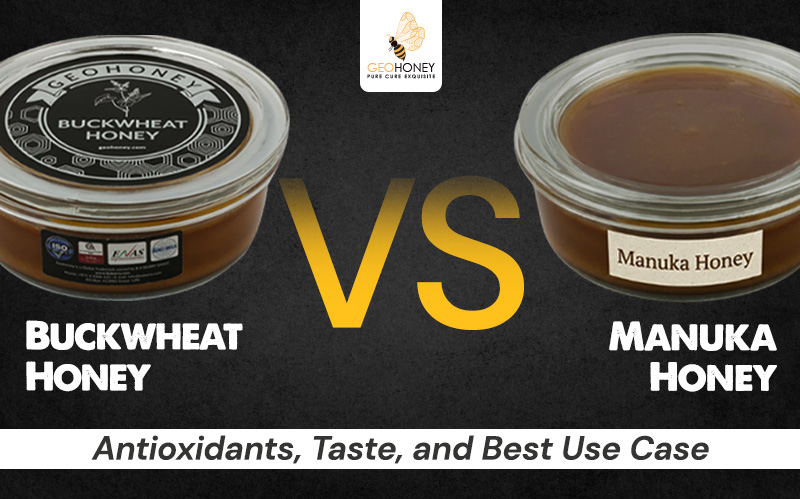
Honey’s worldwide popularity is not just the result of its rich flavor or countless culinary applications. This natural sweetener also contains useful bioactive compounds that offer several health benefits.
Honey comes in so many different variations that depend on the floral origin of the nectar that bees forage. Currently, more than 300 types of honey have been identified by researchers.
Among different honey varieties, Buckwheat Honey and Manuka honey are particularly famous for their unique flavors and health benefits. This blog looks into both of these raw honey varieties in detail, highlighting their key features, uses, and more. So, without any further ado, let’s get started.
What is Buckwheat Honey? What is Manuka Honey? Nutritional Comparison Between Buckwheat and Manuka Honey Manuka Honey vs Buckwheat Honey: Taste and Appearance Antioxidant Features of Buckwheat and Manuka Honey Buckwheat Honey vs Manuka Honey: Best Culinary Use Cases This monofloral organic honey comes from the nectar of buckwheat flowers that belong to the rhubarb and sorrel plant families. Bees make this honey from the nectar, or more precisely, from the honeydew of Buckwheat flowers that are more popular for their grain-like seeds rather than blossoms. This honey comes in a dark brown to black color with a very thick consistency. The flavor of buckwheat honey has malty or molasses-like notes with bitter undertones. Compared with wild plant honey, buckwheat honey has significantly higher concentrations of potassium (K) and copper (Cu). It also possesses higher antioxidant quantifiers. This makes it a much healthier lifestyle choice. This monofloral honey variety comes exclusively from New Zealand. Bees forage the Leptospermum scoparium (manuka) bush to collect nectar for this rare honey. This honey possesses a lighter color along with a subtly sweet flavor. You can find Manuka honey in different quality grades, where each offers different levels of potency, antibacterial strength, or methylglyoxal content. Manuka honey contains MGO levels that range from 38 mg/kg up to 761 mg/kg. These MGO levels are up to 100× higher than other monofloral honey varieties. This honey is characterized by UMF or unique Manuka factor, which gives you a clue about the potency as well as medicinal uses of this honey. Manuka honey with UMF 16 to 20 offers maximum antibacterial effects. Honey with UMF 10 to 15 also offers therapeutic effects. Manuka honey with UMF 5 to 9 possesses lower antibacterial effects. However, it still finds uses in countless culinary applications. Manuka honey comes in dark amber to golden colors. This honey has an Earthy or slightly bitter flavor. It gives out a floral or herbaceous aroma. Before we go any further, let’s take a quick look at the nutritional profiles of these honey varieties. This can help you understand what sets them apart. So, here we go. Both Manuka honey and buckwheat honey taste pretty different. This difference in flavor mainly results from the different floral sources as well as the physical conditions that bees utilize to make these honey varieties. Buckwheat Honey You can describe the flavor of this honey as robust, tangy, or malty with earthy undertones. The flavor of this honey resembles dark chocolate or molasses. This hone possesses a dark brown color; however, you can also find some varieties in the market that are almost black in color. This highly thick or dense honey gives out a bold and intense aroma as well. Manuka Honey You can find Manuka honey in amber to dark amber colors. The flavor of this honey is complex and slightly bitter. Some varieties give out a caramel-like sweetness with mild woody or floral undertones. This honey offers you a mild earthy sweetness with herbal undertones along with a creamy to viscous consistency. The bitter aftertaste of this honey results from its high MGO content. Let’s look at Buckwheat honey and Manuka honey in terms of their antioxidant contents. Buckwheat Honey This honey is an antioxidant powerhouse. This honey contains several components, like phenolic acids, flavonoids, polyphenols, etc., that impart exceptional therapeutic properties to it. Buckwheat honey has much higher flavonoid levels than lighter honeys like acacia or Manuka Honey. This high antioxidant content makes this honey effective for wound healing, gut health, immunity, and overall well-being. Buckwheat honey shows an antibacterial activity against Staphylococcus aureus and Pseudomonas aeruginosa bacteria comparable with Manuka honey, according to comparative biochemical studies. Manuka Honey Manuka honey also possesses sufficient antioxidant concentrations, though not as much as buckwheat honey. Some reports say this honey has at least 10 times more phenolic compounds than generic honey varieties. This honey is particularly rich in Methylglyoxal (MGO), Dihydroxyacetone (DHA), and Leptosperin. These components impart a superior antibacterial activity to this honey. This makes Manuka honey effective for digestive support, wound care, and general topical use. Research shows that food or general consumption accounts for 26–38 % of the organic honey usage. If you are looking for some fun ways to add these two honey varieties to your lifestyle, we have got your covered. Here is how you can do it. Buckwheat Honey You can pair it with strong cheeses like blue cheese or sharp cheddar. It also goes well with whole‑grain bread, dark rye bread, or gingerbread recipes. You can use it as a marinade or a barbecue glaze. Several therapeutic herbal teas and coffee recipes also use this honey. This honey also finds uses in baking recipes that demand a rich or deep flavor. You can also drizzle it over roasted Brussels sprouts or squash to create a balanced flavor. You can also add it to tarts or mousse recipes that use dark chocolate. Manuka Honey This honey pairs well with yogurt and granola. You can also use it in herbal teas. You can use it to make sore throat remedies. One popular one is a ginger and lemon drink with Manuka honey as a sweetener. This honey also goes well with lightly flavored desserts or baked items. You can drizzle this honey over fruits to double the flavor as well as the health benefits. You can also drizzle it over oatmeal or porridge to create a nutritious breakfast. You can glaze roasted fruits like peaches or pears with this honey. Use as a glaze for roasted fruits, like peaches or pears. This honey also finds uses in vinaigrettes that elevate every salad recipe. Buckwheat and Manuka honey are both popular choices among honey enthusiasts all over the world. People who want a stronger flavor with more antioxidant effects often go with Buckwheat honey. On the other hand, Manuka honey is the top choice for people who are looking for a subtle flavor that doesn’t overpower recipes. This honey’s high MGO content also makes it attractive in remedies or antibacterial healthcare products. So, try out both of these honey varieties at least once to figure out the one that aligns with your recipe, flavor, and fitness goals to get the best value for your money. Visit us at Geohoney today to order from our wide range of exclusive monofloral honey varieties that promise an exceptional flavor along with several health benefits. Buckwheat honey shows higher antioxidant activity than Manuka honey, which imparts better healing properties to it. Manuka honey, on the other hand, is rich in MGO, which makes it a better antibacterial agent. Thus, the health benefits of both these honey varieties are somewhat comparable. This honey is an effective natural remedy for sore throat, indigestion, and cholesterol regulation. You can also use it topically on the skin. This honey also finds countless culinary uses in baking or the food and beverages sector. Normal honey has a neutral or sweet flavor. The flavor of buckwheat honey has malty, earthy, or woody notes that resemble dark chocolate or molasses to some extent. No. Manuka honey is an effective prebiotic that contains fructo-oligosaccharides. This combats bad bacteria and nourishes the good bacteria in your body, which reduces the risks of digestive issues. This honey contains high MGO content, which makes it an effective antibiotic or antimicrobial against aeruginosa and E. coli.What is Buckwheat Honey?
What is Manuka Honey?
Nutritional Comparison Between Buckwheat and Manuka Honey
Manuka Honey vs Buckwheat Honey: Taste and Appearance
Antioxidant Features of Buckwheat and Manuka Honey
Buckwheat Honey vs Manuka Honey: Best Culinary Use Cases
Conclusion
FAQs
Is buckwheat honey superior to manuka honey in terms of health benefits?
What are some common uses of buckwheat honey?
How does the buckwheat honey taste in comparison with normal honey?
Does manuka honey feed bad gut bacteria?
Is manuka honey an effective antibiotic?