- Tokyo: 05:18
- Singapore: 04:18
- Dubai: 00:18
- London: 21:18
- New York: 16:18
Can I Use Crystallized Honey — Is It Still Good? (Yes, and Here's the Proof)
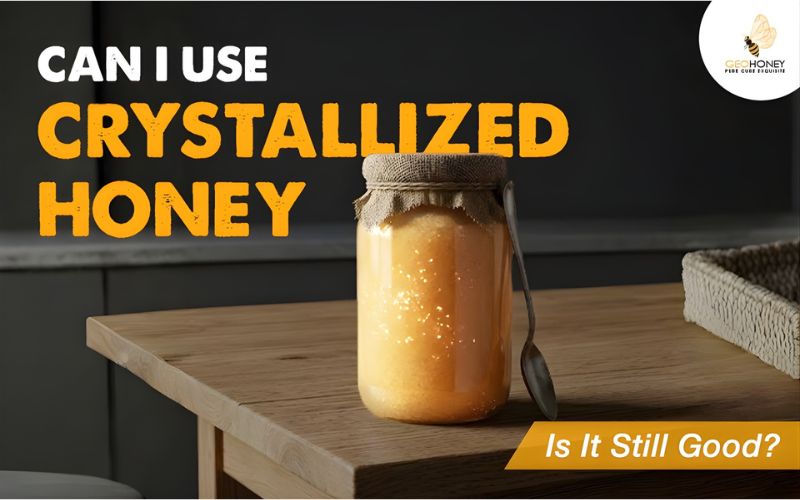
Yes, crystallized honey is absolutely safe to eat. Contrary to what most people believe, crystallized honey is not spoiled. In fact, there is nothing wrong with it at all.
If you have just opened your honey jar and are surprised to see its thick, grainy, or white consistency, it is quite normal to question its quality. But here is what nobody tells you. Crystallized honey that you find in your cupboard or pantry is almost always of higher purity and quality than honey that never crystallizes.
So, if you have been wondering if my crystallized honey is still good, then this blog is all you need. This post explains why honey crystallizes and what it means when it comes to honey’s quality.
You will also find some ways to use organic honey in crystallized form in this blog. And if you like honey in its runny consistency, this blog also gives you some easy ways to liquefy it as well. So, let’s get started.
Is Crystallized Honey Safe?
Why Does Honey Crystallize?
Crystallized Honey: What It Means for Its Quality
Creative Ways to Use Crystallized Honey
Easy Ways to Liquefy Crystallized Honey

Is Crystallized Honey Safe?
Yes, crystallized honey is completely safe for consumption. In fact, honey is one of the rare foods that never goes bad. The credit goes to raw honey’s low moisture content, antibacterial features, and natural acidity, which prevent the growth of harmful microbes.
This ensures it lasts you for decades without any change in its nutritional composition. So, if you have been asking this common question: Can you eat crystallized honey? The answer is pretty simple. You can eat this honey without any worry about its quality or nutritional composition. Crystallization of honey is no more than a mere change in its texture, which you can easily reverse whenever you want.
Contrary to what people believe, crystallization is not an indication of contamination or spoilage in honey. So long as the honey doesn’t smell funny or has visible mold on its surface, it is perfectly edible.
Why Does Honey Crystallize?
If you have just noticed your honey turned white solid and you don’t know what caused it, the explanation is simpler than you think. Crystallization of honey is a natural process that results from its unique composition.
Honey is basically a supersaturated sugar solution that contains about 20% water, 38% fructose, and about 31% glucose. Fructose in honey tends to stay liquid while the glucose tends to crystallize over time.
The excess glucose separates from water in raw honey after a while in the form of small crystals. As time passes, these crystals trigger crystallization in the entire honey and start to grow and spread. This turns the consistency of the honey from smooth to grainy or very thick. So, the next time you wonder why my honey crystallizes, we hope this information proves of some help.
It is also important to note that honey crystallizes much faster at lower temperatures between 10-15 °C or 50-59oF. At temperatures above 25 °C, the crystals start to melt.
Factors That Affect Crystallization of Honey
Now that you know why honey crystallizes, let’s go one step ahead and see some factors that affect the crystallization of honey.
Honey varieties that come with greater glucose concentrations tend to crystallize quickly.
Cooler temperatures can also trigger and accelerate the crystallization of honey.
Particles like pollen, beeswax, or dust act as "nucleation sites," or “seeds” for glucose crystals to form and grow. Pure honey contains these contents, which makes it crystallize faster.
Honey that undergoes heavy heating or filtration tends to crystallize much more slowly as it contains fewer crystallization-triggering components.

Crystallized Honey: What It Means for Its Quality
This might sound counterintuitive, but crystallization of honey is often a sign of higher quality. The honey you find in supermarket aisles never crystallizes. This creates a misconception that this honey is somehow fresher or better. But the opposite is true.
Crystallization is proof that the honey you have just bought is not heavily heated, processed, or ultrafiltered. This honey retains its natural enzymes, pollen, and other nutrients. This honey comes with no adulterations or additives that prevent it from crystallizing.
On the other hand, honey that never crystallizes or stays liquid undergoes heavy processing often at temperatures of more than 160oF. This heavy processing removes beneficial nutrients, antioxidants, enzymes, and pollen from the honey. The result is a honey that is nutritionally less superior than pure, raw honey.
Creative Ways to Use Crystallized Honey
There are many ways you can use crystallized honey in your diet. The next section lists a few uses of this honey in our daily lives.
You can spread this thick and creamy honey on toast, bagels, waffles, or pancakes just like butter.
You can drop a spoonful of crystallized honey in hot beverages like coffee, tea, milk, etc.
Honey in crystallized form also works well in bakery items like cookies, muffins, cakes, etc.
You can mix it with softened butter and add a pinch of cinnamon to it. This gives you honey butter that you can serve with cornbread, toast, pancakes, and biscuits.
This honey also pairs well with oatmeal or yogurt to add sweetness with a subtle crunch to these breakfast items.

Easy Ways to Liquefy Crystallized Honey
There are countless ways to enjoy crystallized honey. But if you still prefer it in liquid or runny form, then don’t worry. Here is how to fix crystallized honey with a few simple methods.
Method 1
Warm some water in a bowl. Then place the honey jar in this bowl for about 10 to 20 minutes. Stir the honey in the bowl until it reaches a uniform liquid consistency. Just make sure to keep the temperature of the warm water below 40°C or 104°F to make sure the nutrients of the honey stay intact.
Method 2
Heat the honey in a microwave for about 10 to 15 seconds. If the honey still remains solid, then repeat the process and keep stirring between the intervals. This process requires special care as high heat can quickly destroy the beneficial enzymes of the honey.
Keep in mind that the crystals of honey dissolve between 95-104oF. If the temperature is between 104-110oF, the beneficial enzymes or nutrients of the honey get destroyed. So, make sure to operate the microwave in this specific range to get the best results.
Conclusion
Unlike what most people think, crystallized honey is not spoiled or inferior in quality. Honey that crystallizes quickly is often more nutritious and pure. The crystallization in honey results from its high glucose content, and it is not in any case an indication of its bad quality.
In fact, honey that never crystallizes often lacks essential nutrients and enzymes that make it less healthy. Crystallized honey finds countless uses in baking, beverages, breakfast items, and more. You can also liquefy this honey by gently heating it in warm water or in a microwave.
So, the next time you notice a change in your raw honey’s consistency, do not throw it out right away. Instead, appreciate its purity as well as the superior nutritional profile that makes it extra special.
Visit us at Geohoney today to order our premium quality raw, monofloral honey sourced from local beekeepers who guarantee exceptional purity, flavor, and consistency in every batch.
FAQs
Does crystallization in honey mean it has expired?
Crystallization does not affect the shelf life of honey. It is merely a change in its consistency. Pure honey doesn’t have any expiry date at all.
2. Can you eat crystallized honey?
Yes, you can eat crystallized honey raw or use it as an ingredient in many baking, cooking, or breakfast recipes.
Which honey varieties crystallize slowly?
Honey varieties that are very high in fructose (like acacia honey) tend to crystallize very slowly. Heavily heated or processed honey types also stay liquid for a long time.
Is it true that crystallized honey is healthier than liquid honey?
Crystallized honey often contains higher nutrient content than processed liquid honey. However, some liquid honey varieties that undergo minimal processing are also equally nutritious.
What is the temperature at which crystals in honey dissolve?
Honey crystals dissolve between 95-104oF. Heating honey at higher temperatures may result in nutrient loss, which is why you need to proceed carefully.