- Tokyo: 07:46
- Singapore: 06:46
- Dubai: 02:46
- London: 23:46
- New York: 18:46
Different Kinds of Bees and What Each One Does
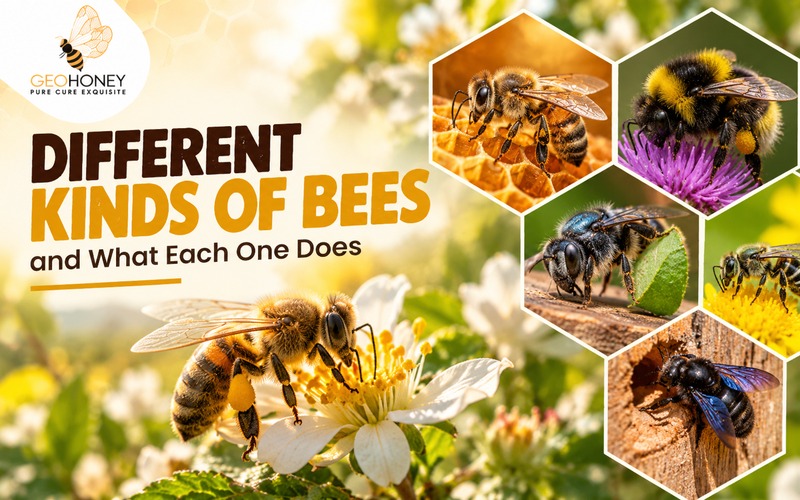
What if the bee story most of us grew up hearing wasn't the whole story? After all, do all bees really spend their days making honey?
Do all bees collect nectar? Does the queen make honey? And what are thousands of other bees doing inside the hive?
The answers are far more interesting than the story many of us grew up hearing.
Key Takeaways
Honey bee colonies contain queens, workers, and drones.
Worker bees are responsible for collecting nectar and producing honey.
Queens focus on laying eggs and maintaining the colony.
Drones exist mainly to mate with new queens.
Worker bees perform different jobs as they age.
A hive succeeds because thousands of bees perform different tasks at the right time.
Not Every Bee You See Is Making Honey
Imagine walking into a bakery.
One person mixes dough. Another operates the oven. Someone else handles deliveries. The person running the business may never touch a loaf of bread.
A honey bee colony works in a surprisingly similar way.
Even though honey is the final product most people associate with bees, only certain members of the colony are directly involved in making it.
The hive is made up of three types of adult bees: queens, workers, and drones. And each has a completely different job description.
The Queen's Job Isn't What Most People Think
When you hear the word "queen," you usually picture the bee as a ruler.
Honey bees don't work that way. Her actual role is much more specific and much more interesting.
The queen's most important responsibility is laying eggs. A healthy queen can lay up to 1,500 eggs in a single day during peak season. That's important because worker bees don't live very long. During busy months, many survive only a few weeks.
The colony constantly needs replacements.
Interestingly, the queen doesn't collect nectar. She doesn't gather pollen. She doesn't build honeycombs. She doesn't even help make honey.
Her contribution is different.
A queen may never visit a flower or make a drop of honey herself. Yet every forager, nurse, guard, and honey maker in the hive exists because she laid the egg that became them.
So, without a queen, the workforce eventually disappears.
The Real Honey Makers Are Worker Bees
If honey production had a department, worker bees would be the entire staff.
These female bees handle almost every task inside and outside the hive. However, even worker bees don't spend their whole lives doing the same thing. A young worker usually starts indoors. She cleans empty cells, feeds developing larvae, and helps care for the queen.
As she gets older, her responsibilities change. She may help build wax comb, process incoming nectar, or regulate temperature inside the hive. Eventually, she graduates to the job most of you recognize: foraging.
These workers leave the hive and visit flowers in search of nectar and pollen. A single foraging bee may visit thousands of flowers in a day.
The nectar she brings home still isn't honey. Other workers receive it, process it, reduce its moisture content, and store it inside honeycomb cells. Only then does it become the honey we recognize.
So when you taste honey, you're really seeing the result of an enormous chain of worker bee labor.
Why Does the Hive Need Drones?
At first glance, drones seem like the easiest members of the colony.
They don't gather nectar. They don't make wax. They don't make honey. They don't even guard the entrance. So why does the colony spend valuable resources raising them?
Because honey bees need future generations too.
Drones are male bees. They have only one role: mating with virgin queens. Their large eyes help them locate queens during mating flights, and unlike worker bees, they cannot sting.
Their contribution doesn't show up inside a jar of honey. It shows up in the survival of future colonies.
How Thousands of Bees Stay Organized
A hive can contain tens of thousands of bees.
You'd expect complete chaos. Yet honey bee colonies are remarkably coordinated. Bees keep on sharing updates. Sometimes they use chemical signals called pheromones. Other times, they literally dance.
When a worker discovers a rich source of nectar, she does a waggle dance at the hive. The dance helps other workers understand where the flowers are located.
Think about that for a moment. A bee finds food, comes home, shares directions, and sends other bees directly to the same location. There are no maps and words. They just move.
What Happens When the Queen Disappears?
Most organizations struggle when they lose an important leader. Honey bee colonies are no different.
That said, they do have a backup plan.
Thankfully, a colony isn't completely helpless when it loses its queen.
Worker bees can take a very young larva and start feeding it large amounts of royal jelly. That single change can completely alter the larva's future, turning it into a potential queen instead of an ordinary worker.
It doesn't always work. But it gives the colony a fighting chance. For a society made up of insects, that's an impressive contingency plan.
Every jar has a bee story behind it. Explore GeoHoney's range of natural honey and find one you'd love to bring home.
FAQs
What is the 3-3-3 rule for bees?
The 3-3-3 rule helps explain bee development. A bee egg hatches in about 3 days. After that, it grows through different stages before becoming an adult bee.
Which type of honey bee is best?
There isn't a "best" honey bee. Queens, workers, and drones all do different jobs. A healthy hive needs all of them.
Are guard bees male or female?
Guard bees are female worker bees. They stand near the hive entrance. They check who comes in and help protect the colony.