- Tokyo: 04:24
- Singapore: 03:24
- Dubai: 23:24
- London: 20:24
- New York: 15:24
Regenerative Agriculture & Bees: A Partnership That Heals the Soil
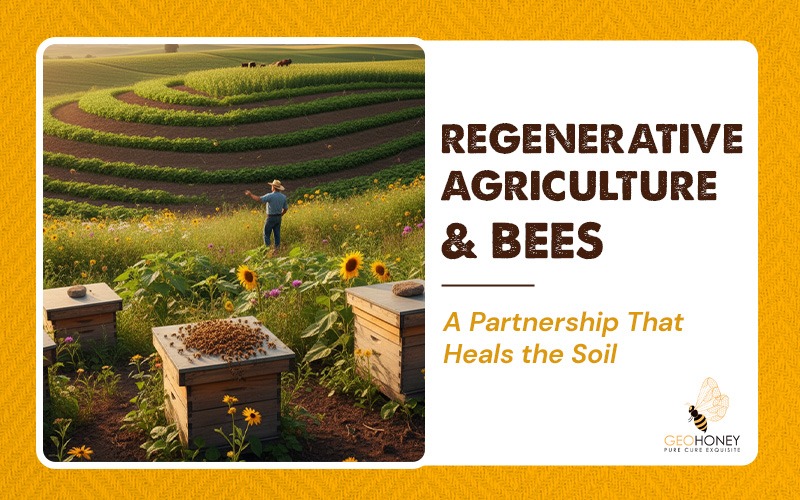
Regenerative agriculture and bees help each other. They heal the soil and protect plants and animals. They also support our food system. This approach treats the soil as living and protects bees and other pollinators. As a result, they help fix damaged land and reduce climate risks.
Today, we try to understand this partnership further and uncover:
What is regenerative agriculture
The role of bees as soil healers
Key Insights
Regenerative agriculture treats soil as a living ecosystem.
Bees are important for soil health. They boost plant diversity and organic matter.
Pollinator-friendly farms are more resilient and productive.
Healthy bee populations signal pesticide-free ecosystems.
This partnership supports carbon sequestration and climate resilience.
Small actions can help scale regenerative, bee-friendly farming.
What Is Regenerative Agriculture?
Regenerative agriculture treats soil as a living organism. Not as an inert growing medium. To increase organic matter and stimulate microbial life, farmers use practices such as:
No-till farming
Cover cropping
Crop rotation
Holistic grazing
Conventional farming often relies on synthetic fertilizers and heavy tillage. Contrary to this, regenerative methods protect soil structure and biological activity.
The benefits are tangible. For example, studies from the Rodale Institute show clear results. Regenerative farms can increase soil organic matter by up to 8% in three years. This helps soil hold more water. It also reduces erosion. Moreover, crops handle droughts and floods better. Healthy soil becomes stronger, needing fewer chemical inputs.
This partnership also addresses climate change. For instance, a 1% increase in soil organic matter can store about 21 tons of carbon per hectare. This helps reduce carbon in the air. Regenerative farms support this process, and bees make it stronger. Together, they help fight climate change.
Bees as Soil Healers
Bees are best known as pollinators. But their role goes much deeper. Bees contribute profoundly to this soil revival.
Honey bees and native pollinators carry pollen while collecting nectar. This helps plants make seeds. It also helps plants grow again. In regenerative farming, many cover crops are used. These include clover, buckwheat, and wildflowers. This supports bee populations throughout the year.
Pollination fuels soil health. Indirectly, but powerfully. How? When pollinated plants grow, die back, and decompose, they add organic matter to the soil and feed microbial communities. A single hive can pollinate millions of flowers daily. As a result, the plant diversity increases and the root systems become stronger. This stabilizes soil and prevents erosion.
FAQs
What is the 3-3-3 rule for bees?
The 3-3-3 rule explains how a bee colony recovers. For the first 3 weeks, new worker bees are born. In the next 3 weeks, they learn to fly and collect food, and in the last 3 weeks, the hive becomes stable. The colony looks stronger and more active.
What is regenerative beekeeping?
Regenerative beekeeping focuses on bee health first. It avoids chemicals and stress. Beekeepers take less honey. They protect flowers and land around hives.
What is the 7/10 rule in beekeeping?
If 7 out of 10 frames are full, the hive needs more room. This stops overcrowding and decreases swarming. The rule keeps bees calm and productive, helping with better beekeeping.
Is bee venom harmful to bees?
Yes, if it is collected badly. But modern methods are safer. Bees release venom without losing their stinger. So, most bees survive. Ethical collection limits stress. Bee health is the priority.