- Tokyo: 20:55
- Singapore: 19:55
- Dubai: 15:55
- London: 12:55
- New York: 07:55
Unfiltered Honey vs. Filtered Honey: What's the Difference?
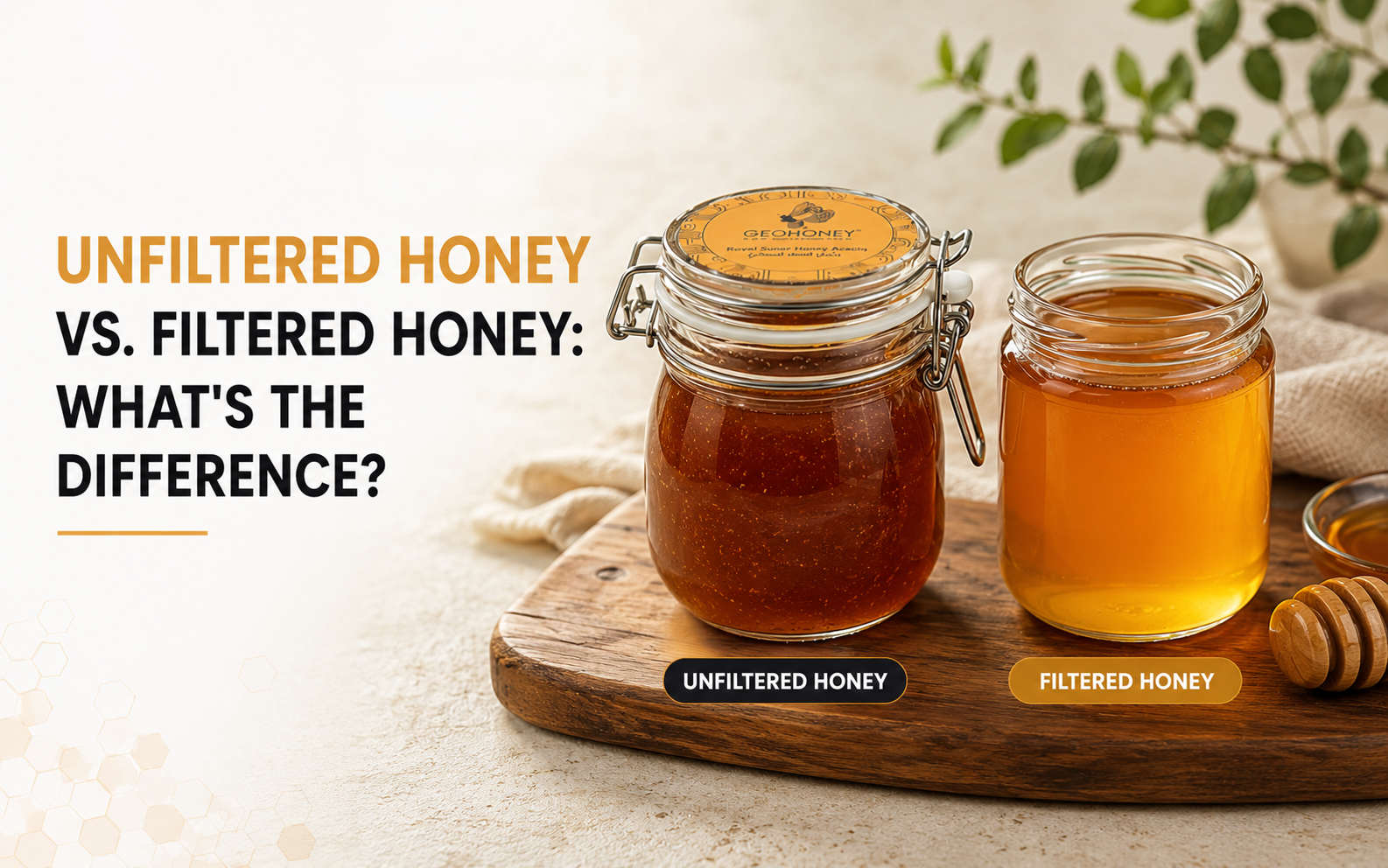
Walk through any supermarket aisle, and you will find honey labelled as "pure," "natural," "organic," and sometimes even "raw." What you will not always see is one of the distinctions that matters most: whether the honey has been filtered or left unfiltered. Most people think the difference is only in the looks. One looks clear, the other looks cloudy. In reality, filtration changes far more than appearance. It affects what remains in the honey, how it tastes, how it behaves over time, and what nutritional value it retains. What Is Unfiltered Honey? What Is Filtered Honey? Key Differences Between Unfiltered and Filtered Honey Unfiltered Honey vs. Filtered Honey: Which One Is More Nutritious? Does Unfiltered and Filtered Honey Taste Different? Unfiltered Honey vs. Filtered Honey: Which Type Should You Buy? Unfiltered honey barely gets touched after it leaves the hive. A basic strainer removes wax chunks and larger debris, and that is about it. Everything else stays in: pollen, propolis, natural enzymes, air bubbles. The honey comes out thick and cloudy, sometimes nearly opaque. That cloudiness is not a flaw. It is what honey actually looks like when nothing has been stripped out. The terms "raw" and "unfiltered" are often used interchangeably, but they describe different things. Raw honey has not been heated above hive temperature. Unfiltered honey has not been pushed through fine filtration. Most raw honeys are also unfiltered, but not always. If you want both, look for something labelled raw unfiltered honey. Filtered honey has been pushed through very fine filters to remove everything that makes it look cloudy: pollen grains, propolis particles, beeswax traces, and fine air bubbles. It is usually heated during this process to make the honey thin enough to filter efficiently. What comes out is smooth, clear, and visually uniform. This is what most commercial honey looks like on a supermarket shelf. The appeal for large-scale producers is practical: it pours easily, looks consistent across batches, resists crystallization, and stays shelf-stable for a long time. What gets traded away in the process is most of what makes honey nutritionally interesting. The gap between filtered and unfiltered honey is not just about appearance. Here is where it actually shows up. This is one of the more significant differences. Unfiltered honey retains its natural pollen, which carries antioxidants, amino acids, and trace nutrients. Filtered honey has most or all of it removed. Pollen is also the only reliable way to verify where a honey came from. Some commercial honeys have been found to contain no detectable pollen at all, making it impossible to trace their origin. Propolis is another casualty of filtering. Bees use it to seal the hive, and it is part of what makes honey naturally antibacterial. Filtering strips most of it out. Enzymes like diastase and glucose oxidase also work better in unfiltered honey, and heat and filtration reduce both. Unfiltered honey also crystallizes faster. The fine particles give crystals something to grip, so it happens sooner than people expect. It has not gone off. Gentle warming brings it back. Filtered honey stays liquid longer, which is why it is preferred for commercial use. Crystallized honey can always be returned to liquid with gentle warmth. Filtered honey wins on convenience. Filtered honey stays liquid longer, pours cleanly, and keeps well without much thought. Unfiltered honey clouds up and crystallizes faster, but neither of those things affects the quality. Whether those are drawbacks or just trade-offs depends on what you are buying honey for. Unfiltered honey is usually better than filtered honey. The pollen, propolis, and active enzymes that filtration removes are the same compounds most associated with honey's health benefits. Raw, unfiltered honey shows higher antioxidant activity and stronger antimicrobial properties than heavily processed honey. Filtered honey is not unhealthy. It is still a natural sweetener with some antioxidant content. But if you are reaching for honey because of what it offers nutritionally, filtered honey is not going to give you the same thing. Yes, though the difference is more noticeable with some honeys than others. Unfiltered honey tends to have a fuller, more layered flavour. The pollen and propolis contribute to the overall taste in ways that are difficult to describe precisely but easy to notice when you compare the two. Filtered honey tastes cleaner and more neutral. For use in baking or hot drinks, the difference is minimal. For eating on its own, on bread, or paired with cheese, unfiltered honey is noticeably more interesting. With monofloral honeys, where a single flower defines the whole flavour, the difference is even more obvious. Unfiltered is the better option for most people. The nutrition is better, the flavour is better, and it has been handled a lot less to get to the jar. The one exception worth noting is pollen allergies. Unfiltered honey carries trace pollen, which can cause reactions in people who are sensitive to it. In those cases, filtered honey is the safer choice. Beyond that, sourcing matters as much as filtration. Unfiltered honey from a verified, single-origin producer is a fundamentally different product from something blended and bottled with no traceability. The label alone does not tell the whole story. Filtered honey is clear, convenient, and long-lasting. Unfiltered honey is cloudy, nutritionally intact, and closer to what bees actually produce. The difference is not cosmetic. If you want honey that still has everything in it, unfiltered is what to look for. At Geohoney, we source 100% pure raw unfiltered honey from verified beekeepers across 53 countries and 155 farms worldwide. If you want honey that is exactly what it claims to be, that is where to start.What Is Unfiltered Honey?
What Is Filtered Honey?
Key Differences Between Unfiltered and Filtered Honey
Pollen Content
Propolis and Enzymes
Crystallization
Shelf Life and Appearance
Unfiltered Honey vs. Filtered Honey: Which One Is More Nutritious?
Does Unfiltered and Filtered Honey Taste Different?
Unfiltered Honey vs. Filtered Honey: Which Type Should You Buy?
Conclusion