- Tokyo: 03:28
- Singapore: 02:28
- Dubai: 22:28
- London: 19:28
- New York: 14:28
Why Saving Bees Matters for Food Supply (and What Consumers Can Do Today)
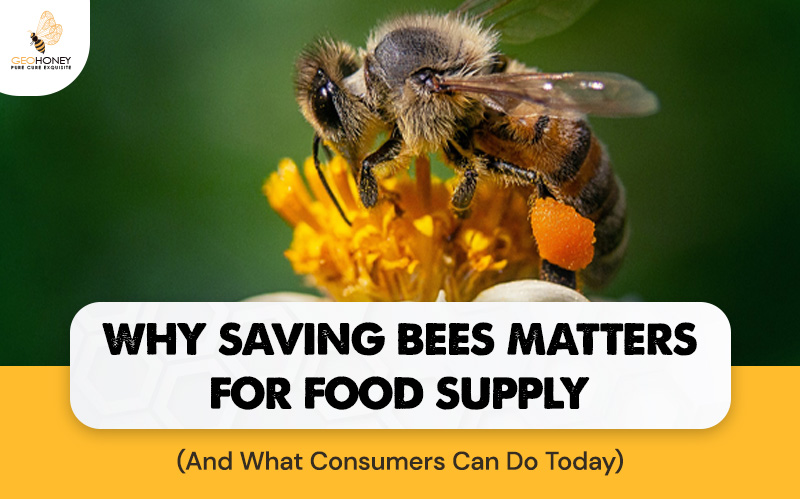
Bees hold so much significance for the global ecosystem. Apart from creating the honey, these unsung heroes also ensure a stable food supply. The role of bees in crop production, biodiversity, and ecosystem balancing cannot be understated.
Estimates suggest that at least one-third of the total world crops result from direct pollination by honeybees. This means conservation of honey bees is not just an environmental talking point. It is instead a matter of survival for humans and the planet in general.
This blog highlights why saving bees should be your top priority if you wish to ensure a stable global food supply. It also lists some important things that every consumer can do to protect this keystone species from population decline. So, let’s get right to it.
The Role of Bees in Global Food Supply
Reasons Why Saving Bees Matters for Food Supply
Effective Things Every Consumer Can Do Today to Save Bees

The Role of Bees in Global Food Supply
Honey bees are among the most important pollinators on Earth. It is through the movement of bees that flowers are able to transfer their pollen from one blossom to another for fertilization or food production. More than 75 % of the world’s important food crops rely at least partially on animal pollinators, mostly bees, for pollination.
And not just that, the crop yields for many important fruits and vegetables may drop by 30 %–40 % when bee populations decline. This means bees have a big role to play in our global food supply. In the absence of honey bees, a huge portion of the crops we eat can become scarcer and more expensive in very little time.
The following are some notable crops that honeybees pollinate for humans.
Fruits such as apples, blueberries, strawberries, pears, cherries, etc.
Vegetables like cucumbers, tomatoes, peppers, potatoes, etc.
Nuts, including almonds, walnuts, pecans, etc.
Oilseed crops such as canola, sunflower, etc.
Wild plants that are important for biodiversity or ecosystem stability.

Reasons Why Saving Bees Matters for Food Supply
There are many reasons why saving bees is important. This next section lists a few of these to give you a general idea.
Bees Are Key Pollinators
Bees are the biggest contributors to crop pollination. They transfer pollen grains from one plant to another, which allows them to reproduce. The plants, fruits, vegetables, and seeds that this pollination produces feeds billions of people and animals every single day.
Research reveals honey bees pollinate hundreds of crop species, including but not limited to apples, berries, tomatoes, cucumbers, melons, citrus, nuts, etc. Bees boost crop yields, which ensures food safety for the entire global ecosystem. Without pollination, plants become less healthy, fruits get smaller, and the crop output drops sharply.

Bees Promote Biodiversity and Ecosystem Health
Apart from pollinating crops, bees also pollinate wild plants while collecting nectar for organic honey. This provides food and shelter to countless fauna. Bees ensure wildlife can enjoy a stable habitat where they can feed and grow.
When bees decline in numbers, wildlife populations also suffer the consequences. This, in turn, creates disruptions in the food supply of the other species. A loss of biodiversity proves detrimental to the global ecosystem as it affects both the agriculture sector and global food security indirectly.
Economic Impact
Pollination from bees and other pollinators roughly adds between US $235 billion and US $577 billion to global agricultural production per year. This enormous economy supports local farmers, large industries, and beekeepers alike.
In the absence of bees, beekeepers have to use manual pollination by using brushes or cotton swabs. This approach is time-consuming, labor-intensive, and overall, less effective.
A decline in the bee population decreases crop yields and increases crop production costs for the farmers. The higher food prices that result from this also affect the buying power of consumers.
Nutritional Impact
Bees pollinate countless nutrient-rich foods like nuts, fruits, vegetables, and seeds, to name just a few. These foods provide humans with essential proteins, vitamins, enzymes, and minerals.
Without bees, our crops become less diverse. This can result in nutrient deficiencies, which can have far-reaching impacts on our health.

Effective Things Every Consumer Can Do Today to Save Bees
It is clear from the above discussion that saving honey bees is not an optional thing. Our entire civilization is at risk of collapse if we do not contribute to bee conservation.
The following are some effective ways you can help save bees as a consumer.
You can plant bee-friendly plants, gardens, or green spaces that provide bees with both nectar and shelter. Some popular options include coneflowers, black-eyed Susans, clover, sunflowers, purple asters, butterfly bushes, wildflowers, etc.
Do not use pesticides or herbicides unless it is absolutely essential, as they can impact the habitats as well as the cognitive abilities of honey bees.
You can also leave some parts of your garden unmanicured to give shelter to the bees.
You can help bees by supporting local beekeepers. You can do this by purchasing honey or honey-based products from local farmers who use sustainable honey bee farming practices or by attending local farmers’ markets.
You can also do your part by spreading awareness about the importance of saving bees among your friends, family, and community in general.
Conclusion
The decline of honey bees is not just an ecological issue. It is a threat to global food security. Without bees, both the global economy and biodiversity will take a huge hit. Bees are the reason why the world has an abundance of crops and ecological stability.
Bees collectively are responsible for more than 30%-40% of the world’s food supply, and that is why it is on each and every one of us to make sure they are able to grow in population.
Consumers can play their part in this individually by spreading awareness, planting bee-friendly flora, and taking steps to ensure bee habitat protection. This can ensure bees are able to work freely to ensure a stable global food supply for years to come.
To learn more about beekeeping and honeybee preservation, visit our website Gehoney. We also offer a wide range of pure, 100% raw monofloral honey varieties sourced from local beekeepers from around the world.
FAQs
What makes honey bees crucial for nature and food?
Since bees are a keystone species, they ensure our ecosystem, as well as the global food supply, remains stable. Bees pollinate food crops, and they ensure our wildlife gets abundant shelter and food. This makes them significant both for the nature and the food supply in general.
Why is saving honey bees extremely important?
Bees are responsible for more than 30% to 40% of the global food supply. One in every three bites of the food you eat comes from the hard work of the honey bees. This makes it crucial that you do everything in your power to protect these creatures.
What are some major challenges that bee populations around the globe face today?
Some major challenges faced by bees include:
Habitat loss
Pesticide exposure
Pollution
Commercial beekeeping practices
Climate change
How can you, as an individual, help preserve bees?
You can plant bee-friendly gardens, cut back pesticide usage, and support local beekeepers to help preserve bee populations.