- Tokyo: 13:58
- Singapore: 12:58
- Dubai: 08:58
- London: 05:58
- New York: 00:58
Desert Honey: Why Arid-Region Blooms Produce Some of the Purest Nectar
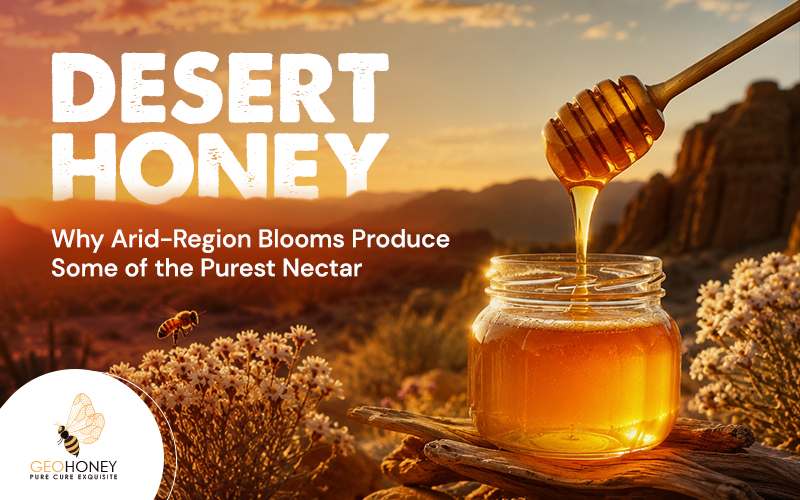
Honey is among the very few natural foods that you can find even in the driest and most arid of landscapes where terrain is rugged and rainfall is sparse. Desert honey that comes from the nectar of blooms in the arid region has no match when it comes to its purity, robust flavor, and nutritional profile.
Honey that belongs to the deserts of the Middle East or the dry plains of Africa and Southwest America is prized globally for its fine texture and flavor. But what exactly is the reason behind the unique features of this organic honey? This is what this blog is all about.
This article lists a few key reasons for the high purity of desert honey to help you understand what makes it truly special.
The Harsh Beauty of Desert Ecosystems
Why Desert Nectar Is So Pure
Popular Desert Honey Types

The Harsh Beauty of Desert Ecosystems
Deserts possess a complex ecosystem where rare plants and animals thrive under extreme conditions due to their highly adaptive nature. These landscapes do not get much rain, and their temperatures can get as high as 45°C to 50°C.
This means both the human population as well as vegetation are sparse in deserts or arid regions. However, even the very few rains that deserts get transform the ecosystem to a great extent.
These rains awaken dormant seeds, which lead to the growth of wildflowers, shrubs, and some rare blooms. This is the point when bees forage these special plants to create desert honey.
The desert blooms only live for a very short time. This means bees have limited time to gather as much nectar as possible to create highly concentrated and pure raw honey.
Flavor and Color of Desert Honey
Desert honey varieties possess a complex flavor profile. Based on floral origins, these honey types can have caramel, molasses, herbal, and spice notes. You can also find some varieties of honey that contain woody, earthy, and resin-like flavors. Desert honey has a silky smooth or very thick texture, which is a result of its very low water content.
Desert honey comes in nearly white, dark brown, golden, or even blackish hues based on the desert flora. This makes it more special than commercial honey, which has a shallow or overly sweet taste with an extra smooth or runny texture and an almost transparent color.
Nutritional and Health Benefits of Desert Honey
Desert honey is the purest honey you can find. It is rich in antioxidants like phenols, flavonoids, minerals like iron, magnesium, zinc, and healthy enzymes like glucose oxidase and catalase.
Studies on arid-region honey that has Gulf and Middle East origin reveal that this honey contains higher polyphenol and a strong antioxidant content compared to honey from temperate regions.
This honey is also rich in vitamins B and C, along with other bioactive compounds that enhance its antibacterial, antimicrobial, and anti-inflammatory features. Research also shows that honey from arid blooms has higher mineral and lower moisture levels, which enhances its shelf stability.
Here is how these compounds benefit your health.
Its use gives you immune support.
Leads to better digestive health.
It promotes faster wound healing and post injury infection prevention.
You can use it in allergy season to get instant sore throat relief.
This calorie-dense superfood gives you steady natural energy throughout the day.

Why Desert Nectar Is So Pure
Desert honey is extremely pure, and this is not by chance. This section lists some key reasons why this honey is more special than the honey that comes from non-desert or non-arid sources.
Minimal Agricultural Pollution
Desert flora grows without large-scale industrial farming, excessive pesticide use, or chemical interventions. This lowers the risks of nectar contamination. Minimal agricultural pollution is what leads to high purity of desert natural honey.
Low Humidity Creates Dense Nectar
Desert climates are hot and dry. The water content in the plants in such regions is very low. This is what makes the nectar thicker as well as sugar-dense. The honey that bees make from this dense nectar has a darker color and more robust flavor. Low moisture in desert honey also extends its shelf life.
Slow-Growing Desert Plants Concentrate Nutrients
Plants grow slowly in deserts due to harsh weather and a lack of water. The slow growth of these plants makes their nectar highly concentrated in terms of phytochemicals, minerals, and antioxidants.
Fewer Airborne Pollutants
Deserts are remote and scarcely populated. There are no factories, heavy traffic, or urban smog. This means the nectar of the flora in these regions doesn’t come into contact with airborne pollutants. This is what leads to the high purity of monofloral honey that bees make from this clean nectar.
Mineral-Rich Desert Soils
The soil in deserts is rich in minerals like magnesium, potassium, calcium, iron, and zinc. These natural minerals not only help plants grow but they also affect the nutritional complexity as well as the flavor of their nectar. This mineral richness is what sets desert honey apart in terms of flavor and purity.
Short Blooming Seasons Intensify Nectar Production
The blooming seasons are very short in deserts. The plants in these regions have adapted to attract more pollinators in less time. Plants in deserts have developed stronger aromas, sweeter nectar, and high sugar concentrations. This evolutionary strategy allows these plants to quickly attract pollinators who can collect their pure nectar and make honey in a very limited time.
Limited Human Interference
Beekeeping and honey harvesting in deserts involve minimal human interference. Beekeepers in these regions use fewer artificial feeding methods and refrain from using intensive hive manipulation. They also harvest seasonally and try to maintain natural bee foraging patterns. This way, by allowing things to run their course, these beekeepers ensure the honey that bees make is in its raw, 100% pure, and authentic form.
Popular Desert Honey Types
Here are some notable desert honey varieties you might have heard of or seen before.
Sidr Honey

This honey comes from the nectar of sidr/cidr trees that grow in arid regions of Yemen and other Middle Eastern countries. This exotic honey possesses a thick texture along with a rich caramel-like flavor. Sidr honey’s impressive nutritional profile makes it a popular medicinal and culinary ingredient globally.
Acacia Honey

Another popular variety is acacia honey, which comes from acacia trees that you can find in the dry and desert climates of Africa and the Middle East. This honey possesses a transparent to pale yellow hue. The flavor of this honey has floral notes with hints of vanilla. The high fructose ratio of this honey allows it to crystallize very slowly, which enhances its shelf life.
Wildflower Desert Honey
Bees can also collect nectar from multiple desert herbs like sage, thyme, desert lavender, etc. The honey that bees make from these sources has a rich, layered flavor profile that contains floral, fruit, and earthy notes.
This honey has light golden, amber, and dark brown hues based on nectar sources. Wildflower honey is rich in nutrients like vitamins, minerals, and antioxidants, as it contains pollen from multiple plant species.
Conclusion
Desert honey’s purity is unmatched, and the reasons for it are many. Bees make this honey in remote locations away from human influence. The blooms in arid or desert regions do not need pesticides or aggressive agricultural practices to grow.
These plants have higher mineral content and low humidity, which further adds to the purity of this sweet nectar. Every spoonful of desert honey is rich in nutrients. The flavor, nutritional profile, and texture of this honey also surpass those of commercial honey products.
This is what makes desert honey a rare superfood that contains goodness in every spoonful.
Visit us at Geohoney today to explore our premium range of 100% pure monofloral honey varieties. Our over 300 honey products are sourced from local beekeepers and organic farms from over 53 countries to give you nothing but the best in every spoonful of honey.
FAQs
What makes desert nectar more pure than regular nectar?
This nectar forms under conditions where there is less industrial pollution, fewer pesticides, minimal agricultural chemicals, and low humidity. These conditions create nectar that is more concentrated and cleaner.
What are some key features of desert honey?
This honey has a robust flavor, low moisture content, thick consistency, and high mineral concentration.
Which flowers produce desert honey?
The flora that mainly produces desert honey includes Sidr trees, Acacia blossoms, Wild thyme, Desert sage, and Lavender.
What is the flavor or desert honey?
Based on floral origins, this honey can have caramel, herbal, earthy, and spicy notes.
Which are some of the top countries that produce desert honey?
These include Yemen, Saudi Arabia, Pakistan, Egypt, Oman, and parts of the USA.
What makes the nectar of desert flowers concentrated?
The rainfall in deserts is scarce. This means the flowers bloom for a short period during which most of their water content evaporates. This makes their nectar rich in nutrients, which quickly attracts pollinators.