- Tokyo: 01:50
- Singapore: 00:50
- Dubai: 20:50
- London: 17:50
- New York: 12:50
Does Honey Go Bad The Complete Guide to Shelf Life, Storage & Crystallization
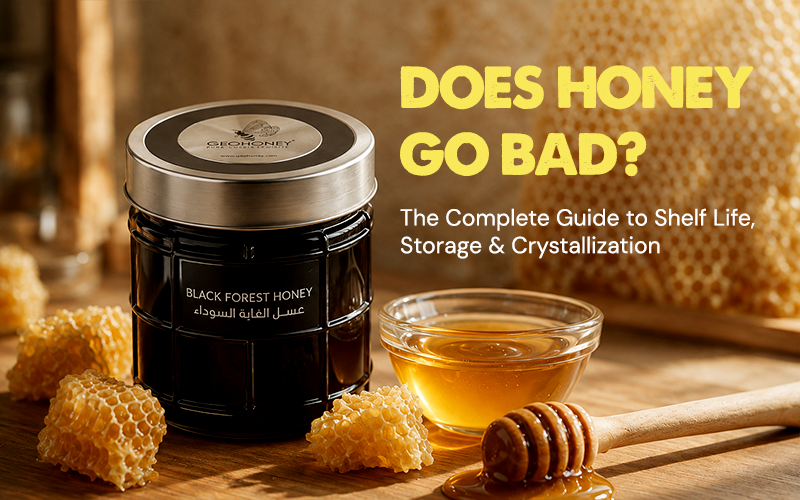
That forgotten jar sitting at the back of your pantry has probably made you pause at least once. "Can I still eat this?"
The answer will surprise you in the best way.
Your honey is one of the very few foods that can last for years, even decades, when stored properly. Unlike milk, bread, or fresh juice, it doesn't follow the usual "use it before it expires" rule. You may see your honey getting darker, thicker, or full of tiny crystals. Relax. It's changing its look, not going bad.
Let’s find out why honey lasts for years, what can make it spoil, how to store it the right way, and why crystallization is nothing to worry about.
Key Takeaways
Pure honey doesn't really expire. Store it well, and it'll last for years. Best-before dates are more about quality than safety.
Honey naturally protects itself. Low moisture, lots of sugar, an acidic nature, and natural enzymes all help keep spoilage away.
Moisture and contamination, not age, are the biggest reasons honey ferments.
Crystallization, darkening, and slight texture changes are completely normal.
Store honey in a sealed container in a cool, dry place and always use a clean, dry spoon.
Foam, a sour smell, an off taste, or visible mold are signs it's time to throw the jar away.
Does Honey Go Bad?
Pure honey doesn't go bad when you store it properly.
That best-before date on your jar isn't counting down to the day your honey becomes unsafe. It's simply the producer's estimate of when you'll enjoy its best flavour and quality.
Honey lasts so long because of the way nature made it.
Low moisture: Microorganisms need water to grow. Proper honey has no more than 20% moisture.
High sugar: The concentrated sugars pull water out of microbial cells. Thus, it is difficult for them to survive.
Naturally acidic pH: Most bacteria, yeast, and mold that spoil food can't grow well in this acidic setting.
Hydrogen Peroxide: Bees don't stop at making honey. They also add an enzyme called glucose oxidase. That produces a little hydrogen peroxide for extra protection.
That's why honey can stay in your pantry for years without going bad. Its colour may deepen. Its texture may become thicker, too. Crystals may also appear. However, none of that automatically means your honey has gone bad.
Can Honey Actually Spoil?
Absolutely. But age usually isn't the culprit.
Your honey is far more likely to spoil because moisture or contamination finds its way into the jar.
Once the moisture level rises above the safe level (around 20%), dormant yeast cells can become active and start fermenting the natural sugars. That's when you'll begin to notice obvious changes.
If honey has fermented, you may notice one (a) foamy, bubbly or fizzy surface, (b) sour or alcohol-like smell instead of a sweet, floral aroma, (c) sour, fermented or unusual taste, (d) runny consistency or excessive watery layers, and (e) visible mold.
So what usually causes this?
Most of the time, it's everyday handling. Leaving your jar unsealed, storing it in a humid environment, using a wet or dirty spoon, storing honey in a non-airtight container, and introducing water into the jar lead to spoilage of honey.
Then What About Crystallization?
Does crystallization mean your honey has gone bad? Not at all. In fact, your honey is doing exactly what pure honey is supposed to do.
Crystallization is a completely natural process. Some of its glucose simply parts ways with the water and forms tiny crystals. With time, your honey may become thick and grainy. It may even turn solid. It can also become slightly lighter or cloudier in colour.
None of this means your honey is spoiled. You can use crystallized honey.
Many people actually prefer crystallized honey because it's easier to spread on toast and doesn't drip everywhere. And the best part? It is still safe and of good quality.
Prefer it runny instead? No problem. To decrystallize honey at home, place the jar in warm water and stir it gently until the crystals dissolve. Just skip the microwave or excessive heat, as overheating can affect your honey's flavour and quality.
How to Store Honey Properly
Keeping honey fresh for years is less about the honey itself and more about how you store it. Keeping honey fresh is easy:
Use a glass jar with a tight lid. Glass is safe for raw honey and helps keep air out. Food-grade plastic containers also work well.
A pantry or kitchen cabinet away from direct sunlight and heat helps preserve honey's quality.
Skip the fridge. Your honey doesn't need it. The cold only makes it crystallize faster and turn thicker.
Always use a clean, dry spoon. A wet or dirty one can bring in tiny unwanted microorganisms and shorten your honey's shelf life.
These simple storage practices help preserve honey's flavour, texture, and quality for years.
The Final Scoop
Honey doesn't expire in the usual sense, and most changes you notice over time, like crystallization or darkening, are completely natural. Keep the jar sealed, keep water out, and you'll probably enjoy it for years.
At GeoHoney, we source pure, authentic honey that's carefully harvested and packed to preserve its natural quality. Just real honey that loves sitting on your shelf almost as much as it loves sitting on your toast. Go ahead, find your favourite jar.