- Tokyo: 07:46
- Singapore: 06:46
- Dubai: 02:46
- London: 23:46
- New York: 18:46
Is Honey Keto-Friendly Carbs, Net Sugar & Low-Carb Alternatives
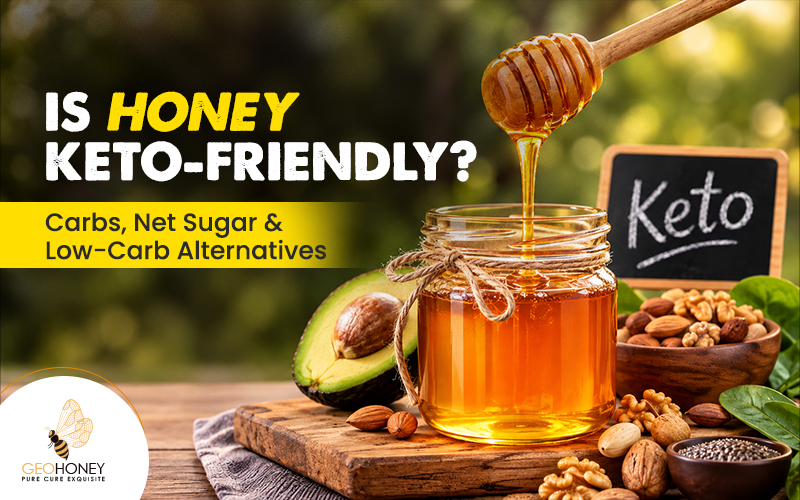
Honey is natural, but that does not make it low-carb. One tablespoon contains about 17.3 g of carbohydrates, almost all from sugars, which can consume most of a strict keto carb budget. A teaspoon may fit some plans, but there is no universal amount that guarantees ketosis. This guide explains the numbers, the metabolism, and better substitutes for keto diets.
Key Takeaways
One tablespoon of honey contains about 17.3 g of total carbohydrates and 17.2 g of sugars, with almost no fiber to subtract.
One teaspoon provides about 5.8 g of carbs, so even a small serving can use a meaningful share of a 20–50 g daily keto carbohydrate target.
“Net sugar” is not a standard nutrition term. Honey’s conventional net carbs are effectively the same as its total carbs because it contains negligible fiber.
Raw, organic, and Manuka honey may differ in processing or bioactive compounds, but none gains a meaningful low-carb advantage.
Allulose, stevia, monk fruit, erythritol, and sucralose can reduce the carb load, but they do not all reproduce honey’s moisture, bulk, viscosity, or browning.
Is Honey Keto-Friendly?
Usually, no. Honey is not a low-carb sweetener, and a normal serving can take up a large share of the carbohydrate allowance used in many ketogenic diets. Keto works by restricting carbohydrate enough to support nutritional ketosis, so concentrated sugars are difficult to accommodate regularly.
There is no universal carb number that defines keto for everyone. Many nontherapeutic ketogenic approaches use roughly 20–50 g of carbohydrate per day, but individual thresholds vary. Therefore, “one teaspoon of honey always kicks you out of ketosis” is more confident than the evidence allows.
How Many Carbs and Sugars Are in Honey?
USDA reference data for generic honey show about 82.4 g of carbohydrate and 82.1 g of total sugars per 100 g. A typical tablespoon weighs about 21 g, while a teaspoon weighs about 7 g.
What Does “Net Sugar” Mean?
“Net sugar” is not a standard FDA nutrition term. Food labels use terms such as Total Sugars and Added Sugars. Keto discussions more commonly use “net carbs,” which is an unofficial consumer calculation intended to estimate digestible carbohydrates.
A common calculation is net carbs = total carbohydrate − dietary fiber. Some low-carb products also subtract certain sugar alcohols or allulose, but there is no single FDA-defined formula for every product.
For honey, this debate barely changes the result. One tablespoon has about 17.3 g total carbs and only a trace of fiber, so its conventional net-carb value remains about 17.3 g. Honey’s sugars are not subtracted from its carb count.
How Much of a Keto Carb Budget Does Honey Use?
The carb cost becomes clearer when honey is compared with illustrative daily limits. The percentages below show how quickly even small honey portions can accumulate.
The formula is:
Percentage of daily carb budget = carbs in honey ÷ daily carb budget × 100
These are examples, not universal keto prescriptions. Still, a tablespoon can consume most of a 20 g target and more than half of a 30 g target, leaving less room for vegetables, dairy, nuts, sauces, and other carb-containing foods.
Can One Teaspoon of Honey Fit Into Keto?
Mathematically, yes, in principle. One teaspoon supplies about 5.8 g of carbs. Against a 20 g daily target, that is roughly 29% of the day’s allowance.
But “it fits my macros” does not guarantee an identical metabolic response in every person. Ketosis depends on the overall diet and individual response, not on a universal honey cutoff.
Will Honey Kick You Out of Ketosis?
Honey can suppress ketone production because its glucose and fructose provide readily metabolizable carbohydrates. Glucose enters circulation and can raise insulin, while fructose is handled substantially by the intestine and liver. Together, they increase carbohydrate availability and work against the low-carbohydrate conditions that promote ketogenesis.
Controlled research has not identified a universal teaspoon or tablespoon threshold for honey. A tablespoon is more likely to disrupt a strict keto pattern than a teaspoon because it supplies almost three times as much carbohydrate.
Does Honey’s Glycemic Index Make It Better for Keto?
Not necessarily. Glycemic index and keto compatibility answer different questions. GI describes the blood-glucose response to available carbohydrate; it does not tell you whether a food is low in carbohydrate.
Published GI values for honey vary substantially with botanical composition and testing conditions. A honey with a lower GI can still provide about 17.3 g of carbohydrate per tablespoon. “Lower GI than sugar” therefore does not equal “keto-friendly.”
Is Honey Better Than Table Sugar on Keto?
Honey is not nutritionally identical to refined sucrose. It contains small quantities of phenolic compounds, minerals, enzymes, and other bioactive substances, and some research has examined possible cardiometabolic effects of particular honeys.
Those differences do not erase its carb load. For a person restricting carbohydrates specifically to maintain ketosis, the 17.3 g of carbohydrate in a tablespoon matters more than trace micronutrients or antioxidants.
By weight, honey contains less carbohydrate than granulated sugar because honey contains water. By tablespoon, honey can contain more because liquid honey is denser. So carb comparisons need a clear serving basis.
Are Raw, Organic, or Manuka Honey More Keto-Friendly?
No meaningful low-carb advantage has been established for any of them. Raw honey may retain different amounts of heat-sensitive compounds; organic certification concerns production standards; Manuka honey is distinguished by botanical origin and authentication markers.
Those differences do not change the central keto calculation. Raw, organic, and Manuka honey remain sugar-rich foods, so none should be treated as a genuinely low-carb form of honey.
Is Honey an Added Sugar?
Yes, in FDA nutrition-labeling terms, honey contributes added sugars when used as a sweetener. The wording can sound odd because no extra sugar has to be physically added to a jar of pure honey.
Single-ingredient honey receives special label treatment so consumers are not led to believe another sweetener was added. When honey sweetens another food, however, its sugars count as added sugars.
Best Low-Carb Alternatives to Honey
Honey does more than sweeten. It also contributes moisture, bulk, viscosity, browning, binding, and flavor. That is why the best replacement depends on how honey functions in a specific recipe.
Allulose
Allulose is useful where bulk or syrup-like behavior matters. FDA allows it to be excluded from Total Sugars and Added Sugars declarations, although it remains within Total Carbohydrate, and it contributes about 0.4 kcal per gram for labeling purposes.
It can brown during cooking, sometimes more readily than sucrose, so it may suit glazes, sauces, and some baked goods where color and surface browning matter.
Stevia, Monk Fruit, and Sucralose
These high-intensity sweeteners work particularly well in coffee, tea, yogurt, or smoothies, where sweetness matters more than honey-like texture. Only small amounts are typically required.
They do not replace honey’s moisture or bulk. Commercial blends may contain carriers or other sweeteners, so check the ingredient list and Nutrition Facts panel.
Erythritol
Erythritol contributes very little usable energy and appears widely in low-carb blends. It can work in desserts, but may create a cooling sensation, crystallize, or cause gastrointestinal discomfort in larger amounts.
Is Maple Syrup, Agave, or Another Natural Sweetener Better?
Usually not for keto. Maple syrup, agave, molasses, date syrup, and coconut sugar remain concentrated sources of digestible carbohydrate. Replacing honey with another caloric “natural” sweetener generally changes the sugar profile more than it solves the carb problem.
Agave is a useful example. Its relatively high fructose content can produce a lower immediate glycemic response than a more glucose-heavy sweetener, yet it remains carbohydrate-rich. Again, lower GI and low carb are not interchangeable.
Who Should Be Especially Careful?
People with diabetes should count honey as carbohydrate, not treat it as a “free” natural sweetener. People taking SGLT2 inhibitors need particular caution with ketogenic diets because very-low-carbohydrate eating is a recognized risk factor for diabetic ketoacidosis in that setting.
Nutritional ketosis is not diabetic ketoacidosis. DKA is a dangerous condition involving significant ketonemia and metabolic acidosis and cannot be diagnosed from one ketone number alone.
Honey should also never be given to children younger than 12 months because of the risk of infant botulism, regardless of whether the honey is raw or processed.
The Bottom Line
Honey is not a low-carb sweetener. One teaspoon contains about 5.8 g of carbs, and one tablespoon contains about 17.3 g, with almost no fiber to reduce the conventional net-carb count.
A very small amount can fit some ketogenic diets, but no serving guarantees that everyone will remain in ketosis. Raw, organic, and Manuka honey do not change the carb math.
For routine keto sweetening, allulose, stevia, monk fruit, erythritol, or sucralose are easier to accommodate. Choose the substitute according to whether you need only sweetness or also honey’s bulk, moisture, viscosity, and browning.
Want the sweetness without the guesswork? Explore Geohoney to discover honey varieties from around the world and find one that fits your taste, recipes, and lifestyle. Sweet choices start with knowing what’s in your spoon.