- Tokyo: 01:51
- Singapore: 00:51
- Dubai: 20:51
- London: 17:51
- New York: 12:51
Is Honey Vegan? The Full Debate, Explained
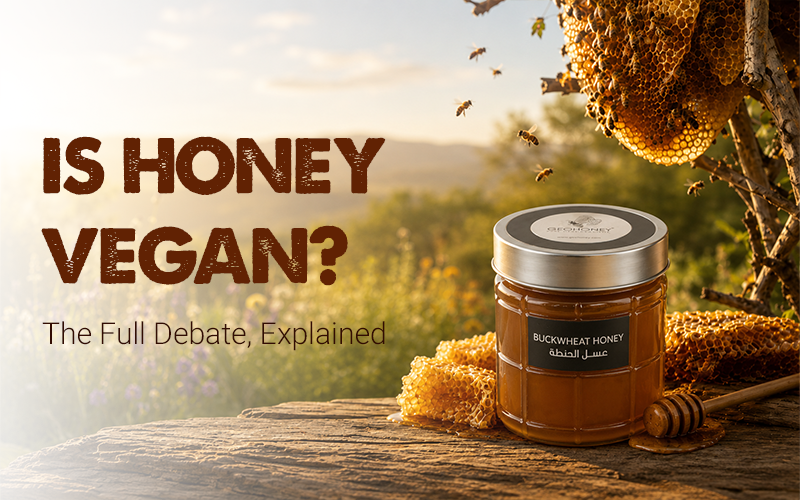
Whether honey is vegan is one of the more genuinely contested questions in plant-based eating. The honest answer is: it depends. It depends on how you define veganism, and more practically, on where the honey comes from and how it was produced.
Most vegan organizations say no. But a growing number of plant-based eaters disagree, and they have reasonable arguments on their side. Let’s explore both sides of that debate in this article.
Why Some Say Honey Can Be Vegan
Why Some Vegans Say Honey Is Not Vegan
What Commercial Beekeeping Actually Involves
Does the Source Determine If Honey Is Vegan?
Where the Honey Vegan Debate Lands
Why Some Say Honey Can Be Vegan
The case for honey being compatible with a vegan lifestyle is stronger than it is often given credit for.
Bees Are Not Sentient in the Same Way
Bees do not have a central nervous system in the way mammals do. Whether they experience pain or suffering in any meaningful sense is genuinely uncertain. Some researchers argue that insect consciousness is so different from mammalian consciousness that the same ethical framework does not hold up well.
Veganism was developed primarily in response to the suffering of vertebrate animals. Extending that framework to insects is a philosophical choice, not a logical necessity.
Bees Benefit the Plant-Based Food System
Bees are pollinators. Managed bee colonies contribute to the food systems that plant-based diets depend on. Many of the fruits and vegetables a vegan eats exist because of pollination, including by commercially managed hives.
Supporting responsible beekeeping could reasonably be seen as supporting the broader ecosystem that makes plant-based eating possible.
Small-Scale Beekeeping Is a Different Proposition
Some people who follow a vegan diet make an exception for honey. Particularly when it comes from small-scale beekeepers who manage their colonies with care. They consider how the honey was produced to matter more than the category it falls into.
Take a beekeeper who manages a handful of hives, does not clip queens, and leaves enough honey for the colony to survive the winter. That person is operating quite differently from a large commercial operation.
Why Some Vegans Say Honey Is Not Vegan
The standard vegan position is straightforward. Honey is produced by bees, bees are animals, and using their labour and their product for human benefit counts as exploitation. The Vegan Society has held this position since the 1940s. Most major vegan organizations agree.
Producing honey at scale means managing hive populations in ways that prioritize yield:
Queen bees are often artificially inseminated and replaced when they are no longer productive
During harvest, bees can be harmed or killed
Beekeepers sometimes replace harvested honey with sugar syrup. It does not carry the same nutritional value for the colony that produced it
Such practices are built into how honey reaches a shelf commercially.
What Commercial Beekeeping Actually Involves
Industrial honey production means managing hives at a scale where individual bee welfare is often not the priority.
In large scale operations, common practices often include:
Queen clipping: the queen's wings are cut to prevent her from leaving with a swarm
Drone destruction: male drones are often killed after mating season
Fumigation: some operations fumigate hives before harvest
Even in more careful operations, harvesting honey means taking something the colony produced for its own survival. Bees make honey to get through winter. When that store is removed and replaced with sugar syrup, the bees get a poor substitute. They spent considerable energy making the real thing.
The abstract question of whether bees can suffer is one thing. The specifics of how commercial honey is produced are another.
Does the Source Determine If Honey Is Vegan?
For many people, yes. Whether sourcing changes the ethical picture depends on how you view veganism:
If the issue is any use of animals at all, sourcing does not help
If the issue is harm and exploitation specifically, responsible small-scale beekeeping is a meaningfully different matter
Raw honey and monofloral honey from single verified farms sit closer to the ethical end of the spectrum. The practices are traceable. The bees are not anonymous. That does not settle the philosophical question. But it does change what you are actually supporting when you buy it.
Is Honey Vegan? The Final Answer
In practice, vegans split on this. Many avoid honey entirely and consider it non-negotiable. Others eat honey but draw the line at meat and dairy. Some look at sourcing and decide case by case.
The Vegan Society's official position is that honey is not vegan. That is the clearest reference point available. It is the one most vegan communities use.
But what the debate shows is that veganism is not a fixed rulebook with a single correct answer for every product. It is a framework for reducing harm. People apply it differently depending on where they think the meaningful harms are.
If your concern is about the treatment of animals rather than a categorical rule, then sourcing becomes the deciding factor. And on that front, not all honey is equal.
Conclusion
The honest answer to "is honey vegan?" is: it depends. It depends on how strictly you define veganism, and more practically, on where the honey comes from and how it was produced.
By strict vegan standards, honey is not vegan. But many plant-based eaters take a more nuanced view. The argument that well-sourced honey from ethical beekeepers is meaningfully different from industrial production is not easy to dismiss.
At Geohoney, we source raw honey from verified beekeepers across 53 countries and 155 farms worldwide. Our sourcing is fully traceable. We work with beekeepers who take the welfare of their colonies seriously. If you are not strictly vegan but care about where your food comes from, that is worth knowing.