- Tokyo: 02:44
- Singapore: 01:44
- Dubai: 21:44
- London: 18:44
- New York: 13:44
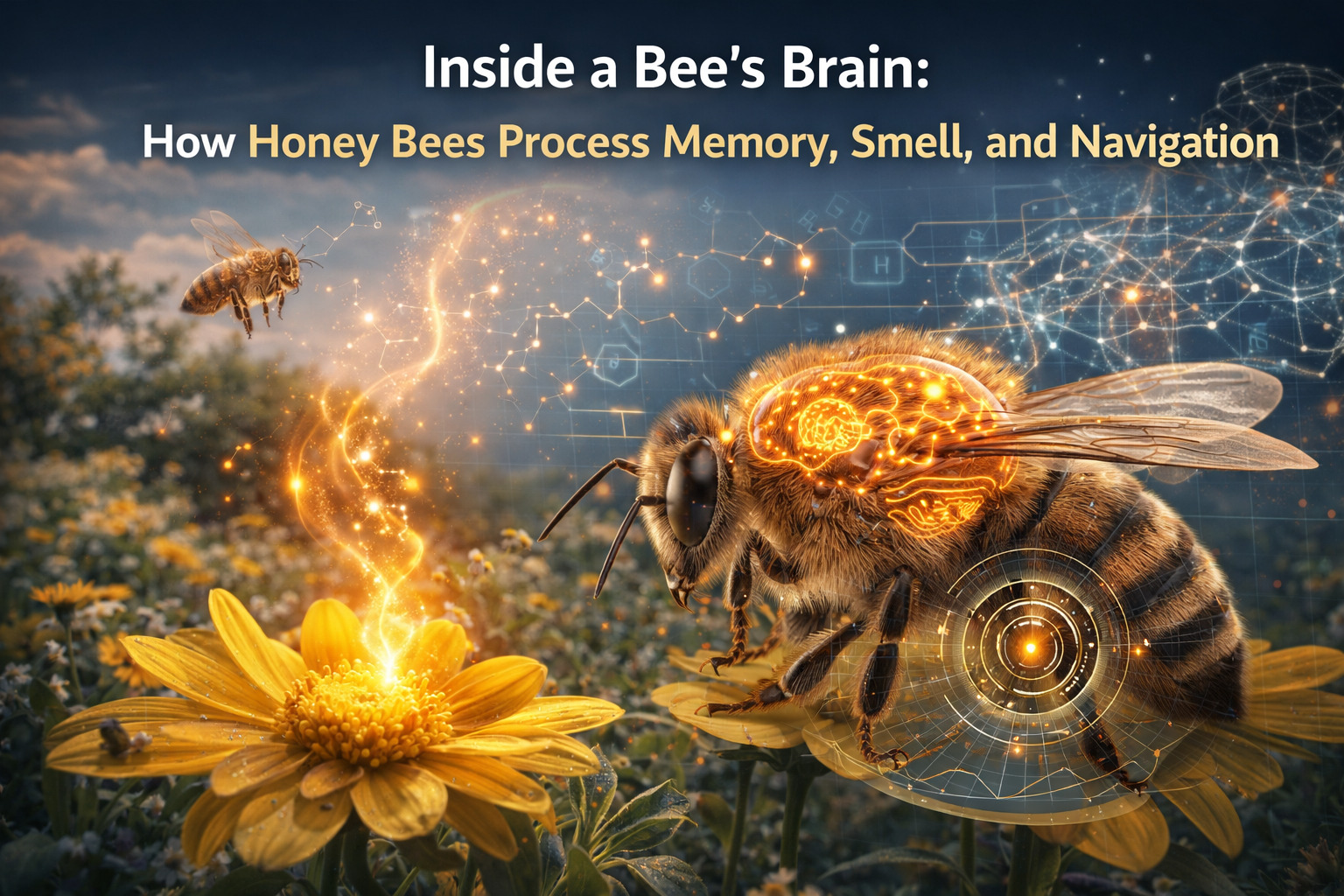


Inside a Bee’s Brain: How Honey Bees Process Memory, Smell, and Navigation
- Reading Time: 2 minutes, 43 seconds
- Post Views: 1327
Honey bees may be small, but their cognitive abilities are remarkably sophisticated. Within a brain no larger than a sesame seed lies a highly organized neural system capable of processing complex information related to memory, scent recognition, learning, and navigation. Understanding how honey bees think and respond to their environment reveals not only the brilliance of nature but also the delicate intelligence that supports global ecosystems and modern apiculture.
The Structure of a Bee’s Brain
A honey bee’s brain contains roughly one million neurons. While this is tiny compared to the human brain, it is extraordinarily efficient. The brain is divided into specialized regions responsible for processing sensory input, coordinating movement, and enabling learning.
One of the most important regions is the mushroom body. This area plays a central role in memory formation, learning, and decision-making. It allows bees to associate specific scents with rewards, such as nectar-rich flowers. Over time, these learned associations guide foraging behavior and improve colony productivity, a topic increasingly relevant in discussions around the future of apiculture.
The Power of Smell
For honey bees, smell is one of the most critical senses. Their antennae are covered with thousands of sensory receptors that detect chemical signals in the air. Floral scents help bees identify nectar sources, while pheromones enable communication within the hive.
When a bee encounters a new flower, scent molecules are processed in the antennal lobes of the brain. Signals are then transmitted to higher brain centers, including the mushroom bodies, where learning and memory are formed. If a flower provides a rich nectar reward, the bee forms a lasting memory of that scent, allowing it to return efficiently to productive blooms.
This precision in scent recognition directly influences nectar selection and the enzymatic transformation process involved in honey production, closely connected to how honey’s enzymes work.
Memory and Learning
Honey bees are capable of associative learning, similar to classical conditioning. If a specific scent consistently leads to nectar, the bee remembers that connection. Studies show that bees can retain long-term memories and adapt their foraging routes based on changing conditions.
Short-term memory allows bees to evaluate immediate rewards, while long-term memory enables them to build reliable foraging maps. This cognitive flexibility ensures that colonies remain efficient even when environmental variables shift.
Modern research and hive management increasingly rely on intelligent monitoring systems, including AI-enhanced hive monitoring and broader applications of AI in beekeeping to better understand colony behavior without disrupting natural patterns.
Beyond individual learning, honey bees also demonstrate remarkable collective intelligence. Information gathered by one forager does not remain isolated but becomes part of a shared decision-making system within the hive. Through chemical signals and coordinated behaviors, colonies evaluate food quality, distance, and environmental safety before allocating more workers to a resource. This decentralized yet highly efficient communication network allows thousands of bees to function as a unified organism, constantly adapting to external conditions while maintaining internal stability.
Navigation and Spatial Intelligence
Perhaps the most fascinating aspect of bee cognition is navigation. A foraging bee may travel several kilometers and still return precisely to its hive. This remarkable ability relies on a combination of solar positioning, polarized light detection, visual landmarks, and internal spatial memory.
Bees use the sun as a compass and compensate for its movement throughout the day. Even under cloudy conditions, they detect polarized light patterns invisible to the human eye. Upon returning, bees communicate directional data through the waggle dance, encoding distance and direction relative to the sun’s position.
Innovations such as smart hives and agri-tech innovations are helping researchers observe these navigation patterns more closely while supporting sustainable hive environments.
A Delicate Intelligence Worth Protecting
The cognitive sophistication of honey bees underscores the importance of environmental protection. Climate change, pollution, and habitat loss interfere with scent signals, floral diversity, and navigational cues. When ecosystems are disrupted, bees struggle to forage efficiently, which impacts pollination and food security worldwide.
As explored in The Bee’s Knees: Exploring Honey in the Digital Age, the intersection of technology and environmental awareness is becoming increasingly important in preserving pollinator health.
The study of bee cognition reveals a powerful truth. Intelligence is not measured by size but by efficiency, adaptation, and harmony with the environment. Within their miniature brains, honey bees carry a system refined by millions of years of evolution, quietly sustaining ecosystems and nourishing the world.
