- Tokyo: 01:49
- Singapore: 00:49
- Dubai: 20:49
- London: 17:49
- New York: 12:49
How Long Do Bees Live? Lifespan by Bee Type, Season and Role
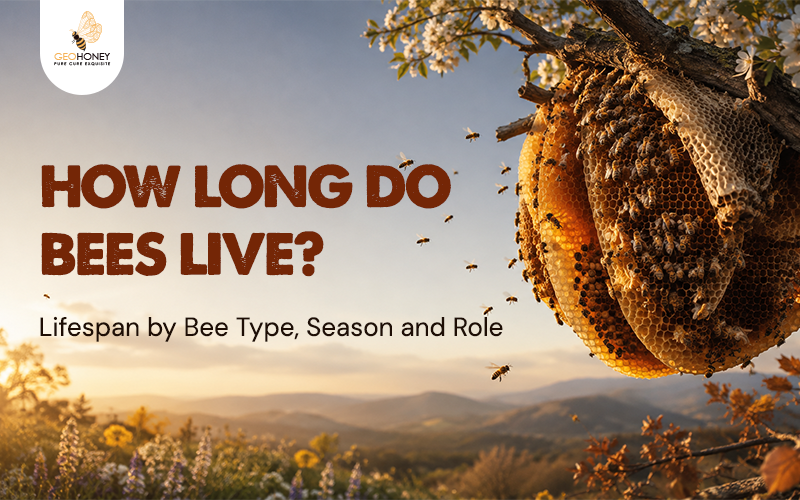
There is a huge difference in the lifespan of different types of honey bees. The exact duration for which a honey bee lives depends on its type or the role it plays in a bee colony. Queen bees typically live for around 2-4 years. Worker bees, on the other hand, can survive for 4-6 weeks in the summer and for 4-6 months in the winter.
Drone bees generally live for 2-4 months. However, they die faster when they mate with the queen or when the food becomes scarce in the fall and worker bees expel them.
There is a dramatic difference in how long bees live, and this is among the most fascinating features of any bee colony. This blog explores how long different types of bees live in terms of their types, roles, and the season in which they work. So stay with us till the end to know all there is about the lifespan of a bee inside the hive.
An Overview of The Lifespan of Honey Bees
How Long Does a Queen Honey Bee Live?
How Long Do Worker Honey Bees Live?
How Long Do Drone Honey Bees Live?
Honey Bee Lifespan by Season
Does a Bee's Job Determine How Long It Lives?

An Overview of The Lifespan of Honey Bees
This section gives you a quick look at the lifespan of different honey bees along with the main roles that they play in a colony.
How Long Does a Queen Honey Bee Live?
Queen bees live the longest inside the hive. Generally, the lifecycle of a queen bee is about 2 to 3 years. Research reveals that the lifespan of a queen bee can be dozens of times longer than that of a worker bee. On average, the queen's lifespan is about 2–5 years in some cases.
Queen bees can even live longer than that. However, their productivity generally reduces after the first two years. The queen bee’s primary role inside the hive is reproduction.
These bees have fully formed reproductive organs due to their special diet of royal jelly. These bees can lay about 2,000 eggs per day under optimal conditions.
Unlike worker bees that fly outside the hive to collect the nectar or protect the hive against threats, queen bees mostly stay inside. These bees do not have to raise the brood or make honey.
Worker bees tend to them completely while they lay eggs or mate with the male drone bees. These bees do not perform physically challenging tasks, which results in their longer lifespans.

How Long Do Worker Honey Bees Live?
Worker bees live for the shortest duration, especially in the summer. Studies show the lifespan of worker bees in the summer is about 18.8 days on average and in winter is about 140 days.
Worker bees are the most active individuals inside the hive. Young worker bees clean brood cells or feed larvae. They also tend to the queen, produce beeswax, and guard the hive.
Older worker bees go outside to forage for nectar or pollen. They also collect water or plant resins on these trips.
Worker bees die quickly in the summer as they have to make several trips outside to collect nectar and bring it back to the hive, which is energy-intensive.
In the winter, worker bees survive for months because their lifestyle changes in this season. These bees do not forage. They instead form clusters inside the hive to keep it warm. In this season, they simply eat the raw honey they make in the summer to survive.
How Long Do Drone Honey Bees Live?
According to research, drone male bees have a maximum lifespan of about 2-4 months on average. These male members of the bee colony mate with virgin queens from other bee colonies.
Drones do not collect nectar or raise the brood. They also play no part in building combs inside the hive. The main goal of this bee is to mate with the queen. However, this act has dramatic consequences for a drone bee.
Once a drone bee mates with a queen, this process damages their reproductive organs, resulting in their death. This means if a drone does not mate with a queen bee during its flights, it can survive longer.
Another factor that affects the life of the drones is the season. Drones fare well inside a hive in summer or spring. This is the time when the colony has abundant food to keep the hive fed.
However, in autumn or fall, the food becomes scarce as the foraging stops. This is when worker bees force the drones out of the hive. The drones that bees expel survive for a very short time outside.

Honey Bee Lifespan by Season
The lifespan of honey bees significantly changes if the season is not favorable. Here is how different seasons influence honey bees.
Spring
In this season, the honey bee colonies expand in population. With a rise in temperatures, more flowers bloom. It also increases egg production. This is the time when the hive has plenty of workers or drones. In the summer, worker bees are more active. They collect pollen and raise their brood. However, this increased activity reduces the lifespan of the worker bees.
Summer
This is the busiest period for a bee colony. Worker bees keep collecting nectar while queens lay eggs in even larger numbers. This high-intensity season takes a toll on worker bees. In this season, bees survive for less than 4-6 weeks.
Fall
In this season, the temperatures fall, and the flowers become scarce. Bees reduce unnecessary consumption of food to prepare for the winter. In this season, worker bees also start to expel the drones. Worker bees that the hive raises in the fall have a different physiology, which allows them to last for months.
Winter
In this season, honey bees demonstrate complete social cooperation. Worker bees form clusters around the queen to generate heat with their muscular activity. There is very limited or no foraging in this season. The adult bee population also reduces in this time. In the winter, bees rely on their food stores to survive.
Does a Bee's Job Determine How Long It Lives?
Yes. The lifecycle of a honey bee depends a great deal on its role inside the hive. Honey bee colonies work on a concept called age polyethism or age-related division of labor.
Worker bees do not perform the same tasks in their lifecycle. The work they do changes significantly as they grow older. Young workers start with housekeeping, where they clean the cells or remove debris. Then they move on to the nursing of the larvae. In the next stage, they do hive maintenance or nectar processing. Finally, these bees become ready to guard the hive and to forage for nectar.
If a colony loses its worker bees to the summer season, food shortage, or injuries and their number drops drastically, newer or younger worker bees take up their tasks to keep the hive functional.
As the roles of the bees change, so does the amount of energy they spend and the number of dangers that they are exposed to. This way, the role of the bee significantly affects how long it can survive in a hive.
Conclusion
Unlike most other species, the average lifespan of a honey bee is not easy to estimate. How long a bee lives depends on its role, the season, and its type. Queen bees with an average lifespan of 2-3 years live the longest. These bees do not perform physically demanding jobs. They spend most of their time inside the hives laying eggs.
Worker bees, on the other hand, live the shortest in the summer. Their lifespan is about 4-6 weeks since they work tirelessly during this time. In winter, they live for 4-6 months due to less outside activity.
Drone bees or male bees live for 2-4 months. These male bees mate with queens and die instantly after the act. The hive throws them out in the winter when the food supply reduces.
This way, the lifespan of a bee hinges on several factors, which makes it hard for you to make a fair assessment at a single glance. However, it is still fascinating to see how these different bees cooperate with each other to keep the whole hive functional for years, even after generations.
Check out our website Geohoney today to learn all there is about bees and beekeeping. You can also visit our online store to order from our wide range of raw and pure monofloral honey varieties that promise the highest nutritional value in every spoonful.