- Tokyo: 01:52
- Singapore: 00:52
- Dubai: 20:52
- London: 17:52
- New York: 12:52
The Lifecycle of a Honey Bee: From Egg to Adult
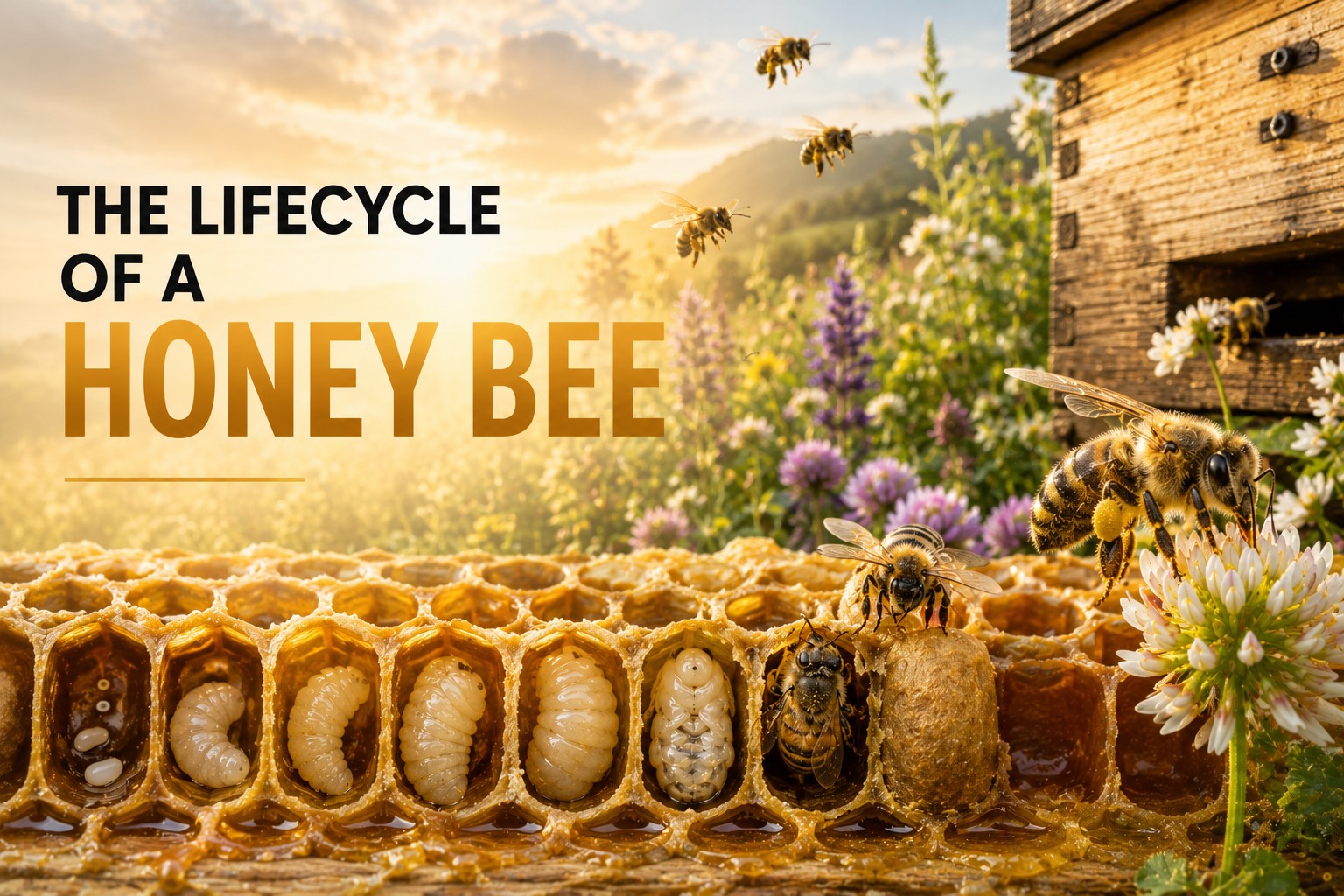
Have you ever happened to notice a honeycomb where there seem to be lots of very small, white, egg-like things sitting inside it? At first glance, they all look exactly the same.
But give them a few weeks, and you’ll see a dramatic difference. One may become a worker bee collecting nectar from flowers. Another may become a drone. One could even become the queen of the entire colony.
How does that happen? Every honey bee goes through 4 stages: egg, Larva, Pupa, and Adult stage. They have their own developmental speeds, and it’s actually the food that decides what a bee becomes. Surprising, we know!
Key Takeaways
Every honey bee starts as an egg.
Bees go through four life stages.
Not all bees develop at the same speed.
Food helps decide what a bee becomes.
Queens grow faster than workers and drones.
A bee's future starts taking shape very early.
How a Honey Bee Grows From Egg to Adult
Every honey bee follows the same basic journey.
Egg. Larva. Pupa. Adult.
But what happens during those stages can send bees down very different paths.
Egg Stage
Think about a queen bee moving across a honeycomb.
She pauses at a cell, lays a tiny egg, and moves on to the next one. Then another. And another. During peak season, she can lay up to 1,500 eggs in a single day.
Each egg is small, white, and barely visible without looking closely. This stage lasts about three days. The fascinating part is that a bee's future starts taking shape almost immediately. Some eggs are fertilized. Others aren't.
Fertilized eggs can develop into female bees. Those females may later become workers or queens. Unfertilized eggs become male bees known as drones. At this point, though, they still look the same. You wouldn't be able to point at an egg and predict what kind of bee it will become.
Larva Stage
Fast forward a few days. The egg hatches, and what emerges doesn't look much like a bee at all. It's a tiny white larva. No wings. No legs. No fuzzy striped body. Just a growing larva waiting to be fed.
And that's when things get really interesting.
Worker bees begin feeding the young larvae. For the first few days, all of them receive royaljelly, a nutrient-rich food produced by worker bees.
Then, most larvae are switched to a different diet made from pollen and nectar. A few aren't. Those selected larvae continue receiving royal jelly throughout their development.
Now imagine two larvae sitting side by side in neighboring cells. They started from nearly identical fertilized eggs. One continues receiving royal jelly. The other doesn't.
Weeks later, one becomes a worker bee. She spends her life cleaning cells, feeding young bees, guarding the hive, and collecting nectar. The other becomes the queen. Same beginning. Completely different future.
During this stage, larvae grow rapidly and shed their outer skin several times as their bodies expand. By the end of the larval stage, they've grown many times larger than when they first hatched.
Pupa Stage
Worker bees seal the cell with a wax cap, and the developing bee disappears from view.
If you looked at the honeycomb from the outside, it might seem as though nothing is happening. In reality, almost everything is happening.
Inside the capped cell, the larva enters the pupal stage. In this stage, the transformation is big. Wings begin to form. Legs develop. Eyes appear. The body gradually takes on the shape of an adult bee.
A good comparison is a butterfly inside its cocoon. From the outside, the process looks still. Inside, an extraordinary amount of change is taking place. This stage lasts several days and varies depending on the type of bee developing inside the cell.
Adult Stage
Then comes the moment everything has been leading to.
The young bee chews through the wax cap above it and enters the world for the first time. But not every bee enters the same life.
Worker bees first work inside the hive. In the beginning stage, they first do the cleaning work of the small cells. After that, they look after the young baby bees. Later, when they become older, they participate in the process through which nectar changes into honey. Some guard the hive door. Others help keep the hive warm or cool.
Eventually, these are the ones who become foragers. And what's a forager? These are the bees you see visiting flowers and collecting nectar.
Queens follow a very different path. Once mating has taken place, the main responsibility that belongs to the queen is laying eggs and also contributing towards keeping the colony population maintained.
Drones have a different role altogether. Their main purpose is to mate with virgin queens. Unlike worker bees, they don't collect nectar or make honey. Three bees. Three completely different lives. And they all started in nearly the same way.
Why Do Queens, Workers, and Drones Develop at Different Speeds?
Let's say a colony suddenly loses its queen. Waiting too long for a replacement could create serious problems. That's one reason queens develop faster than other bees. A queen typically reaches adulthood in about 16 days. Worker bees take around 21 days. Drones take the longest, at about 24 days.
The difference isn't huge. But inside a busy colony, even a few days can matter.
From tiny eggs to busy bees, honey has a big story. It starts with a very small egg and ends with sweet honey in a jar. Explore GeoHoney's collection and taste the sweet result.
FAQs
What are the stages of beekeeping?
People usually mean the bee life cycle. The four stages are egg, larva, pupa, and adult.
How many days does the bee remain in the egg stage?
Honey bee eggs usually hatch after about 3 days before moving into later growth stages.
How long is a bee's lifecycle?
Honey bees usually become adults in about 16 to 24 days, depending on whether they develop into queens, workers, or drones.
How many eggs can a honey bee lay in one day?
Queen bees can lay over 2,000 eggs per day in peak season. They usually live for 7 or more years.